Chemical Industry Anti-Involution Year! Cyclical Turning Point Still Awaits Verification
2026 has been dubbed the “Year of Anti-Overcompetition” for the chemical industry. After enduring over two years of losses, the industry has finally shifted its focus away from solely relying on demand recovery and begun proactively adjusting supply-side dynamics. Currently, the core of supply-demand rebalancing is shifting from the demand side to the supply side, with “voluntary downsizing” emerging as the key theme. Market performance confirms these changes are real: as of early May 2026, the China Chemical Products Price Index had risen to 5,299 points—a sharp year-on-year increase of 31.7% and a 1.8% sequential gain—indicating that chemical product prices are genuinely emerging from their bottoming phase. At the sub-sector level, the impact of supply contraction is even more pronounced: Ethylene glycol prices rose significantly as multiple production units underwent maintenance, driving the industry’s operating rate down markedly to 61.58%; meanwhile, inventory at East China ports declined steadily from 911,000 tons at the beginning of the month to 798,000 tons by month-end—a reduction of 113,000 tons in one month. Similarly, PTA inventory has fallen to 4.2418 million tons, with capacity utilization remaining at a relatively low 65.31%. These inventory drawdowns and reduced operating rates demonstrate that industry-wide production cuts are not merely rhetorical—companies are genuinely curtailing output to improve cash flow.
However, a calm, holistic review of the data reveals that the signs of demand-side recovery are not solid. According to data from the National Bureau of Statistics, the national utilization rate of production capacity for designated-size industrial enterprises stood at 73.6% in Q1 2026—down by 1.3 percentage points quarter-on-quarter and 0.5 percentage points year-on-year. Specifically, the capacity utilization rate for the chemical raw materials and chemical products manufacturing sector was 73.8%, also remaining at a relatively low level in recent years. This indicates that, even as supply contracts, overall production capacity remains underutilized; enterprises are raising prices largely “passively” rather than “proactively.” The downstream situation is even less encouraging: the real estate sector remains weak, and operating rates in traditional sectors such as plastic woven products and plastic piping have not shown notable improvement; end-user procurement remains predominantly demand-driven, with little enthusiasm for speculative inventory replenishment. Whether downstream sectors can absorb the price increases driven by supply contraction remains uncertain.
Another feature of this round of price increases is cost-driven rather than demand-driven. In early February 2026, the blockade of the Strait of Hormuz pushed international oil prices above $100 per barrel, while domestic coal prices remained relatively stable, causing a sharp expansion in the oil-coal price spread. By April, the average cost of coal-to-olefins was about 6,801 yuan per ton, while the cost of oil-to-olefins reached as high as 10,700 yuan per ton, with the cost advantage of the coal-based route expanding by 3,899 yuan per ton. At high oil prices, the breakeven point for coal-to-olefins is only 45-50 dollars per barrel, while for coal-to-oil it is around 55-65 dollars per barrel. The cost differential has given coal chemical processes a relative advantage of over 30%. Profitability of products has shown significant differentiation: in the olefins sector, the gross margin of coal-based routes exceeds 38%, while oil-based and PDH routes are respectively losing 340-900 yuan per ton. Integrated leading companies have achieved a gross profit of about 2,500 yuan per ton through cost control. Methanol prices rose by more than 40% month-on-month in March due to geopolitical conflicts in the Middle East. Although ethylene glycol has benefited from inventory reduction, its operating rate remains at 60.8%, and its profit recovery is still unstable.
Domestic PE Raw Material Source Cost Data Trend Chart (RMB/ton)
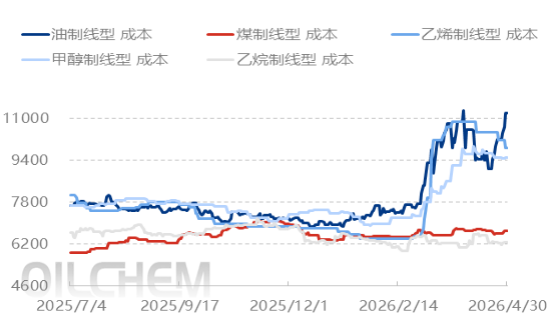
Against the backdrop of "anti-involution" and high oil prices, the relative cost advantage of the coal chemical route has indeed welcomed a "golden window" phase. However, the sustainability of this window faces two constraints. One is the uncertainty of oil price trends: the current oil price of over $100 per barrel is based on the geopolitical conflict in the Strait of Hormuz. Should the situation ease, a drop in oil prices will compress the cost advantage space of coal chemical. The other is the potential pressure from capacity expansion: during the 15th Five-Year Plan period, regions such as Xinjiang plan to add 15-30 million tons of coal-to-methanol and 4-8 million tons of coal-to-olefins capacity. Under the constraints of energy efficiency and carbon emissions, the concentrated release of advanced capacity may once again change the supply and demand situation. Overall, the "active slimming" of the chemical industry is a positive signal, marking the industry's shift from "competing on output" to "competing on quality." Capacity clearance is conducive to long-term healthy development. However, the confirmation of a cyclical turning point still requires waiting for two conditions: one is the sustainability of supply contraction, that is, whether the industry can truly shut down marginal capacity rather than just halting production temporarily; the other is whether the demand side can show a substantial recovery, even if it is just a structural improvement. Before these conditions are met, the price rebound driven by cost is prone to fluctuation, and the formation of the industry's bottom may be more prolonged than expected.

【Copyright and Disclaimer】This article is the property of PlastMatch. For business cooperation, media interviews, article reprints, or suggestions, please call the PlastMatch customer service hotline at +86-18030158354 or via email at service@zhuansushijie.com. The information and data provided by PlastMatch are for reference only and do not constitute direct advice for client decision-making. Any decisions made by clients based on such information and data, and all resulting direct or indirect losses and legal consequences, shall be borne by the clients themselves and are unrelated to PlastMatch. Unauthorized reprinting is strictly prohibited.
Most Popular
-
Continental Plans to Begin Sale of ContiTech in Early 2026
-
Mastering Screw Configuration and Pressure Management Strategies to Unlock the Secrets of "Efficiency and Cost Reduction"
-
Pakistan opens transit corridor for goods from multiple countries; explosion at japanese pharmaceutical plant leaves five injured, two seriously
-
Daily Review: Operating Rates Decline, Polypropylene Powder Market Prices Surge
-

BASF Delivers First Batch of Innovative Cathode Materials for Semi-Solid-State Batteries to Weilan New Energy