Bosch and Chery Deepen Cooperation, Leading 48V Vehicle Architecture Mass Production
The transition of vehicle low-voltage electrical architecture from 12V to 48V is evolving from a marginal energy-saving initiative into a mainstream solution driving the transformation of intelligent electric vehicles.
The 48V vehicle technology, which began large-scale application around 2016, has evolved over nearly a decade—from its initial role as a 48V mild-hybrid system designed to alleviate engine load into today’s core electrical architecture supporting high-level intelligent driving, smart cockpits, and drive-by-wire chassis systems.
At this critical turning point in the industry, Bosch, as a global leading Tier 1 supplier, is actively promoting the transformation and implementation of the 48V voltage architecture, based on its continuous deep cultivation in core automotive components and 48V technology.
Recently, Bosch announced a deepened strategic partnership with Chery to advance the 48V vehicle architecture from an industry-discussed "next step" into a tangible reality.
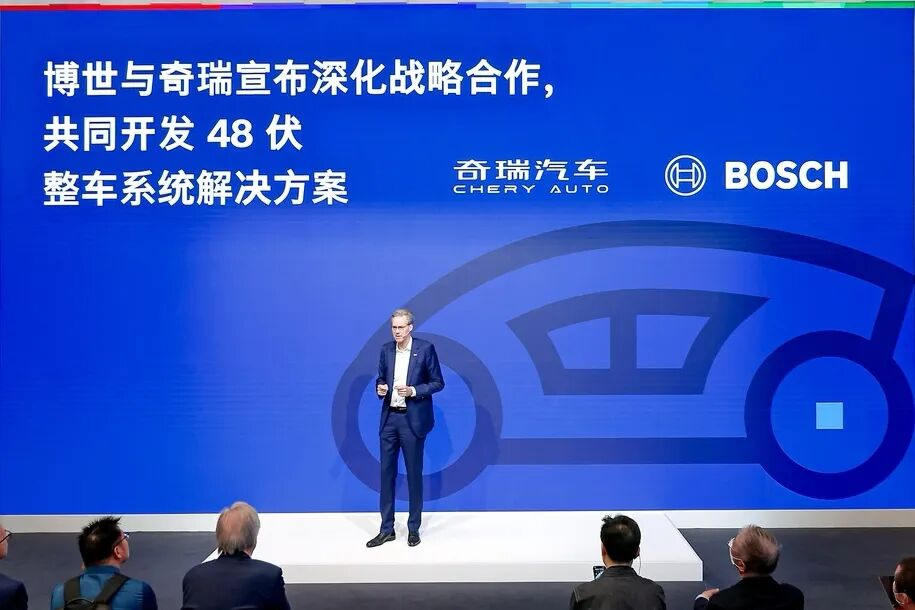
Image source: Bosch
Joining forces to lead the mass production of 48V vehicle architecture
On April 24, Bosch (China) Investment Co., Ltd. and Chery Automobile Co., Ltd. signed a framework agreement in Beijing for the joint development and mass production of a new 48V vehicle architecture. The two parties will jointly promote the first mass production of this next-generation 48V vehicle architecture in China.
Targeting the 48V vehicle architecture, Bosch and Chery signed a Memorandum of Understanding (MoU) on the 48V low-voltage system in October 2024 and established a joint pre-research team. Over the subsequent 18 months of collaborative development, the team successfully achieved three core objectives: development of the complete vehicle system and functional prototype vehicle, development of key component prototypes, and preliminary research into industrialization pathways—laying a solid technical and industrialization foundation for the signing of this latest mass-production agreement.
Building on their existing collaboration, Bosch and Chery have recently joined hands again, focusing on redefining the underlying electrical architecture of intelligent vehicles.
According to information released by both parties, the latest jointly developed 48V vehicle architecture offers advantages including high power, lightweight design, high integration, high reliability, and high scalability: the vehicle's power supply capacity has been increased to 15 kW, system weight has been reduced by over 10 kg, and the response speed of the steer-by-wire chassis steering motor has improved by more than 20%.
A 15kW power supply capacity means what? Compared horizontally, the mainstream power supply capacity of the current 12V system is between 3kW and 4kW, which is approaching the physical limit. Especially with the rapid adoption of high-power components such as smart cabins, high-level driving assistance, and drive-by-wire chassis, the power gap of the entire vehicle is constantly widening. Upgrading the low-voltage power grid is no longer a choice, but a matter of time.
A 15kW power level, equivalent to the of sufficient margin for next-generation intelligent electric vehicle functions during the initial vehicle design by Bosch and Chery.
From a certain perspective, this is equivalent to "trading architectural redundancy for a time window": rather than waiting for electricity demand to catch up with supply capacity, it's better to let supply capacity get ahead first.
Not only that, in terms of safety, this architecture also adopts an independent redundant power supply design, providing independent power circuits for critical systems such as intelligent driving, braking, and steering. Even if the main circuit fails, the backup circuit can still operate stably under extreme conditions.
Notably, for high-level autonomous driving at L3 and above, this design is not an extra convenience, but a safety baseline. Because when the system allows drivers to "remove hands and eyes," any single point failure in the power supply network could pose an unacceptable risk.
According to the plan, the technology will first be applied to the flagship models of Chery's premium brand, Exeed, and can be further expanded to emerging fields such as robotics in the future.
Bosch has been deeply involved in 48V technology for many years and has already built a complete product portfolio ranging from chips, core components to system solutions, and even to vehicle integration. It can not only provide a complete system architecture externally but also offer core components such as domain controllers, 48V grid batteries, braking systems, steering systems, thermal management products, and comfort motors individually.
In other words, whether automakers need a full-stack solution from scratch or targeted optimization for a specific module, Bosch can flexibly adapt.
Taking a 48V battery as an example, Bosch has already accumulated mass-production experience of over one million units in mild-hybrid vehicles, laying a solid engineering foundation for adapting to the next-generation 48V electrical architecture. During IAA 2025, Bosch showcased a 48V lithium-ion battery that can be flexibly integrated into the vehicle's overall structure. Featuring a lead-free design, this battery can continuously power safety-critical components and advanced autonomous driving systems, ensuring power supply even during extended vehicle standstill periods.
In the field of intelligent chassis, Bosch has already developed a 48V direct-drive steer-by-wire product, which is expected to go into mass production as early as 2027.
Moreover, Bosch’s “from the bottom layer to the entire vehicle” full-stack capability enables it to achieve superior architectural design and performance optimization at the system level.
For example, Bosch can precisely allocate vehicle energy consumption through simulation and system-level energy management software to enhance overall efficiency; meanwhile, leveraging its comprehensive system-level technical expertise, Bosch ensures that the 48V electrical system maintains high reliability and safety even under complex operating conditions.
As autonomous driving systems continue to evolve, redundancy has become central to safety. A 48V architecture can provide a more stable and reliable independent power supply path for critical systems such as braking, steering, and autonomous driving computing. In the event of a primary power failure, the backup power source can seamlessly take over, further enhancing overall vehicle safety.
Of course, for the 48V vehicle architecture to truly transition from early-stage technological exploration to large-scale production, supplier-side breakthroughs alone are far from sufficient; support from OEMs is also essential.
In this regard, Chery, as a domestic automaker deeply engaged in whole-vehicle architecture R&D, possesses both mature vehicle production capabilities and an accurate understanding of local market demands for intelligent and electric technologies, making their collaboration a perfect complement of technical expertise and implementation experience.
In particular, Bosch and Chery, with their 25-year partnership, have established a strong foundation of trust and extensive engineering collaboration, which is expected to accelerate technical validation of this 48V vehicle architecture and enable its rapid transition to mass production, thereby providing a replicable roadmap for the broader automotive industry’s adoption of 48V architectures.
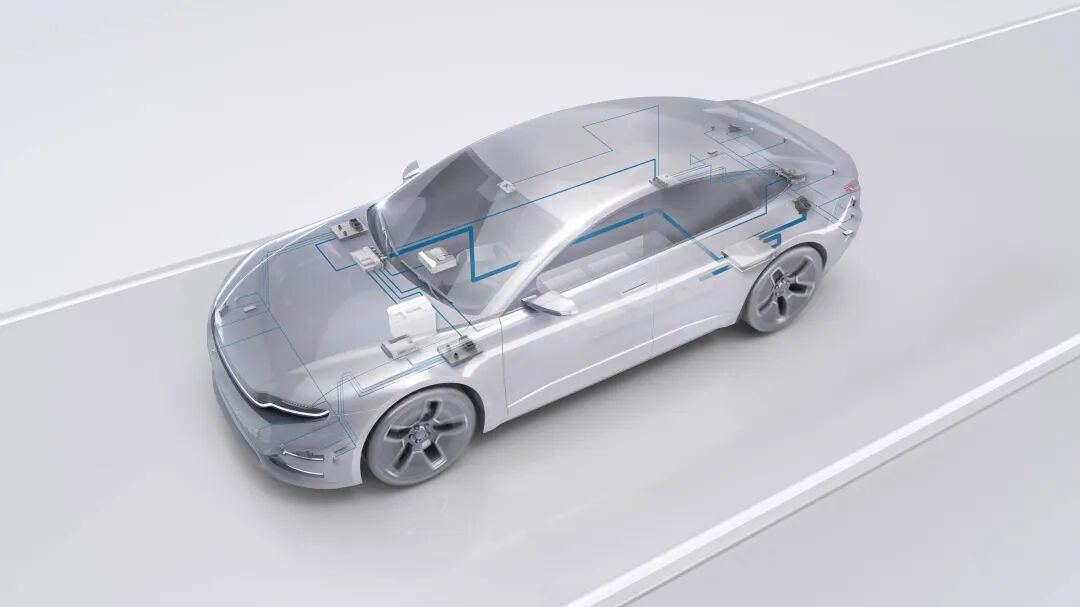
Image source: Bosch
48V becomes a must-have option, large-scale implementation is imminent
Undoubtedly, the 48V vehicle architecture is becoming the core technological foundation for intelligent electric vehicles entering the next phase.
Dr. Markus Heyn, a member of the Bosch Group's board of management and chairman of the Bosch Smart Mobility Group, previously made a clear assessment when discussing the 48V architecture: As cars become smarter, their energy consumption also increases, making it necessary to upgrade the 12V low-voltage grid architecture that has been in use since the 1960s. He predicted that the low-voltage grid architecture in the Chinese market will gradually transition over the next three to five years.
The logic behind this judgment is not complicated.
With the increasing power consumption of intelligent electric vehicles, including intelligent cockpit, intelligent driving, and intelligent chassis, the power requirements of core components continue to rise. The traditional 12V architecture can no longer support these high-load power consumption scenarios, making voltage upgrade an inevitable trend in industry development.
Compared to the 12V architecture, the 48V architecture brings changes far beyond merely increasing the voltage value. Since power (P) equals voltage (U) multiplied by current (I), quadrupling the voltage allows the current to be reduced to one-quarter for the same power output. Consequently, under identical power and wire cross-section conditions, transmission losses decrease to one-sixteenth of the original, resulting in a significant improvement in energy efficiency.
This physical law-driven efficiency leap directly delivers multiple benefits—thinner wires, lighter harnesses, and more flexible routing—enabling better fulfillment of the high-power demands of multiple components in intelligent electric vehicles, particularly supporting the implementation of advanced intelligent driving features and high-power peripherals, all while keeping cost increases manageable. This provides ample performance headroom for vehicle intelligence expansion and effectively enhances driving range.
If we use a simple analogy, 12V is like the narrow water pipe in an old apartment building, sufficient for the daily water needs of a few households; whereas 48V is akin to the intelligent high-pressure water supply network in a newly constructed supertall building—capable of supporting simultaneous water usage for hundreds of households and enabling intelligent water distribution.
Going from 12V to 48V, the main water pipeline doesn't need to be as thick to provide a greater flow, and the "water leakage loss" during transportation is also less. This is exactly the underlying appeal of the 48V architecture - not just an iteration of technology, but a transformation in the way of energy supply thinking.
However, although the automotive industry has long reached a consensus on the advantages of 48V technology, it was initially employed primarily in mild hybrid systems to improve fuel economy and help automakers meet increasingly stringent fuel consumption and emission regulations.
Until the past two years, with the continuous improvement of automotive intelligence and electrification, the power demand of vehicles has also risen accordingly. At the same time, leading players such as Tesla and Xiaomi have increasingly focused on 48V technology, enabling 48V architecture to truly evolve from a hybrid auxiliary configuration in traditional gasoline vehicles into a mainstream voltage option for intelligent electric vehicles.
Looking at the market, more and more enterprises are positioning themselves for the 48V architecture, and the related industry chain is also rapidly following up with production capacity. The entire industry is standing at the threshold of mass production, about to enter the booming phase of 48V architecture.
However, it cannot be ignored that currently, most automakers apply 48V mainly to specific high-power components such as suspension and steering, essentially representing a "partial trial."
In comparison, the focus of this collaboration between Bosch and Chery is at the "vehicle architecture" level — this is not just about setting up a dedicated circuit for a high-power device, but rather migrating the entire low-voltage power distribution network of the vehicle from 12V to 48V.
However, a deeper restructuring of the vehicle voltage platform also means greater technical challenges. To some extent, components related to the 48V architecture need to be redesigned, from motors, battery management systems, to controllers and actuators, covering a wide range. This means that breakthroughs in a single area are far from enough, and it requires vehicle manufacturers and suppliers to work together to advance under a unified standard framework.
And this is precisely where Bosch's strength lies.
As one of the few global suppliers with deep expertise across semiconductors, controllers, actuators, and system integration, Bosch possesses cross-layer integration capabilities along this value chain.
Furthermore, the collaboration between Bosch and Chery reflects the entire intelligent electric vehicle industry's urgent need for upgrades in electrical architecture.
On the vehicle voltage platform, the dominance of 12V has persisted for decades, with its mature supply chain and extremely low cost creating a natural barrier in the past. However, the wave of intelligence is dismantling this barrier—when computing power becomes the core driver, the power supply architecture must keep pace.
This is not a gradual improvement, but a leap from "passive adaptation" to "active reconstruction."
From 12V to 48V, it's not just a simple increase in the vehicle's voltage, but a generational restructuring of the intelligent electric vehicle's electrical architecture. With the continuous deepening of the transformation towards vehicle intelligence and electrification, the demand for high-power low-voltage power supply has become a necessity. The large-scale adoption of the 48V voltage platform in vehicles is already an inevitable trend.
And Bosch, with its comprehensive technology layout and deep cooperation with Chery, is gradually establishing a leading position in the mass production of 48V vehicle architecture.
【Copyright and Disclaimer】The above information is collected and organized by PlastMatch. The copyright belongs to the original author. This article is reprinted for the purpose of providing more information, and it does not imply that PlastMatch endorses the views expressed in the article or guarantees its accuracy. If there are any errors in the source attribution or if your legitimate rights have been infringed, please contact us, and we will promptly correct or remove the content. If other media, websites, or individuals use the aforementioned content, they must clearly indicate the original source and origin of the work and assume legal responsibility on their own.
Most Popular
-

Why did a century-old european dental instrument giant relocate its manufacturing hub to china?
-

$4 Billion! Medtronic Makes Another Acquisition
-
Profit and Revenue Growth Struggle to Conceal Debt Repayment Pressure; Success of Kingfa Sci & Tech's High-End Strategy Yet to Be Seen
-

Toray Industries and SGL Carbon Establish Carbon Fiber Supply Partnership for Aerospace Sector
-

Deadly Impact: Hormuz Strait Blockade Sparks Shortage of Plastic Raw Materials, Threatening Shutdowns at Japanese and Korean Chemical Plants