



[ZSZ Index] Futures Shaken and Strengthened, Polyolefin Spot Prices Rise
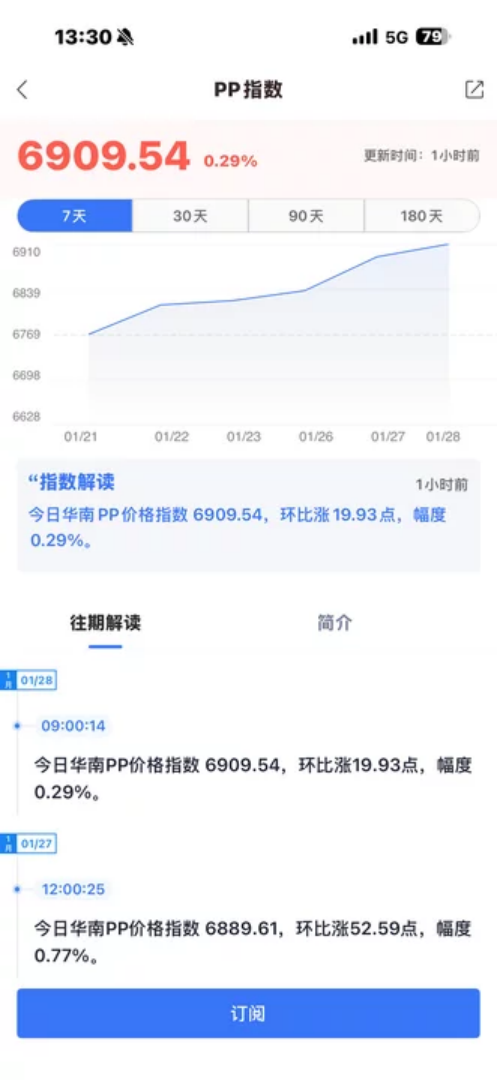
The South China PP Price Index stands at 6,909.54 points, up 128.04 points or 1.89% from last week. Among the categories, raffia increased by 150, fiber by 100, copolymer by 150, thin-wall injection by 100, and homopolymer by 120.
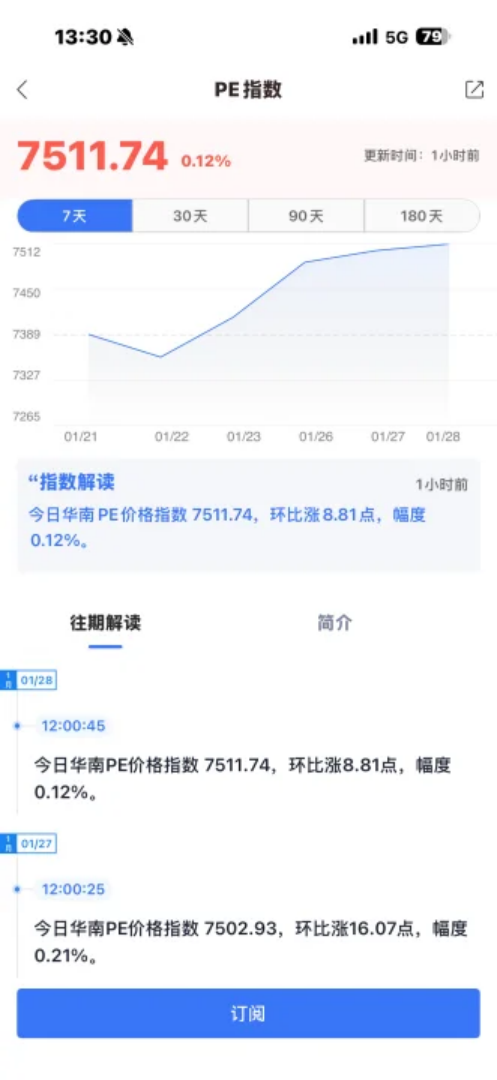
The South China PE price index stood at 7,511.74 points, up 142.29 points or 1.93% week-on-week. Specifically, LLDPE rose by 200, HDPE by 50, and LDPE by 100.
This week, domestic polyolefin market prices fluctuated and strengthened, with spot prices rising synchronously. Geopolitical risks in crude oil provided strong cost support, coupled with the emotional boost from capital rotating into the chemical sector. However, the polyolefin supply and demand structure itself has not substantially improved. Downstream demand is generally weak due to the approaching Chinese New Year holiday, with only a small amount of essential stocking, and inventory showing structural differentiation. In the short term, geopolitical factors and pre-holiday stocking sentiment will continue to support a strong market. It is expected that polyolefin market prices will continue to fluctuate and strengthen next week.
On the cost side, international crude oil prices rebounded with volatility this week, with both WTI and Brent crude rising by over 4%. This was primarily driven by recurring tensions in the Middle East, which continue to provide a risk premium for international crude. Meanwhile, OPEC+ maintained its plan to pause production increases until February-March 2026, further strengthening expectations of tightening supply. Additionally, in late January, North America experienced an extreme cold wave, causing U.S. natural gas prices to surge by 63% within a single week. This directly drove up feedstock prices, providing strong cost support for polyolefins.
On the supply side, for PE, the capacity utilization rate this week was 84.67%, an increase of 3.17% from last week; output was 698,800 tons, an increase of 28,900 tons from last week, mainly due to the restart of units at Fujian United, Maoming Petrochemical, and Shanghai Petrochemical, leading to increased capacity release. Next week, units at Maoming Petrochemical, Shanghai Petrochemical, and Sinopec Quanzhou are scheduled to restart, while Daqing Petrochemical and Yangzi Petrochemical plan maintenance. However, the capacity to be restarted is greater than the capacity to be maintained, and output is expected to increase to 734,800 tons in the next period, with a loosening supply environment. For PP, the capacity utilization rate this week was 76.02%, an increase of 0.40% from last week; output was 784,900 tons, an increase of 4,100 tons from last week, mainly benefiting from the restart of Fujian United old line, Fujian United second line, and Yulong Petrochemical 5PP units. Maintenance losses decreased to 176,700 tons, a reduction of 17,250 tons from last week. Next week, units at Fujian United and Sinopec Quanzhou are scheduled to restart, with no new planned maintenance units. Output is expected to increase to 788,000 tons, with a slight increase in supply pressure, but some supply sources still remain structurally tight. Overall, polyolefin supply is expected to increase slightly.
In terms of demand for PE, this week the overall operating rate of downstream industries was 39.53%, a decrease of 1.4% from last week, indicating a generally weak performance. Specific operating rates varied significantly. The agricultural film industry's overall operating rate was 43%, an increase of 2% from last week. While demand for mulching film slightly increased, the production of greenhouse film was largely halted due to low temperatures in the north, so overall demand for agricultural film remained weak. The packaging film operating rate was 48.7%, an increase of 1.1% from last week, but order growth was limited, maintaining only essential inventory replenishment. The PE pipe operating rate was 35.8%, down 0.3% from last week. The PE blow molding operating rate was 41.2%, up 1.2% from last week. The PE injection molding operating rate was 39.6%, down 1.4% from last week. The PE monofilament operating rate was 42.6%, down 0.4% from last week. Influenced by increased supply pressure and worker holidays, downstream enterprises' purchasing intentions were low, and demand provided insufficient support for PE prices.
Regarding PP, the overall operating rate of downstream PP this week is 52.87%, a 0.34% increase compared to last week, which is at a neutral level for the same lunar calendar period in previous years. There is a clear divergence among sectors. The operating rate of the woven bag industry is 42.04%, a 0.56% decrease compared to last week, with a slight MoM decrease in orders, slightly lower than the same period last year. The operating rates of PP pipes and PP transparent materials are 38.2% and 45.7% respectively, both slightly down by 0.3-0.4% compared to last week, mainly due to the Spring Festival holiday and workers returning home early. The operating rate of BOPP film is 59.9%, a 2.3% increase compared to last week. In addition, the PP non-woven fabric industry saw its operating rate drop to 37.8%, a 1.2% decrease compared to last week, due to sufficient inventory from previous stocking, a decrease in new orders, and some small factories shutting down early. Overall, downstream order follow-up is limited, and companies maintain low inventory levels, with procurement mainly based on rigid demand, which has a limited impact on boosting PP prices. Overall, the downstream of polyolefins is affected by the approaching Spring Festival and workers taking holidays early. Terminal order follow-up is limited, with only a small amount of rigid demand stocking, and overall demand is weak.
The polyolefin market is expected to maintain a volatile and slightly upward trend next week, but the rate of increase will slow down and range fluctuations will intensify. On the cost side, uncertainties in the US-Iran geopolitical situation remain, coupled with OPEC+'s suspension of production increase plans, crude oil prices are expected to remain high, continuing to provide support for polyolefins. On the supply side, the capacity restarted for PP and PE plants exceeds the capacity under maintenance, resulting in a slight increase in supply, but PP still faces structural tightness. On the demand side, pre-holiday stockpiling is coming to an end, and downstream factories are gradually taking full holidays, further shrinking demand and suppressing the increase in prices.
【Copyright and Disclaimer】This article is the property of PlastMatch. For business cooperation, media interviews, article reprints, or suggestions, please call the PlastMatch customer service hotline at +86-18030158354 or via email at service@zhuansushijie.com. The information and data provided by PlastMatch are for reference only and do not constitute direct advice for client decision-making. Any decisions made by clients based on such information and data, and all resulting direct or indirect losses and legal consequences, shall be borne by the clients themselves and are unrelated to PlastMatch. Unauthorized reprinting is strictly prohibited.
Most Popular
-

Key Players: The 10 Most Critical Publicly Listed Companies in Solid-State Battery Raw Materials
-
Vioneo Abandons €1.5 Billion Antwerp Project, First Commercial Green Polyolefin Plant Relocates to China
-

EU Changes ELV Regulation Again: Recycled Plastic Content Dispute and Exclusion of Bio-Based Plastics
-
Clariant's CATOFIN™ Catalyst and CLARITY™ Platform Drive Dual-Engine Performance
-

List Released! Mexico Announces 50% Tariff On 1,371 China Product Categories

