



World First! Continuous Breakthroughs by Toray Industries of Japan
Recently, Toray Industries, Inc. of Japan announced two major achievements: one is the "World's First Heat-Resistant Piezoelectric Polymer" announced on January 27th, focusing on vibration detection in multiple fields; the other is the "CFRP Aviation Simulation Structure Thermal Welding Technology" announced on January 26th, which solves the problem of joining aviation composite materials and contributes to aviation carbon neutrality. The core value of these two breakthroughs will be analyzed one by one below.
Breakthrough: World's First! Piezoelectric Polymer Resistant to Over 200℃ Solves High-Temperature Vibration Detection Challenges
Piezoelectric materials convert external forces like vibration and pressure into voltage and are widely used in microphones, strain sensors, etc., but mainstream products in the industry have long suffered from significant shortcomings.
Polyvinylidene fluoride (PVDF): Flexible in design, but loses its polarized structure at 120°C, with a maximum operating temperature of only 80°C, making it unsuitable for high-temperature applications.
Lead zirconate titanate (PZT): It possesses strong piezoelectric properties, but its brittle and hard texture makes it difficult to install on complex shapes or large-area equipment, thus limiting its application.
In recent years, escalating vibration detection requirements in aerospace and other fields have necessitated materials that combine large-area installation, complex adaptability, and high-temperature stability, which traditional materials struggle to satisfy.
Toray's newly developed piezoelectric polymer precisely solves this world-class problem, and it is currently the world's first known material of its kind that can withstand temperatures above 200°C.
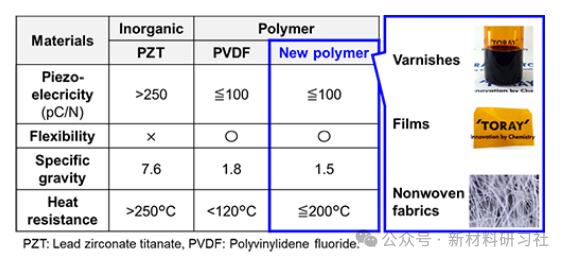
Building on polymer molecular design and higher-order structure control technologies, it has achieved two major breakthroughs: first,Heat resistance far exceeds industry standards, and the polarization structure can remain stable even above 200℃. High design flexibility. , can be made into varnish, film, or non-woven fabric, suitable for complex and large-area sensor installation.
The material is lead- and fluorine-free, compliant with the EU's RoHS Directive and PFAS-related regulations, balancing environmental friendliness and compliance. Toray plans to commercialize the material around 2028 and is currently providing customer samples, with plans to upgrade vibration testing technologies in various fields in the future.
Breakthrough 2: Tripling Efficiency! Carbon Fiber Thermal Welding Technology Paves New Path for Aviation Carbon Neutrality
Following piezoelectric polymers, Toray's next breakthrough precisely targets a key pain point in the aviation industry: solving the challenges of joining CFRP (carbon fiber reinforced plastic), providing a revolutionary solution for weight reduction, increased efficiency, and carbon neutrality in the aviation industry.
CFRP is a core material for aircraft lightweighting (at comparable strength, it is only 1/4 the weight of steel, which can improve aircraft fuel efficiency by 20%), but the two mainstream types of CFRP in the industry have long struggled to work together synergistically.
Thermoset CFRP: Suitable for primary aircraft structures, resistant to high temperatures and extreme operating conditions, but cannot be reprocessed after forming.
Thermoplastic CFRP: recyclable, suitable for high-volume production, and adaptable to complex geometries, aligning with the carbon neutrality concept, but cannot be efficiently bonded with thermoset CFRP.
Traditional adhesive bonding and bolting processes further restrict the combination of the two: adhesive bonding involves cumbersome procedures and time-consuming curing; bolting, on the other hand, increases the weight of the airframe and reduces efficiency, directly limiting the widespread adoption of carbon fiber in single-aisle small aircraft (which account for over 70% of the global aviation market).
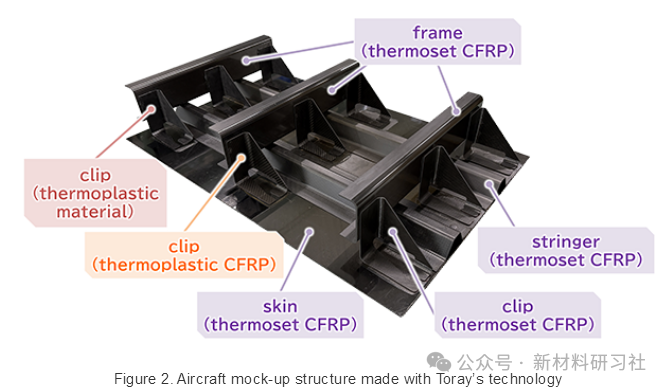
Toray has completed the full-process verification of its CFRP heat welding technology, a key breakthrough in overcoming this impasse. Leveraging its long-standing technical expertise in CFRP prepreg and molding processing, Toray has developed a proprietary welding resin that enables integrated joining of two materials without adhesives or bolts, achieving strength superior to traditional adhesive bonding (verified by ISO 4587 testing).
Efficiency is significantly improved: In testing 900mm x 600mm aircraft simulated structural components, the joining process is reduced from over one day to approximately 20 minutes, an efficiency increase of nearly 3 times, and is expected to rival the production rate of aluminum alloys.
This technology is supported by Japan's NEDO program and responds to ICAO's 2027 aviation carbon reduction requirements, with lightweighting and high efficiency being the core pathways for aviation decarbonization. Currently, Toray has partnered with Boeing to promote the technology's implementation, targeting the single-aisle small aircraft market to further expand its share of aviation-related components.
【Copyright and Disclaimer】The above information is collected and organized by PlastMatch. The copyright belongs to the original author. This article is reprinted for the purpose of providing more information, and it does not imply that PlastMatch endorses the views expressed in the article or guarantees its accuracy. If there are any errors in the source attribution or if your legitimate rights have been infringed, please contact us, and we will promptly correct or remove the content. If other media, websites, or individuals use the aforementioned content, they must clearly indicate the original source and origin of the work and assume legal responsibility on their own.
Most Popular
-
Supply Extremely Tight! LG Chem Declares Force Majeure on Export Contracts for Di-Octyl Terephthalate (DOTP)
-
Huntsman Introduces “War Surcharge” Amid Shipping Disruption and Soaring Energy Costs, Global MDI Prices Continue to Rise
-
Deadly Impact: Hormuz Strait Blockade Sparks Shortage of Plastic Raw Materials, Threatening Shutdowns at Japanese and Korean Chemical Plants
-

LG Chem Declares Force Majeure on DOTP Exports! SABIC Joins Five Giants to Redefine EV Safety
-

Tao Lin: Tesla’s Supercharger Stations in China Surpass 2,500


