



The First "Committee Member Passage" Goes Viral at the Two Sessions
Currently, China's scientific and technological innovation is at a critical stage of making significant progress, with continuous breakthroughs emerging in the forefront, but there is still a long way to go. We need to remain clear-minded. Science is an endless frontier, and innovation requires a long-term perspective. It necessitates the joint efforts of all parties to fully unleash the vitality of scientific and technological innovation, steadily advancing towards becoming a nation of science and technology.
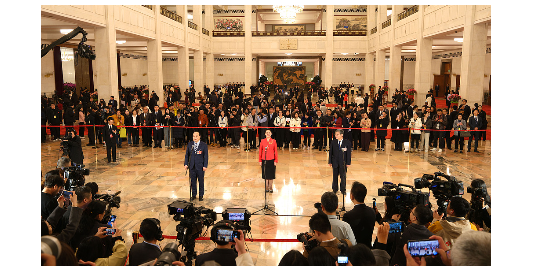
On the afternoon of March 4th, the first "Deputies' Corridor" of the 2026 National Two Sessions took place. National People's Congress deputies Huang Sanwen, Zeng Yuqun, Pan Jianwei, Li Ying, and Yang Jie faced the public, sharing cutting-edge developments and addressing social concerns in the fields of agricultural science and technology, intelligent manufacturing, quantum science and technology, and information and communication.
This open group interview quickly became a focal point of public attention and flooded the coverage of the Two Sessions.
The popularity of the "CPPCC Members' Channel" reflects the public's high expectations for scientific and technological innovation and new-quality productive forces. From quantum technology firmly securing a leading international position, to the accelerated advancement of new energy and intelligent manufacturing; from breakthroughs in core and critical technologies, to deeper integration of industry, academia, and research—the members’ pragmatic narratives not only summarize the innovation achievements of the 14th Five-Year Plan period but also clearly signal the direction for development during the 15th Five-Year Plan period.
Liu Jieyi, spokesperson for the National Committee of the Chinese People's Political Consultative Conference (CPPCC), stated that vigorously promoting the development of new quality productive forces is a key focus of policy deliberation and recommendations. The CPPCC has prioritized integrated reform in education, science and technology, and talent development, with over 100 proposals submitted to inform policy formulation. Lou Qinjian, spokesperson for the National People's Congress (NPC), emphasized that the crux of scientific and technological innovation lies in achieving independent control over core technologies. During the upcoming "15th Five-Year Plan" period, China will strengthen original innovation and tackle key core technologies, promoting deeper integration between scientific innovation and industrial innovation, and striving for decisive breakthroughs in key areas.
The suggestions from the representatives and committee members attending the meeting reflect both ambition for technological breakthroughs and a clear-sighted approach to addressing problems. Frontiers such as quantum technology and fusion energy are steadily advancing, but core challenges and industrial weaknesses remain to be addressed; new fields such as artificial intelligence, smart cars, and humanoid robots are rapidly emerging, but supporting measures such as safety and compliance, standard systems, and regulatory policies need to catch up.
For instance, National People’s Congress (NPC) member Pan Jianwei proposed that during the 15th Five-Year Plan period, China will continue strengthening original innovation and promoting deep integration of industry, academia, and research to better harness quantum science and technology in cultivating new quality productive forces. Meanwhile, Duan Xuru, NPC member and Chief Scientist for Fusion at China National Nuclear Corporation, stated directly that commercialization of fusion energy has entered an accelerated phase, with nearly 40 countries worldwide advancing related initiatives; however, core scientific and technological challenges, as well as industrial ecosystem gaps, still require time to be gradually resolved.
In response to the challenges of safety, privacy, and ethics in artificial intelligence applications, Representative Zhou Yunjie suggested establishing a comprehensive AI standard system; strengthening technical source control; and building a co-governance ecosystem. Representative Lei Jun put forward suggestions covering areas such as humanoid robots and smart cars, including practical measures like perfecting the technical standards for smart connected vehicles and promoting the lawful operation of autonomous driving. Representative He Xiaopeng focused on the upgrade of autonomous driving and the research and development of humanoid robots, proposing to perfect relevant laws and management policies to pave the way for the commercialization of technology.
Deputies and members not only discuss “hard breakthroughs” in technology but also extend their proposals to the “soft support” of the innovation system, making their suggestions more practically targeted.
Currently, China's scientific and technological innovation is at a critical stage of climbing and overcoming obstacles. Breakthroughs at the forefront continue to emerge, but there is still a long way to go. We need to remain clear-minded. Science is an endless frontier, and innovation requires a long-term perspective. It calls for the joint efforts of all parties to fully unleash the vitality of scientific and technological innovation, steadily moving towards becoming a strong country in science and technology.
【Copyright and Disclaimer】The above information is collected and organized by PlastMatch. The copyright belongs to the original author. This article is reprinted for the purpose of providing more information, and it does not imply that PlastMatch endorses the views expressed in the article or guarantees its accuracy. If there are any errors in the source attribution or if your legitimate rights have been infringed, please contact us, and we will promptly correct or remove the content. If other media, websites, or individuals use the aforementioned content, they must clearly indicate the original source and origin of the work and assume legal responsibility on their own.
Most Popular
-
Supply Extremely Tight! LG Chem Declares Force Majeure on Export Contracts for Di-Octyl Terephthalate (DOTP)
-
Huntsman Introduces “War Surcharge” Amid Shipping Disruption and Soaring Energy Costs, Global MDI Prices Continue to Rise
-

Deadly Impact: Hormuz Strait Blockade Sparks Shortage of Plastic Raw Materials, Threatening Shutdowns at Japanese and Korean Chemical Plants
-

LG Chem Declares Force Majeure on DOTP Exports! SABIC Joins Five Giants to Redefine EV Safety
-
Tao Lin: Tesla’s Supercharger Stations in China Surpass 2,500


