



Stable Ingredients, Thoughtful Packaging: Exploring Cosmetic Inner Packaging
In order to attract consumers, merchants have increasingly focused on the packaging of cosmetics, with various innovative and delicate designs emerging one after another. Excellent external packaging and bottle design have indeed become factors contributing to product sales. In fact, the role of cosmetic packaging is not only to attract consumers, but also to provide essential storage space and protective functions for the product itself.
Cosmetic Packaging
Divided into inner and outer packaging materials
Inner packaging materials are in direct contact with the product.
The chosen form is closely related to the product's ingredients.
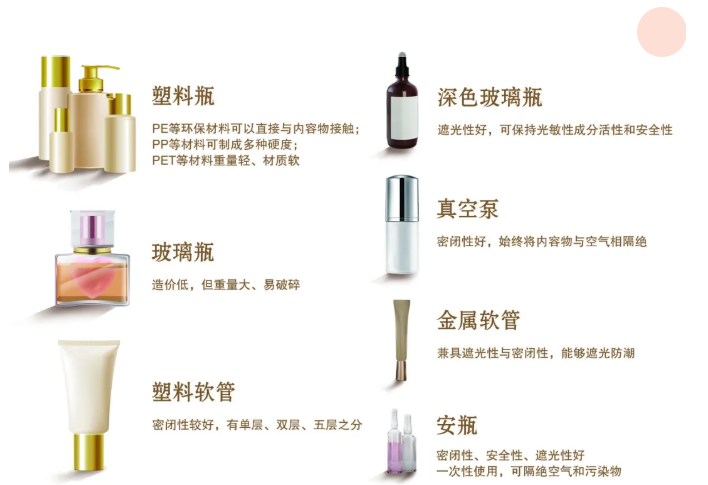
Common cosmetic primary packaging materials
Common cosmetic primary packaging materials include plastic bottles, glass bottles, and tubes. Different materials possess distinct characteristics and are suitable for cosmetics of varying textures and formulations.
Plastic bottle
Plastic bottles are made of various materials, including ABS (acrylonitrile-butadiene-styrene), PP (polypropylene), PE (polyethylene), PET (polyethylene terephthalate), AS (styrene-acrylonitrile copolymer), acrylic, etc. Among them, PP, PE, and PET are environmentally friendly materials that can be directly in contact with the contents. PP and PE are translucent, with a white color, and can be manufactured in various hardness levels. PET is transparent, lightweight, and has a soft texture.
Glass bottle
Glass bottles in cosmetics are mainly used for products with smaller volumes such as creams, pastes, lotions, serums, and essential oils. Based on the type of bottle opening, glass bottles can be categorized into wide-mouth bottles and narrow-mouth bottles. Wide-mouth bottles are mostly used for solid paste cosmetics like facial creams and applied masks, while narrow-mouth bottles are generally used for water-based and lotion-type cosmetics.
Glass bottles are typically paired with caps, pumps, or used with droppers to better ensure product cleanliness and hygiene. The bottle body can undergo treatments such as frosting, spraying, or screen printing.
Glass bottles have the advantage of low cost, but the disadvantages of being heavy and easily breakable. Perfume products often use glass bottles to better prevent liquid evaporation and preserve the fragrance.
Plastic Hose
Hoses are classified by the number of layers into single-layer, double-layer, and five-layer types; by material, they can be divided into plastic and metal hoses, among which plastic hoses are the most common—typically used for packaging regular facial cleansers and usually made of PE plastic.
Tube packaging offers excellent sealing performance, effectively isolating the contents from external air while preventing leakage. The barrier properties of tubes vary depending on the number of layers. Tubes are typically paired with screw caps or flip caps, and the tube body can undergo various finishing processes such as silk-screen printing.
Special ingredients require special packaging.
Some cosmetics require special packaging due to the unique nature of their ingredients to maintain ingredient efficacy. Common special packaging includes dark glass bottles, vacuum pumps, metal tubes, and ampoules.
Cosmetic brands focusing on functional ingredients often use dark glass bottles for packaging to ensure the efficacy of the ingredients.
It should be noted that although amber glass bottles are used to protect against light, their selection may also be purely based on tradition or aesthetic considerations. Some cosmetic products do not contain light-sensitive ingredients; however, brands may still adopt amber glass bottles and dropper dispensers—drawing on their traditional use in pharmaceuticals—to appeal to consumers.
Dark glass bottles, although they have good light-blocking properties, can only completely isolate air before use and are not suitable for components that require higher air isolation (such as ubiquinone and ascorbic acid used for antioxidation), and easily oxidized oil components (such as shea butter).
If the product components require higher sealing performance of the packaging, a vacuum pump can be used. The vacuum pump is generally made of AS material, which has the significant advantage of effectively isolating the contents from the outside air. There is a piston at the bottom of the vacuum pump bottle. When the pump head is pressed, the piston at the bottom moves upward, the contents flow out, the space inside the bottle decreases, and air does not enter.
Since vacuum pumps are made of plastic, their light-blocking capability is suboptimal. For products whose ingredients have high requirements for both light protection and air isolation—such as retinol-based substances—metal tubes must be used. High-concentration retinol products are typically packaged in aluminum tubes, which offer superior sealing performance compared to plastic and effectively block light and moisture, thereby better preserving the active ingredients’ stability.
Store cosmetics according to ingredient requirements.
Although primary packaging helps maintain the stability and active ingredient efficacy of cosmetics, consumers must store products according to the instructions after purchase to further extend their shelf life. Special storage requirements—such as avoiding direct sunlight or storing in a dry place—are indicated on the outer packaging for cosmetics with specific needs.
If the room temperature is too low, some water-based or pure oil-based cosmetic products may freeze or crystallize. If the formulation contains a very low amount of emulsifier, phase separation can occur at low temperatures. In such cases, the product can be gently warmed or stored at an appropriate temperature.
【Copyright and Disclaimer】The above information is collected and organized by PlastMatch. The copyright belongs to the original author. This article is reprinted for the purpose of providing more information, and it does not imply that PlastMatch endorses the views expressed in the article or guarantees its accuracy. If there are any errors in the source attribution or if your legitimate rights have been infringed, please contact us, and we will promptly correct or remove the content. If other media, websites, or individuals use the aforementioned content, they must clearly indicate the original source and origin of the work and assume legal responsibility on their own.
Most Popular
-
Supply Extremely Tight! LG Chem Declares Force Majeure on Export Contracts for Di-Octyl Terephthalate (DOTP)
-
Huntsman Introduces “War Surcharge” Amid Shipping Disruption and Soaring Energy Costs, Global MDI Prices Continue to Rise
-
Middle East Tensions Escalate Sharply: How Polyolefins Respond Amid Soaring Risk Premium
-

Deadly Impact: Hormuz Strait Blockade Sparks Shortage of Plastic Raw Materials, Threatening Shutdowns at Japanese and Korean Chemical Plants
-

LG Chem Declares Force Majeure on DOTP Exports! SABIC Joins Five Giants to Redefine EV Safety


