



South Korea Initiates Anti-Dumping Investigation Into China’s PVC Suspension Resin! Triple Tariff Iron Curtain Falls, Who Pays for China’s Chemical Exports?

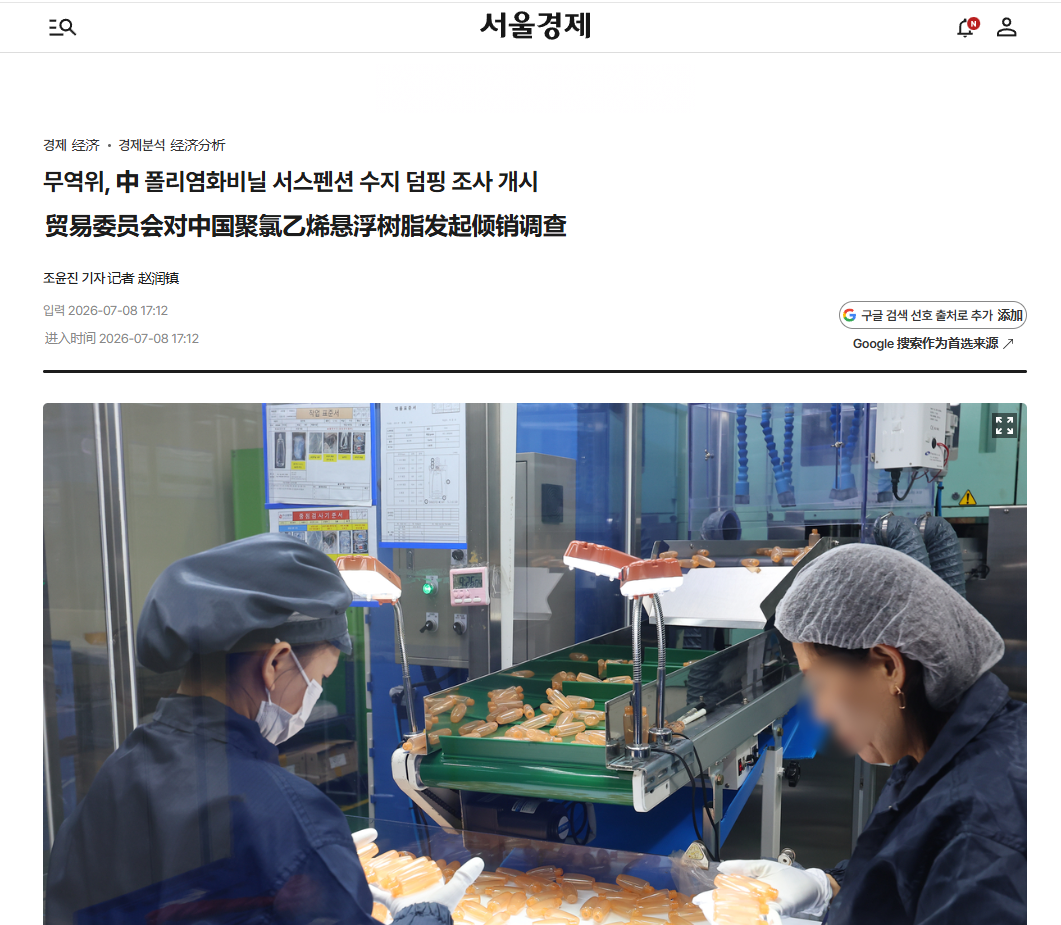
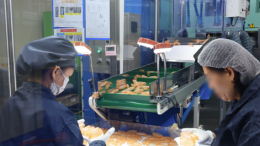
Image source: Hanwha Corporation
According to South Korean media reports on July 8, 2026.,The Korea Trade Commission has issued Announcement No. 2026-13, deciding to initiate an investigation into the dumping of Chinese-produced polyvinyl chloride (PVC) suspension resin and the damage to the domestic industry. The applicant, Hanwha Corporation, submitted the application on April 28, 2026. The subject of the investigation is porous white granular PVC suspension resin produced through the suspension polymerization of vinyl chloride monomer, with an average particle size of 100-180 μm (chemical formula (C₂H₃Cl)ₙ, and resin produced by emulsion or micro-suspension polymerization in paste form is not included in the scope of investigation), specifically targeting Chinese chemical giants Tianjin Bohua and Wanhua Chemical.
This is not an isolated trade friction. Before South Korea took action, India had already imposed anti-dumping duties ranging from $122 to $232 per ton on PVC suspension resin from mainland China in August 2025, and Pakistan also levied anti-dumping duties of 3.44% to 20.47% on PVC from mainland China. From South Asia to Northeast Asia, a tightening net of anti-dumping measures against China's PVC exports is being woven.
115%Whose interests were hurt by the surge in imports?
The core controversy of this investigation lies in the stark disparity between two sets of figures.
According to statistics from the Korea International Trade Association, South Korea's imports of suspension-grade PVC resin from China surged from 14,345 tons in 2024 to 30,806 tons in 2025, an increase of as much as 115%. However, during the same period, the import value rose only from US$11.6 million to US$26.8 million, far below the growth in import volume. Based on this, the Korea Trade Commission believes that the Chinese products may involve "unfair low-price dumping."
The litigation logic of Hanwha Solutions is not complicated: there is a serious overcapacity of PVC production in China, and a large number of low-priced products are impacting the Korean market, causing substantial damage to the domestic industry. As the creator of the Korean PVC industry—achieving Korea's first PVC localization in 1966—Hanwha Solutions' sensitivity and anxiety reflect a deeper industrial concern: as Chinese chemical giants' capacity carriers sail into the nearby waters, the regional leaders' moat is being rapidly filled.
Wanhua Chemical and Tianjin Bohua: Two Chinese Companies Standing at the Crest of the Wave
The two companies singled out for investigation by the Korea Trade Commission happen to represent the two major forces behind the current expansion of China’s PVC industry.
Wanhua ChemicalThis Chinese chemical flagship, whose revenue exceeded RMB 200 billion for the first time in 2025, is undergoing a strategic transformation from a polyurethane leader to a diversified chemical platform. Its petrochemicals segment—covering bulk products such as ethylene, propylene, and PVC—overtook the polyurethane segment in the first three quarters of 2025 to become its largest source of revenue. Fujian Wanhua’s 500,000-ton-per-year PVC facility and Wanhua Rongxin New Materials’ 960,000-ton PVC project are propelling Wanhua Chemical into the ranks of major players in the PVC arena. At this moment, however, some of its facilities are undergoing annual maintenance turnarounds, while the impact of an anti-dumping investigation in South Korea has suddenly narrowed its path to overseas expansion.
Tianjin BohuaBohai Chemical Group's core enterprise is also in a capacity ramp-up phase. Its 400,000 tons/year PVC new facility is set to be put into operation in 2025 and is currently in a critical window for expanding into overseas markets. Although the South Korean market is not large—importing over 30,000 tons annually compared to China's total PVC exports exceeding 2 million tons—it holds symbolic significance that far exceeds its actual share. Once South Korea makes a definitive ruling and imposes anti-dumping duties, it is likely to create a demonstration effect, prompting more trade partners to follow suit.
Threefold Tariff Iron Curtain: China's PVCThe Besieged-City Dilemma of Exports
When viewed in a broader perspective, South Korea’s current investigation is by no means an isolated event.
In August 2025, India’s Ministry of Commerce and Industry issued a final affirmative anti-dumping determination on PVC suspension resin from mainland China, imposing anti-dumping duties of US$122 to US$232 per ton for a period of five years. India is one of the largest export destinations for Chinese PVC, and this ruling is being described as a “seismic” blow to China’s PVC export landscape. Industry analysts point out that China’s PVC exports to India will likely shrink significantly as a result, while supplies from Japan, South Korea, the United States, and other sources will fill the gap.
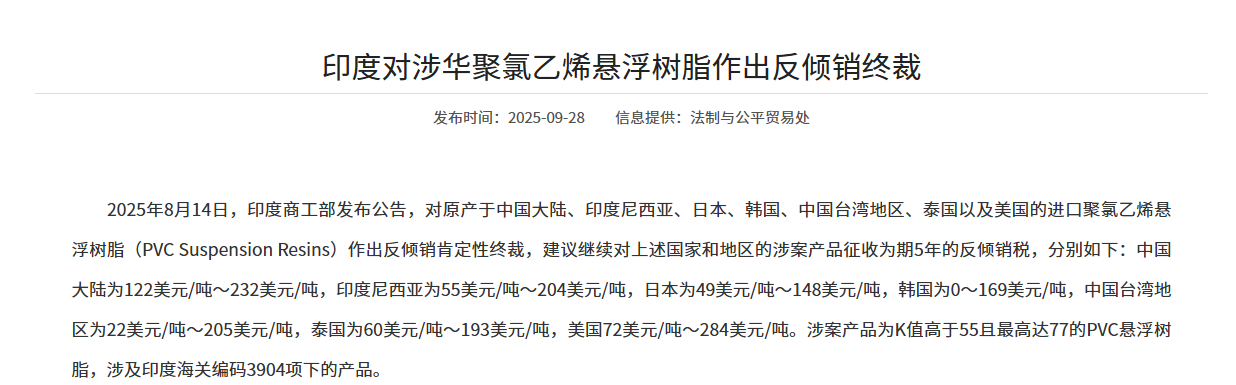
Screenshot source: Beijing Municipal People's Government website
Following closely, Pakistan imposed anti-dumping duties ranging from 3.44% to 20.47% on PVC imported from mainland China. With South Korea now launching an investigation as well, the three major anti-dumping fronts of “India, Pakistan, and South Korea” have effectively formed a continuous line, and Chinese PVC exports are facing an unprecedented siege.
More alarming is the macro backdrop. 2025 is a major year for PVC capacity expansion in China, with approximately 2.2 million tonnes of new capacity coming on stream over the year and total additions falling in the range of 2.0 million to 2.5 million tonnes. Capacity is set to grow 7.35% year on year, marking the largest wave of new commissioning in the past five years. Multiple new ethylene-based and calcium carbide-based production lines, including Tianjin Bohua’s 400,000 tonnes, Wanhua Fujian’s 500,000 tonnes, Xinpu Chemical’s 500,000 tonnes, and Shaanxi Jintai’s 300,000 tonnes, are coming online in close succession. Coupled with the continued ramp-up of newly added units during the same period, the industry’s average capacity utilization rate for the year is expected to remain at 77%-78%, leaving supply and demand under sustained pressure. In 2025, domestic downstream demand remains weak, while expectations that PVC export tax rebates will be fully abolished from April 2026 make exports virtually the core relief channel for absorbing China’s excess domestic capacity.
And when export routes are also blocked by layers of tariff barriers, the industry’s deep-rooted contradictions are being brought to light at an accelerating pace.
Price fluctuations on the same day: Resonance between supply side and sentiment.
Market divergence between bulls and bears is significant, coinciding with rumors on July 8 that South Korea had launched an anti-dumping case. On the one hand, news of an anti-dumping investigation into Chinese PVC has worsened the industry’s pessimistic expectations for future exports; on the other hand, ex-factory PVC prices in some domestic regions have been raised slightly by RMB 20–40/mt, with clear regional divergence in quotations. Price support mainly comes from the continued supply contraction caused by concentrated maintenance in the industry during the second quarter. Multiple units at LG, Ordos, Fujian Wanhua, Tosoh, Anhui Hwasu and others were shut down for overhaul between April and June, and some units continued to operate at low loads in July. The resulting temporary tightness in supply has offset the pessimism caused by trade frictions.
This precisely reveals the deep-seated contradiction in the current PVC market: the long-term fundamental oversupply and the supply disruptions caused by periodic plant maintenance are alternately dominating price movements. In the short term, the recent wave of concentrated maintenance has continued to support ex-factory spot prices; in the medium term, the anti-dumping barriers successively introduced by India, Pakistan, and South Korea will materially compress the export space for domestic PVC; in the long term, how to develop new demand channels for China’s massive PVC capacity stock approaching 30 million tons remains the core challenge for the industry.
Intensive Trade Remedies: A New Variable in China-South Korea Economic and Trade Relations
The PVC anti-dumping investigation is not an isolated case.
Looking back at the timeline, trade remedy petitions initiated by Korean companies increased significantly in 2025, with the number of investigations targeting Chinese products ranking first. In May 2026, South Korea issued an affirmative final anti-dumping ruling on PVC paste resin originating in Germany, France, Norway, and Sweden, recommending the imposition of anti-dumping duties ranging from 25.79% to 31.55% for a period of five years. Following the imposition of trade barriers on European PVC paste resin, the launch of this investigation into Chinese suspension PVC resin reflects South Korea’s continued escalation of trade protection against Chinese chemical products.
For Chinese chemical companies, the South Korean market alone may not be a critical issue, but as a member of the OECD and an important participant in global trade rules, the "signal effect" of South Korea's anti-dumping rulings should not be underestimated. Once South Korea determines that Chinese PVC is being dumped, other markets may refer to this ruling as a precedent when initiating trade relief investigations.
Who is paying for ChemChina’s overseas expansion?
Back to the question in the title: Who is footing the bill for Chinese chemical companies going global?
In the short term, the impact falls on the companies themselves. Wanhua Chemical and Tianjin Bohua will need to devote substantial legal and consulting resources to respond to the investigation, while facing uncertainty over export orders and a wait-and-see attitude from customers during the investigation period. If South Korea ultimately imposes anti-dumping duties, re-export trade, production capacity deployment in third countries, and product mix upgrading will become essential courses of action.
In the medium term, it is about the industry. China’s PVC sector is standing at the crossroads of the end of a capacity expansion cycle and escalating trade frictions. In 2026, the launch of new domestic PVC capacity will shrink significantly, marking the official end of this round of concentrated expansion. However, the absorption of existing capacity is far from complete. Obstacles to exports mean more products will flow back into the domestic market, intensifying price competition, while industry consolidation may accelerate.
In the long run, this is a recalibration of the entire Chinese chemical industry’s overseas expansion model. From “winning by volume” to “winning by quality,” from price competition to brand and channel building, from reliance on a single market to a globalized production footprint — this path is destined to be long, but there is no other choice.
In South Korea, the period of investigation for a regular anti-dumping investigation is generally the 12 months prior to the initiation of the case. If this case is initiated on July 8, the dumping investigation period will most likely be from July 2025 to June 2026, while the injury investigation will cover data for the full year of 2025. In accordance with the investigation procedures of the Korea Trade Commission, separate investigations into the existence of dumping and injury to the domestic industry will be conducted after initiation. If dumping is ultimately found to exist and to have caused injury to the domestic industry, the Commission will recommend that the Ministry of Economy and Finance of Korea impose anti-dumping duties.
For Wanhua Chemical, Tianjin Bohua, and China’s entire PVC industry, this is not merely an anti-dumping defense battle, but also a stress test of just how far their “going global” path can extend. With India imposing anti-dumping duties starting at $122 per ton, Pakistan levying duties of up to 20.47%, and South Korea’s investigation still underway, a tariff curtain is descending inch by inch. The window of time left for China’s PVC exports to adjust is running short.
Editor: Lily
【Copyright and Disclaimer】This article is the property of PlastMatch. For business cooperation, media interviews, article reprints, or suggestions, please call the PlastMatch customer service hotline at +86-18030158354 or via email at service@zhuansushijie.com. The information and data provided by PlastMatch are for reference only and do not constitute direct advice for client decision-making. Any decisions made by clients based on such information and data, and all resulting direct or indirect losses and legal consequences, shall be borne by the clients themselves and are unrelated to PlastMatch. Unauthorized reprinting is strictly prohibited.
Most Popular
-
Layoffs, Divestments, Plant Closures While Pouring Billions: BASF Undergoes Major Transformation!
-
Ascend Adipic Acid Hit By Force Majeure, Market Expects Supply Resumption In Mid-September
-

Raw Material Supply Shortage! INEOS Phenol Declares Force Majeure on Phenol and Acetone Businesses
-
South Korea initiates anti-dumping investigation against Chinese PVC suspension resin! The target is Tianjin Bohua and Wanhua Chemical. How to break through?
-

Sixth national procurement set to be implemented: A “Reshuffling” Moment for the $10-Billion Medical Device Market


