



Report | U.S. Tire Market “Splits” to Reveal New Opportunities—Why Chinese Brands Haven’t Even Earned a Seat at the Comparison Table
1. Core Summary
-
It is not a single United States, but multiple United States: tire demand is segmented simultaneously by geography and vehicle type structure; the same strategy rarely works nationwide.
-
Income stratification is further fragmenting the tire replacement market: Income stratification is reshaping the entire price structure of the tire replacement market - lower-income groups are more concentrated in low-price and second-hand demands, while middle- and high-income areas are more distributed in the mid-to-high price range, with demand hotspots showing a clear stratification rather than an even distribution.
-
The language market is also structurally segmented: the scale and proportion of Spanish speakers have increased to 20%, and they account for a relatively high percentage among automotive service technicians/mechanics; Spanish-speaking users' search and decision-making paths tend more towards "confirming the need first before finding nearby fulfillment," corresponding to independent content and channel strategies.
-
Channels are highly localized, and entry points define market boundaries: independent tire dealers and store networks have consistently accounted for approximately two-thirds of the market, and “fulfillment-oriented searches” such as “near me” or store names constitute nearly half of all searches—indicating that the core competitive battleground in many sub-markets revolves around local installation and delivery access.
-
Chinese tires need to pass the "trust test" in the US: they must repeatedly explain "who I am and who made me." Identity verification > price comparison: the brands are still in the "entry period," far from being in the candidate zone to compete with major brands in terms of performance and price.
2. Structuralin the existing market: The US tire market is being "torn apart" It seems there was a direct translation attempt, but "" could be better translated. Here's a more accurate translation: 2. Structural division in the existing market: The US tire market is being "torn apart"
1) Market: Structural "fragmentation" under market-driven replacement
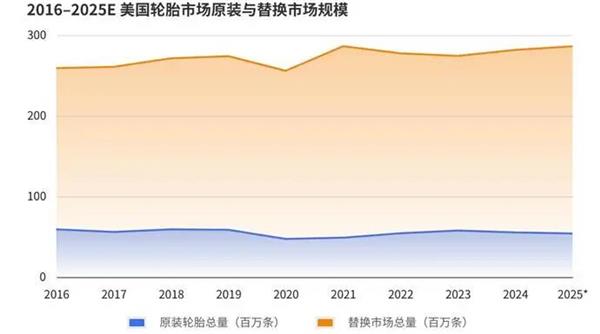
The absolute scale is dominated by the replacement market in the long term: for example, in 2019, the replacement market sales were 274.0 million units, while the OEM market was 58.7 million units, with the replacement market accounting for about 82%.
Between 2020 and 2024, the replacement market share has consistently remained above 80%.
According to USTMA's latest official forecast methodology for 2025, the replacement market volume will reach 286.2 million units, still significantly exceeding the OEM segment, indicating that the primary battleground of the overall market remains the replacement market rather than the original equipment (OE) segment.
Within the replacement market, the structure itself is also differentiating:
-
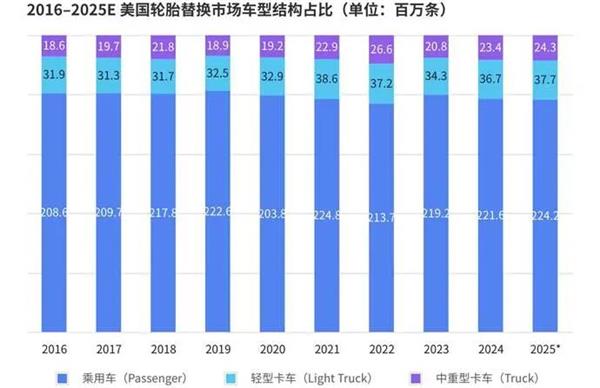
Passenger cars remain the largest single category, but growth is becoming sluggish. From 2016 to 2024, the sales of replacement tires for passenger cars have basically remained between 210-225 million pieces; in 2024, it was 221.6 million pieces, and it is forecasted to reach 224.2 million pieces in 2025, with limited growth.
-
In contrast, replacement market demand has become more concentrated in the Light Truck and Truck segments: Light Truck replacement sales increased from 31.9 in 2016 to 36.7 in 2024 (projected to reach 37.7 in 2025); Truck replacement sales rose from 18.6 in 2016 to 23.4 in 2024 (projected to reach 24.3 in 2025).
In other words, the replacement market is not "growing in unison," but rather showing a structural split where the largest existing categories are stabilizing, and the growth is concentrating in specific categories.
|
Note: The vehicle categories used in this report—Passenger, Light Truck, and Truck—are standard statistical classifications adopted by the U.S. tire industry (e.g., USTMA) and do not fully align with China’s vehicle classification system based on vehicle attributes. This is noted for clarification. • Passenger: Primarily refers to passenger car tires, typically covering sedans and some small to mid-size crossover vehicles. It should be noted that, under U.S. statistical definitions, not all SUVs or MPVs are classified under the Passenger category. • Light Truck: A category unique to and significantly represented in the U.S. market, typically encompassing pickups, a large number of SUVs/CUVs, and some light vans or light-duty vehicles. This classification is based on the vehicle's purpose and tire specifications (load capacity, structural characteristics, etc.), and is not entirely equivalent to the "light commercial vehicle" or "light truck" in the Chinese context. • Medium and Heavy Trucks (Truck): Typically refers to medium and heavy truck tires, corresponding to logistics transportation, engineering applications, and other medium and heavy commercial vehicle models, excluding pickup truck models. Therefore, in this report, "Passenger" does not correspond to the definition used for passenger cars in China, while "Light Truck" actually accounts for a significant portion of tire demand from SUVs and pickups in the U.S. market. Readers should pay close attention to these classification differences when comparing or interpreting market structures between China and the U.S. |
According to the official 2025 forecast, the replacement market remains the primary driver of overall growth: the replacement market is projected to grow by approximately +1.6% year-on-year in 2025, with positive growth across passenger vehicles, light trucks, and medium- and heavy-duty trucks in the replacement segment; meanwhile, the OEM market contributes relatively little to the overall change in volume.
2) Vehicle model segmentation: The ownership structure is shifting toward trucks, with almost all growth in the existing fleet occurring in this segment.
Tire replacement demand is primarily determined by the vehicle fleet size at the macro level.
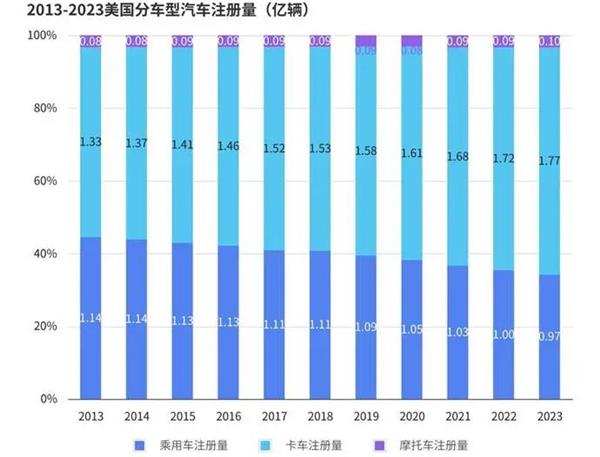
From 2013 to 2023, the U.S. vehicle fleet composition continued shifting toward trucks (in U.S. statistical terms, “trucks” generally include pickup trucks and certain light-duty SUVs).
-
Meanwhile, passenger vehicles (primarily traditional sedans) experienced a structural contraction during the same period, with registrations declining from 114 million to less than 100 million (a decrease of approximately 20 million).
-
Truck registration volume increased from 130 million to 170 million (about +40 million). The ten-year stock expansion was almost entirely contributed by trucks.
This change is continuous rather than characterized by phased fluctuations. Passenger vehicles reached a peak of 114 million units in 2014 and then entered a sustained downward trend, declining to approximately 97 million units by 2023.
Meanwhile, the truck category maintained a positive cumulative growth throughout the entire period: 133 million in 2013, 158 million in 2019, 161 million in 2020, and 177 million in 2023, and the growth rate did not reverse after 2019.
3) Geographic Differentiation: East-West differences in mainstream new vehicle models are reshaping tire demand structures.
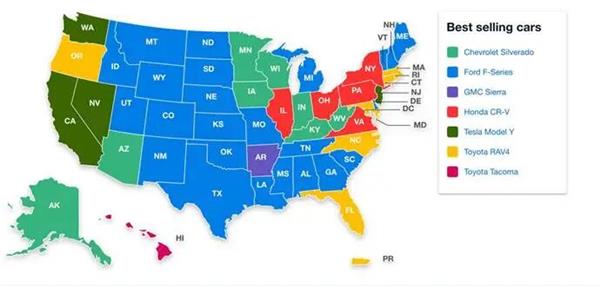
The Best-Selling Car Models in Each U.S. State in 2024
From the distribution of best-selling vehicle models by state in 2024, a clear regional disparity emerges between the East and West coasts in terms of new vehicle sales in the United States.
-
In most states in the West and Midwest, pickup trucks and large SUVs are the mainstream.
-
Compact SUVs and passenger cars still dominate in the Northeast and parts of the East.
This vehicle segmentation directly translates into tire replacement demand: regions dominated by trucks tend to favor larger-sized, high-load, durable tires, whereas areas where passenger cars and compact SUVs prevail primarily demand smaller- to mid-sized tires emphasizing comfort and fuel efficiency.
As a result, the U.S. replacement tire market is not homogeneous nationwide but is instead segmented into multiple regional markets driven primarily by vehicle model composition.
4) Economic polarization: Income disparities are reshaping the price segment structure of tire replacement.
The U.S. tire replacement market is not a uniform demand market, but rather a segmented market composed of consumers with varying payment capabilities.
-
In some states, the search demand for used tires is significantly higher, while the search for brand tires is relatively weak.
-
In other states, consumer search behavior is clearly concentrated on branded new tires, such as Michelin.
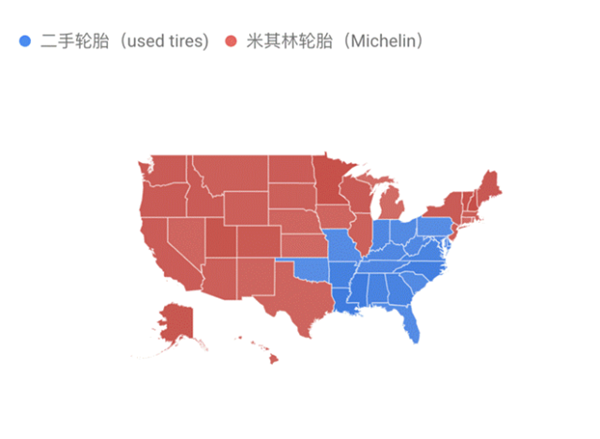
Used tires vs Michelin search index by U.S. states in 2025
This disparity is not coincidental but rather a typical manifestation of price affordability stratification. State-level comparative data shows:
-
“Used tires” searches are more active in the southern and parts of the central U.S. states.
-
West, Northeast, and some high-income states, Michelin and other brands are more concentrated in search.
Note: Consumers do not first decide on a brand, but rather first enter a price range they can afford.
Income level is significantly positively correlated with the ability to choose price ranges.
A positive correlation can be seen between the median household income of U.S. states and the tire affordability index (Michelin search index / used tire search index * 100).
-
States with high incomes (e.g., New Hampshire, Massachusetts, Colorado) have a higher share of branded tire searches.
-
The search ratio for used tires is significantly higher in low-income states such as Mississippi, Louisiana, Arkansas, etc.
Therefore, the demand for used tires is not a nationwide demand, but a structural market driven by income pressure.
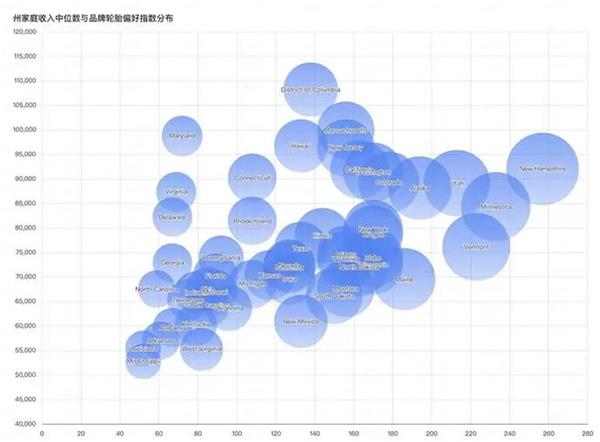
Median Household Income by U.S. State & Michelin/Used Tires Search Index
|
Note: Tire Consumption Affordability Index = Michelin search index / Used tire search index * 100. This index measures the relative strength of consumer demand for new Michelin tires versus used tires in a region, reflecting consumers' purchasing power and price sensitivity in tire replacement decisions. Greater than 100: Indicates stronger search demand for branded tires (e.g., Michelin) than for used tires, typically corresponding to regions with higher purchasing power and lower price sensitivity. Less than 100: Indicates stronger search demand for used tires than for branded tires, typically reflecting regions with greater price pressure and a cost-prioritization decision-making characteristic. Close to 100: indicates a relatively balanced demand between the two types, belonging to a transitional area where the differentiation in price range selection is not obvious. |
The tire replacement market features a three-tier pricing structure.
By combining the price ranges of best-selling tires in each state from Discount Tires, this stratification can be further validated.
A. First Tier: Brand New Tire Price Range
• Price range: about $120–220 per piece
• Typical brands: Michelin, Bridgestone, Continental
•Mainly concentrated in high-income states and areas with a higher proportion of new cars
B. Second layer: Mainstream cost-effective price range
• Price range: approximately $70–$120 per piece
• Typical brands: Goodyear, Cooper, and some domestic tire brands
• The largest market segment for replacement in the U.S.
C. Third layer: Low-cost and second-hand alternative layer
• Approximately $25–$70 per piece
• Including used tires and ultra-low-end new tires
Mainly concentrated in low-income states and areas with high vehicle age
3. Opportunities in the incremental market
1) Incremental Market 1: The Spanish-speaking market is rising, but national chains have not yet captured the channel mindshare entry point.
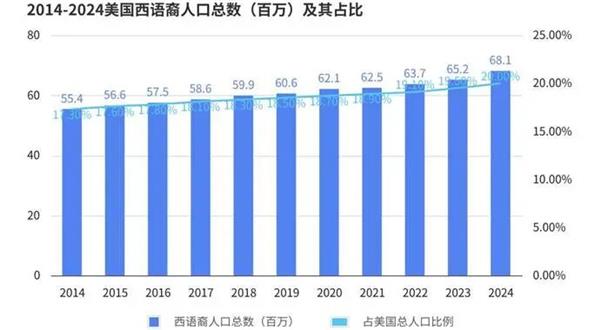
The U.S. Hispanic population has grown by approximately 13 million over the past 10 years, accounting for nearly 20% of the total population.
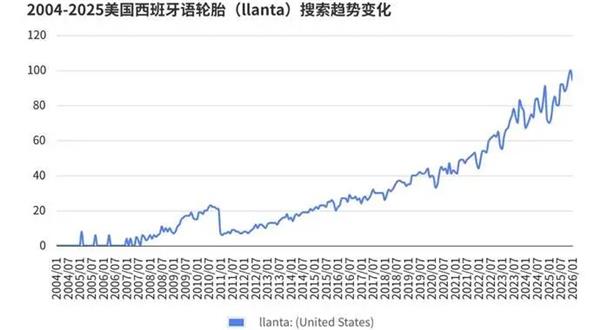
Simultaneously, tire-related searches have shown exponential growth, with Spanish-speaking users becoming a significant new source of traffic in the replacement market.
According to the U.S. Bureau of Labor Statistics 2024 occupational outlook, about 30% of automotive service technicians and mechanics in the U.S. are Hispanic/Latino. This group not only undertakes core maintenance tasks such as tire replacement and installation but also has a real influence on consumers' tire choices.
Therefore, the Spanish-speaking/Hispanic population serves both as a significant source of consumer demand and as a key decision-influencing node, making it an indispensable core demographic for tire brands in the U.S. market.
From the perspective of differences in users’ search expressions and decision starting points:
-
In the English-speaking context, users looking for tires often directly access national channels and service points such as Costco, Walmart, Discount Tire, Tire Rack, and Mavis, reflecting the typical decision path of "brand/channel → service action".
-
In the Spanish language context, users' searches mostly remain at the stage of concept and specification confirmation (such as word meanings, air pressure, dimensions, 91V/91H, etc.), and generalized expressions of local stores (llantera(s) cerca de mi). National chain channels have not become a prominent entry point.
This indicates: In terms of search, the tire decision-making path for Spanish-speaking users is more like "self-understanding and confirmation → then find a nearby store," and they have not yet been systematically absorbed by the mainstream chain channel system in the U.S. as a stable entry point in their mindset.
This presents a structural incremental opportunity for subsequent channel penetration, content education, and local service integration.
Incremental Market II: Electric vehicle penetration rate jumps to about 10%, tire demand begins "specification upgrade"
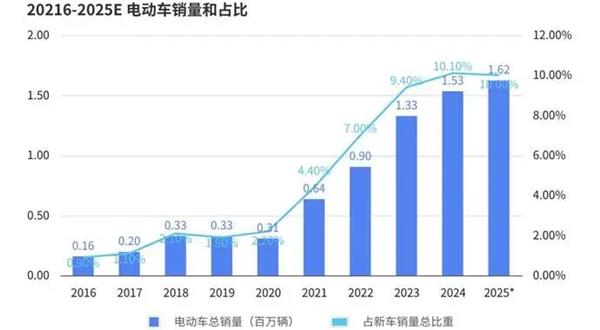
U.S. new electric vehicle sales (including battery electric and plug-in hybrid vehicles) have continuously increased from 2016 to 2024, entering an acceleration phase after 2021.
-
The annual sales of electric vehicles increased from approximately 0.16 million units in 2016 to about 1.53 million units in 2024, and are projected to reach approximately 1.62 million units in 2025.
-
During the same period, the share of electric vehicles in new car sales increased from approximately 0.9% to about 10%.
This means electrification has moved from "marginal incremental growth" to "scaled penetration" and will gradually extend its impact to the aftermarket replacement segment.
4. Installation Channel
1) Purchase and installation channels: An overwhelmingly dominant independent distribution system, with a highly stable channel structure
From 2022 to 2024, the U.S. tire retail and installation channel exhibited a highly concentrated structure: independent tire dealer networks have long accounted for approximately two-thirds of the market, and their share steadily increased from 66.0% to 67.0% over this three-year period, indicating that the replacement market remains firmly dominated by local independent shops and regional dealer networks.
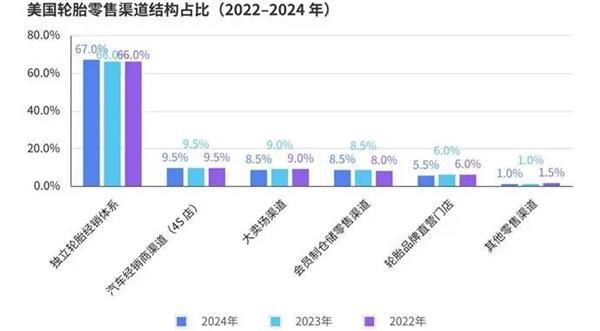
Meanwhile, other channels show more of a "stable division" rather than substituting for each other: car dealers (4S) remain at about 9.5% with no significant fluctuation; hypermarkets drop slightly from about 9.0% to 8.5%; membership-based warehouse stores increase from 8.0% to 8.5%; brand direct-operated stores decline slightly from about 6.0% to 5.5%; other channels remain below 2% for a long time.
The core meaning of this structure is that channel competition in the U.S. tire replacement market is not about “new channels disrupting old ones,” but rather about competing for shelf space and installation access within independent, established systems.
Whoever can get into the main promotion list of independent stores, ensure stable supply, and reduce installation and delivery friction, is closer to the real market share.
|
Instructions: Translate the above content into English, output the translation directly, without any explanations. • Independent tire distribution network: The core channel for the U.S. replacement market, covering national chains (e.g., Discount Tire, Mavis, Les Schwab, Big O) as well as numerous regional chains and independent stores. • Automotive dealer channels (4S stores): Mainly the after-sales service departments of new car dealers, tires are usually sold as an additional item during maintenance or repair processes. • Big-box store channel: Refers to large retailers primarily engaged in general merchandise retail while also providing basic automotive services (typical example: Walmart Auto Care). • Membership warehouse channels: represented by Costco, Sam's Club, BJ's. This channel operates through a membership system, emphasizing a curated selection of few SKUs + clear value for money; • Tire brand-owned retail stores: Retail and service networks directly operated or tightly controlled by tire manufacturers (e.g., certain premium or regional brand networks). |
From the search terms, the channel and conversion decision: the fulfillment node is the main entry point, brand is not the main anchor.
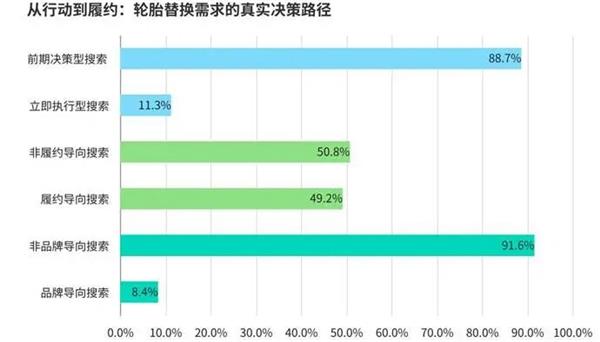
From the structure of tire-related search terms, consumers' decision-making path shows a clear "research first, then fulfill" characteristic. To facilitate analysis, this paper classifies search intent into three categories:
-
Immediate Search: Refers to search queries containing spatial indicators such as “near” or “near me”, e.g., “tire shop near me”, “tire and repair near me”, “tire shop near me open now”. These queries explicitly indicate an “immediately actionable” installation need.
-
Performance-oriented search: refers to search queries that already point to specific offline service nodes, including “near”-type terms or explicit store names, e.g., “Costco tire near me,” “discount tire near me.” Its core characteristic is that the user’s need has already converged on “who will install and where the installation will take place.”
-
Brand-oriented search: refers to search terms that include a specific tire brand name, reflecting that the user is still in the stage of comparing and evaluating brands or products.
From the results, the number of searches that truly enter the "immediate execution" phase is not high in quantity: keywords containing "near" account for only 4.4% of the total search volume, yet they contribute 11.3% of the total search volume, indicating that although this type of search has a limited proportion, its action certainty and conversion intent are significantly stronger.
More importantly, once users enter the execution phase, the demand quickly converges on specific offline fulfillment nodes. According to statistics, "fulfillment-oriented searches" that include "near" or specific store names already account for nearly half (49.2%) of all searches, almost equal to non-fulfillment-oriented searches (50.8%).
This indicates that in the category of tire replacement, which highly depends on installation and delivery, consumers do not directly move from abstract brands or specifications to purchase, but rather complete their final decision around "where it can be installed, who can install it, and whether it can be installed immediately."
By comparison, brand is not the main decision anchor in tire replacement searches. Brand-oriented searches account for only 8.4% of the total search volume, while non-brand-oriented searches reach 91.6%. This means that the key to competition in the tire market is not just about establishing brand awareness, but also about occupying the fulfillment entry points (stores and installation points), and completing product recommendations and conversion within these entry points.
This structure further confirms that the conversion logic of the US tire market is not "brand → product → purchase," but rather "demand trigger → information confirmation → fulfillment node → on-site transaction." Whoever can occupy the first fulfillment entry point after the user enters the execution phase is closer to the real transaction, while brand influence mostly occurs within the fulfillment scenario, not at the search starting point.
3) New Trends in Mobile Tire Installation
From the perspective of service model evolution, the U.S. tire replacement sector is seeing the emergence of "mobile installation" as a complementary fulfillment method.
Since 2019, searches for “mobile tire” have shown a sustained upward trend, rising from an early range of 35–45 to frequently approaching the high range of 90–100 during 2024–2025, indicating that demand for on-site tire replacement services has entered a stage of large-scale diffusion.
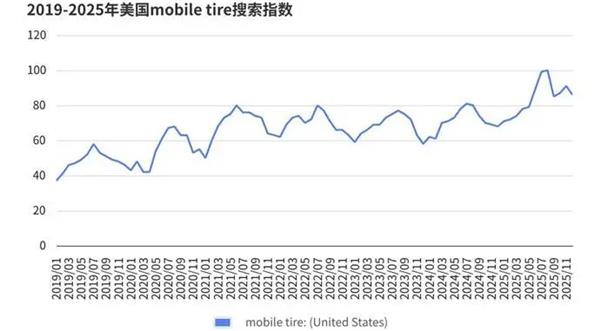
Its time series shows a typical "fluctuating upward with rising bottom" structure: the low point was around 40 in 2019–2020, rose to 55–60 in 2021–2022, and further moved up to 65–70 in 2023–2024. The demand floor continues to rise after each correction, indicating that mobile tire changing has evolved from a temporary convenience option to a stable service option.
This trend essentially reflects the increasing weight of time cost in replacement decisions. As commuting distances lengthen, vehicle usage frequency increases, and urban congestion worsens, the willingness of some middle- to high-income groups to pay for "saving time traveling to and from stores" continues to grow, providing a sustainable demand base for mobile services.
However, from the perspective of the penetration structure, mobile tire replacement has not changed the dominant fulfillment pattern, but rather exists as a supplement to the traditional store system. Its high fulfillment costs, complex scheduling, and limitations in applicable scenarios make it difficult to form a scale advantage in low average transaction value areas, mainly concentrating in densely populated, higher consumption, and higher service density metropolitan markets.
Therefore, the rise of "mobile tire" does not mean the elimination of physical stores, but rather indicates the emergence of a "multi-form stratification" in the fulfillment network: the core still relies on physical stores for large-scale delivery, while mobile services cater to the high-timeliness and high-convenience needs of specific segments of the population. Future fulfillment competition will be more about the ability to coordinate multiple models, rather than the expansion capability of a single channel.
5. The "Trust Barrier" of Chinese Brands: High Sales but Low Visibility
From the perspective of brand search structure, Chinese tire brands are not lacking in attention in the U.S. replacement market, but rather have not been systematically integrated into mainstream decision-making comparison frameworks. This issue is not reflected as a single-dimensional "brand weakness," but rather concentrated in three aspects: trust precedence, source verification, and absence of comparison references.
1) "Trust Preposition" in Search Behavior: Chinese Brands are Defaulted into the Verification Zone
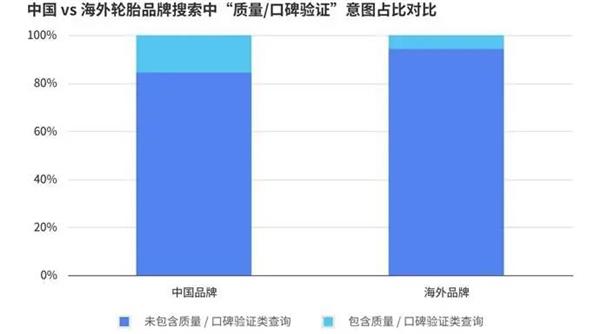
In brand-related searches, Chinese tire brands show a significantly higher proportion of verification-type searches.
In terms of caliber statistics, in brand searches involving "credibility verification" keywords such as good / review / reliable, the proportion corresponding to Chinese brands is 15.5%, significantly higher than the 5.6% for major overseas brands, with the former being approximately 2.8 times that of the latter.
This difference indicates that when U.S. consumers search for Chinese tire brands, their decision-making starts not with “Is it suitable for me?” but with “Is it trustworthy?”
The search structure already reflects a clear psychological hierarchy: Chinese brands are implicitly placed in the “to-be-verified” candidate pool, whereas established international brands are regarded as “market-validated” options.
Source uncertainty amplifies decision-making costs: "Who is the manufacturer?" becomes a frequently asked preliminary question.
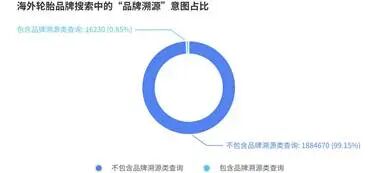
In addition to quality and reputation verification, Chinese brands incur higher “source explanation costs” in search.
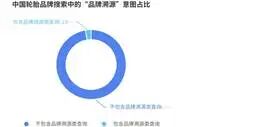
In brand-related searches, the proportion of queries involving origin-related keywords—such as “who manufactures it,” “who is the manufacturer,” or “is it under a particular group”—is 2.56% for Chinese brands, compared to only 0.85% for mainstream overseas brands, representing approximately three times the level.
This means that in the mindset of American consumers, Chinese tire brands have not yet established a stable, low-cost source of recognition, and additional searches are needed to compensate for information uncertainty.
This type of search is not directly a negative review, but it significantly lengthens the decision-making process and increases the psychological cost, thereby reducing the probability of entering the final comparison stage.
3) In the search references compared with Michelin, Chinese tire brands are almost absent.
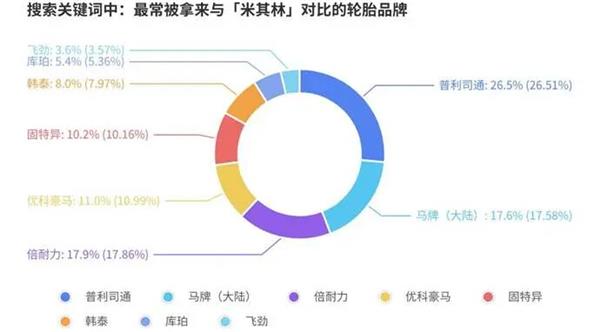
In the "brand + Michelin / vs Michelin" comparative search, the reference structure is highly concentrated and stable.
Brands frequently compared with Michelin are mainly international top-tier brands such as Bridgestone, Goodyear, and Pirelli; Chinese tire brands appear at an extremely low frequency in such searches, remaining virtually at the level of statistical noise.
This result indicates that Chinese brands have not yet entered the mainstream quality perception of American consumers.
Even though some Chinese brands have already achieved scale in terms of price or distribution channels, their perceived position remains in the pre-consideration zone of "whether they are worth considering," rather than in the core comparison zone of "who is better compared to whom."
4) Price-intent structure in brand terms: Not frequently subject to price comparison, but rather not yet entered the price-comparison stage.
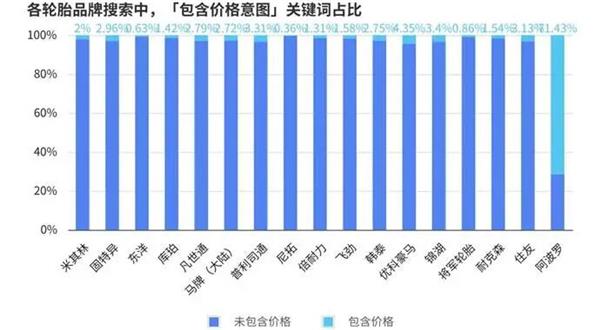
From the perspective of brand keyword searches containing price (price) intent, brand-oriented searches account for only 8.4% of the total tire searches, while non-brand-oriented searches account for as high as 91.6%.
More critically, in this limited brand price search, established international brands still dominate, while Chinese brands have not yet become primary objects of price comparison. This means that Chinese tire brands currently face not the issue of “excessive price-based scrutiny,” but rather the challenge of not yet having entered the candidate set where fine-grained price differences are even considered.
In consumers' minds, they are more at the stage of "whether it's reliable" rather than the stage of "whether it's worth the price".
【Copyright and Disclaimer】The above information is collected and organized by PlastMatch. The copyright belongs to the original author. This article is reprinted for the purpose of providing more information, and it does not imply that PlastMatch endorses the views expressed in the article or guarantees its accuracy. If there are any errors in the source attribution or if your legitimate rights have been infringed, please contact us, and we will promptly correct or remove the content. If other media, websites, or individuals use the aforementioned content, they must clearly indicate the original source and origin of the work and assume legal responsibility on their own.
Most Popular
-

Supply Extremely Tight! LG Chem Declares Force Majeure on Export Contracts for Di-Octyl Terephthalate (DOTP)
-
Huntsman Introduces “War Surcharge” Amid Shipping Disruption and Soaring Energy Costs, Global MDI Prices Continue to Rise
-

Middle East Tensions Escalate Sharply: How Polyolefins Respond Amid Soaring Risk Premium
-

Deadly Impact: Hormuz Strait Blockade Sparks Shortage of Plastic Raw Materials, Threatening Shutdowns at Japanese and Korean Chemical Plants
-

LG Chem Declares Force Majeure on DOTP Exports! SABIC Joins Five Giants to Redefine EV Safety


