PET Recycling Makes It to Nature Journal
With the increasing severity of the global plastic pollution crisis, polyethylene terephthalate (PET) and other polyester plastics, due to their extensive use and resistance to degradation, have become major sources of environmental burden. Nearly half of the world's plastic waste is landfilled, and about one fifth is incinerated, causing serious resource waste and environmental issues such as greenhouse gas emissions. Although mechanical recycling and chemical recycling (such as hydrolysis) are the main methods for treating PET waste plastic, they generally face challenges such as high energy consumption, low product separation efficiency, and limited value of downstream products. How to convert waste plastics into high-value products while reducing energy consumption and environmental footprint has become a core challenge in the field of circular economy.
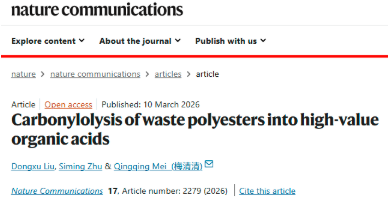
To address these challenges, Dr. Mei Qingqing’s research group at Zhejiang University has developed a novel one-pot strategy termed “carbonylolysis.” This approach integrates polyester depolymerization with in situ carbon-chain reconstruction, enabling the quantitative conversion of PET into high-value, higher-carbon (C3+) organic acids under relatively mild conditions (170 °C, 2 MPa CO). Using a rhodium–iodide catalyst, PET is converted nearly quantitatively into terephthalic acid (99% yield) and propionic acid (96% yield). Life cycle assessment and techno-economic analysis demonstrate that, compared with conventional recycling routes, this technology achieves significant improvements in energy efficiency, carbon footprint reduction, and wastewater minimization, establishing a sustainable new pathway for transforming waste polyesters into high-value carboxylic acids. The work is published in Nature Communications under the title “Carbonylolysis of waste polyesters into high-value organic acids.”
During the construction and optimization of the catalytic system, the research team systematically screened various metal catalysts, iodide additives, and solvents. Results showed that Rh³⁺ exhibited the highest catalytic activity, while methyl iodide (CH₃I) and hydroiodic acid (HI) proved to be the most effective iodine sources; hexafluoroisopropanol (HFIP) emerged as the optimal solvent owing to its excellent PET solubilizing capability and system compatibility (Figure 2). Through precise optimization of reaction parameters, the team established the optimal reaction conditions: complete PET depolymerization occurred under 2 MPa CO atmosphere at 170°C for 12 hours, achieving a 96% yield of propionic acid from ethylene glycol (EG). Kinetic studies revealed that EG concentration initially increased and then decreased during the early reaction stage, whereas propionic acid yield steadily rose, confirming the effective coupling of EG with CO.。
The research team further validated the robustness of this technology in processing real-world waste plastics. Whether it was beverage bottles, nonwoven fabrics, colored trays, or various textile blends (including cotton, spandex, etc.), the depolymerization and conversion efficiency of PET remained largely unaffected, with propionic acid yields maintained at 89–98% and terephthalic acid yields at 90–98% (Fig. 3a, 3b). More importantly, this strategy is broadly applicable to multiple polyester substrates, including poly(ethylene 2,5-furandicarboxylate) (PEF), poly(ethylene adipate) (PEA), and poly(butylene terephthalate) (PBT), with corresponding diacid or hydroxyacid yields all exceeding 90% (Fig. 3c), demonstrating exceptional substrate generality.
To elucidate the reaction mechanism, the team conducted in-depth kinetic decoupling studies and density functional theory (DFT) calculations (Figure 4). The study revealed that PET first undergoes hydrolysis to generate ethylene glycol (EG) and terephthalic acid; EG then undergoes double substitution under iodide ion catalysis to form 1,2-diiodoethane, followed by β-elimination to generate ethylene, which finally undergoes rhodium-catalyzed carbonylation with CO to yield propionic acid. DFT calculations indicate that the energy barrier for the β-elimination pathway (29.9 kcal/mol) is significantly lower than that for the direct oxidative addition pathway (40.8 kcal/mol), theoretically explaining the selective formation of propionic acid instead of 3-hydroxypropionic acid or succinic acid. In this tandem reaction mechanism, the carbon chain of EG is reconstructed via carbonyl insertion, achieving both high selectivity and atom economy.
Based on the understanding of the reaction mechanism, the team designed a complete process: first, solid terephthalic acid was recovered by pressurized filtration under a CO atmosphere, then the rhodium catalyst was recovered by atmospheric filtration, and finally, propionic acid was separated from the mother liquor by vacuum distillation (Fig. 5a). Life cycle assessment showed that the energy consumption of this process was reduced to 20.9 MJ/kg PET in Europe and 22.9 MJ/kg PET in China, with global warming potential values of 1.17 and 1.42 kg CO₂eq/kg PET, respectively, significantly better than the traditional hydrolysis process (51 MJ/kg PET, 4.47 kg CO₂eq/kg PET) (Fig. 5c). Techno-economic analysis showed that with an annual processing capacity of 100,000 tons of PET waste, this process could achieve an annual profit of 35.92 million US dollars (Fig. 5d), demonstrating promising prospects for industrial application.
The decoupling strategy for carbonylation proposed in this study, which integrates polymer depolymerization with precise carbon-chain reconstruction, not only establishes a new paradigm for the high-value utilization of waste polyesters but also effectively reduces reliance on fossil resources. Although challenges remain—particularly in developing non-precious metal catalysts and adapting the process to complex waste streams—this technology undoubtedly provides crucial theoretical foundations and practical pathways for circular carbon science and closed-loop plastic recycling, holding profound significance for global plastic pollution mitigation and climate goal achievement.
【Copyright and Disclaimer】The above information is collected and organized by PlastMatch. The copyright belongs to the original author. This article is reprinted for the purpose of providing more information, and it does not imply that PlastMatch endorses the views expressed in the article or guarantees its accuracy. If there are any errors in the source attribution or if your legitimate rights have been infringed, please contact us, and we will promptly correct or remove the content. If other media, websites, or individuals use the aforementioned content, they must clearly indicate the original source and origin of the work and assume legal responsibility on their own.
Most Popular
-
Supply Extremely Tight! LG Chem Declares Force Majeure on Export Contracts for Di-Octyl Terephthalate (DOTP)
-
Huntsman Introduces “War Surcharge” Amid Shipping Disruption and Soaring Energy Costs, Global MDI Prices Continue to Rise
-

Deadly Impact: Hormuz Strait Blockade Sparks Shortage of Plastic Raw Materials, Threatening Shutdowns at Japanese and Korean Chemical Plants
-

LG Chem Declares Force Majeure on DOTP Exports! SABIC Joins Five Giants to Redefine EV Safety
-

Tao Lin: Tesla’s Supercharger Stations in China Surpass 2,500