



Pcr promotion faces chill! efs executives call for policy + collaboration as key to breaking through in plastic recycling
The global plastic recycling industry is at a crossroads, facing multiple challenges including economic pressure, regulatory changes, and evolving market dynamics.
Recently, held in Cleveland, Ohio, USAAMI Plastics World ExpoHeadquartered in Canada, a plastic recycling and modification company.EFS PlasticsClosed-loop project and sales managerArjun KrishnanKrishnan delivered a keynote speech focusing on the current market applications of post-consumer recycled (PCR) resins. He emphasized that to maintain the momentum of the plastic recycling industry, it is urgent to collaborate across multiple sectors, improve green regulatory policies, and formulate innovative development strategies.
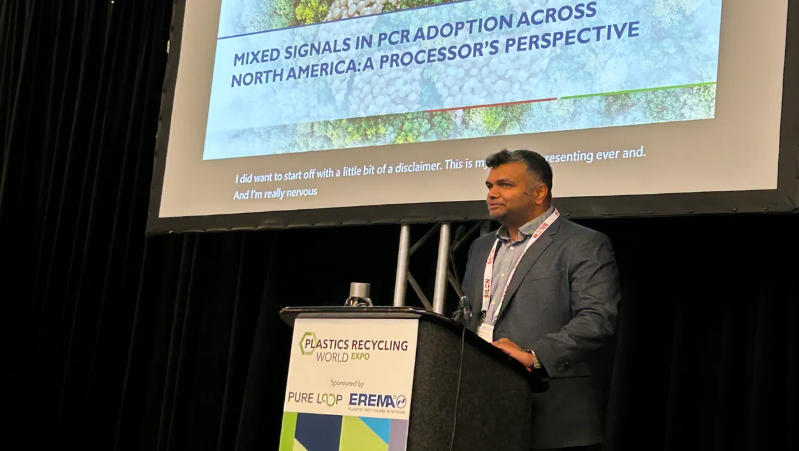
"Plastic recycling is not merely a sustainable development initiative, but also a means to build a circular economy system that benefits all parties," said Krishnan. "To achieve this goal, we must remove the economic and regulatory barriers hindering the industry's development."
EFS Plastics, as a company 100% focused on post-consumer plastic recycling, has three production facilities in North America: two located in Canada (Ontario and Alberta) and one in the United States (Pennsylvania). The company has an annual processing capacity of 150 million pounds, specializing in the recycling of rigid plastics and soft plastic films collected from residential communities and commercial channels.
"Our core business is entirely focused on post-consumer plastics," Krishnan explained, "and does not involve the recycling of post-industrial plastics. This allows us to concentrate on creating high-quality PCR resins for the non-food packaging and durable goods sectors."
EFS Plastics has achieved vertical integration by owning the custom injection molding factory Execlast and the subsidiary AFS Equipment, which is responsible for equipment design and maintenance. This vertical integration model helps EFS Plastics improve the quality of resin products, expand its product line, and launch custom-colored and custom-modified resin products.
Challenges in Promoting the Application of PCR Resin
Krishnan emphasized several key challenges currently facing the industry, including the price difference between PCR resin and virgin resin. He pointed out, "Virgin resin prices are at historic lows, making PCR resin economically unattractive for many processors."
He also mentioned that the green regulation policy framework in North America is still not well-developed. Green regulation policies refer to a mechanism where brands are required to pay corresponding fees based on the recyclability of their packaging, and this system is still in its infancy in North America.
"Although Quebec has implemented green regulatory policies, the incentives are minimal," Krishnan stated. "We need to establish a more comprehensive policy framework, such as the UK's plastic packaging tax, which penalizes manufacturers for not using recycled materials."
Another major obstacle facing the industry is the fragmentation of the supply chain. Many recycling companies rely on the spot market to purchase raw materials rather than signing long-term contracts, resulting in extremely unstable raw material supplies. Krishnan explained, "The Extended Producer Responsibility (EPR) system can effectively solve this problem by signing long-term raw material supply agreements, providing recycling companies with stable raw material assurance."
Market Sentiment and Sustainable Development Goals
The speech also mentioned the market's ambivalent attitude towards the promotion and application of PCR resin. Although sustainability remains a core strategy for many brands, under the dual impact of economic pressure and missed targets, companies' sustainability measures are shifting from "PR-oriented" to "investment return-oriented."
"Many large corporations have withdrawn from the U.S. Plastics Pact and have failed to meet their PCR resin usage targets," Krishnan stated. "Nowadays, companies' sustainability strategies focus more on projects that can generate quantifiable benefits."
Despite numerous challenges, Krishnan remains optimistic.
He stated, "We have experienced market adjustments similar to those during the COVID-19 pandemic, and the plastic recycling industry always finds a way to transform and thrive against the odds."
Solutions for Building a Sustainable Future
Krishnan proposed several feasible plans to promote the popularization of PCR resin, specifically including:
Tax regulation mechanismImpose fines on non-compliant companies by emulating the UK's plastic packaging tax.
Improve green regulation policiesImplement a differentiated pricing mechanism to enhance the incentive for using recycled materials.
Sign a long-term supply contractSign stable supply agreements based on the price benchmarks of PCR resin and virgin resin.
Furthermore, Krishnan also suggested that the industry broaden its development focus, shifting attention from the food-grade packaging sector to the field of durable consumer goods and material handling products with high PCR content.
"We need to assist brands in creating a circular economy narrative aimed at consumers," Krishnan stated, "Consumers are still concerned about sustainability, but product prices and supply stability are often key factors influencing their purchasing decisions."
Future Development Direction
Looking ahead, Krishnan predicts that the prices of virgin resin will continue to remain low in the short term, which will force recycling companies to focus their target customers on niche brands that value sustainability. In the medium term, he believes that the Producer Responsibility Extension System (EPR) will gradually improve and mature, stabilizing the supply of raw materials and narrowing the price gap between virgin resin and PCR resin.
"Recycling companies with solid partners will lead in product quality and supply stability," Krishnan stated. "The future of the plastic recycling industry depends on the collaboration among processing companies, brand owners, and policymakers."
At the end of his speech, he made an appeal, emphasizing that the momentum for sustainable development in the industry needs to be maintained through fair incentive mechanisms and the trust of all market parties.
He stated, "We should join hands with partners who do not view recycled resin as a cost burden, but rather as a core component of their strategic approach."
Transformation Opportunities in the Plastic Recycling Industry
Despite the economic and regulatory challenges affecting the plastic recycling boom in North America, which has now entered a transitional adjustment period, Krishnan remains confident about the industry's prospects.
He stated, "This is not the end of the plastic recycling boom, but rather a new opportunity for the industry to achieve transformation and upgrading through innovation, collaboration, and sustainable development concepts."
【Copyright and Disclaimer】This article is the property of PlastMatch. For business cooperation, media interviews, article reprints, or suggestions, please call the PlastMatch customer service hotline at +86-18030158354 or via email at service@zhuansushijie.com. The information and data provided by PlastMatch are for reference only and do not constitute direct advice for client decision-making. Any decisions made by clients based on such information and data, and all resulting direct or indirect losses and legal consequences, shall be borne by the clients themselves and are unrelated to PlastMatch. Unauthorized reprinting is strictly prohibited.
Most Popular
-

Key Players: The 10 Most Critical Publicly Listed Companies in Solid-State Battery Raw Materials
-

Vioneo Abandons €1.5 Billion Antwerp Project, First Commercial Green Polyolefin Plant Relocates to China
-
EU Changes ELV Regulation Again: Recycled Plastic Content Dispute and Exclusion of Bio-Based Plastics
-

Clariant's CATOFIN™ Catalyst and CLARITY™ Platform Drive Dual-Engine Performance
-

List Released! Mexico Announces 50% Tariff On 1,371 China Product Categories

