



【Overseas news】Hormuz Strait Navigation Drops to Zero; Asian PP Surges $330 Per Ton Weekly; Arburg Suspends U.S. Expansion
International News Highlights:
Raw Material News - IEA Discloses Details of Oil Stock Release: 400 Million Barrels of Oil to Enter the Market, with Asia-Pacific Member Countries Already in Action
Automotive News - BASF, another high-end TPU project put into operation, focusing on robotics and charging cable for new energy vehicles
Packaging News - Turkey Plans to Phase Out Single-Use Plastic Products
Equipment News – German machinery manufacturer Arburg suspends its U.S. expansion plan and focuses on the Chinese market.
Unit Dynamic - 1400,000 tons/year! Two ethylene units permanently closed
Macro News -UK media: Number of vessels passing through the Strait of Hormuz drops to zero for the first time
Price InformationThe Chinese yuan fell to a 6.9057 exchange rate against the US dollar, the lowest since March 9.
International News Details:
1. IEA discloses details of oil reserve release: 400 million barrels of oil will flow into the market. Asian member countries have already taken action.
On Sunday local time, the International Energy Agency (IEA) unveiled detailed information about its oil reserve release plan, stating that it will soon supply over 400 million barrels of oil from its emergency reserves to stabilize international oil prices.

The International Energy Agency said that its Asian and Oceania member countries will immediately provide reserve energy, while oil stockpile releases in Europe and the Americas will begin at the end of March. This is the latest detail released four days after the IEA announced its plan to release oil reserves last week.
On Monday morning, the Japanese government announced that it would begin releasing oil reserves from the 16th. The total release amounts to about 80 million barrels, equivalent to 45 days of oil supply for the country, and is the largest release since the establishment of Japan's national oil reserve system in 1978.
According to the IEA statement, in its oil release plan, 271.7 million barrels of oil came from government reserves of member countries, 116.6 million barrels of oil from industry reserves under obligation, and another 23.6 million barrels of oil from other sources.
2. Middle East conflict triggers a global surge in polypropylene (PP) prices, with Asia seeing the largest increase!
According to data from Platts, a division of S&P Global Energy, global polypropylene (PP) prices have risen across the board since the start of March, driven by the outbreak of hostilities in the Middle East.
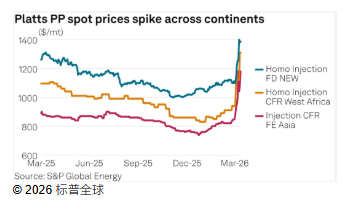
According to Platts data, polypropylene (PP) homopolymer injection-grade prices in Europe have risen by €220 per metric ton since early March, with the delivered duty-unpaid spot price in Northwest Europe standing at €1,200 per metric ton on March 13.
In the African market, the Platts-assessed North Africa PP raffia grade cost and freight (CFR) spot price on March 11 was $1,290/mt, up $190/mt on the week, marking the largest single-week increase since the price assessment was launched on March 17, 2021. Additionally, Platts data showed that the raffia grade CFR price in West Africa has risen by 39% since the outbreak of the conflict.
The Asian market saw the most significant gains. Platts assessed the Far East Asian PP injection molding grade CFR spot price at 1180 USD/tonne, an increase of 330 USD/tonne from March 2nd.
The price increase was driven by multiple shocks resulting from the conflict in the Middle East, including a tightening of supply due to suppliers in the region suspending offers, and rising raw material and energy costs, which in turn led to some producers in Asia and Europe halting PP production.
Propylene supply interrupted, one factory shut down! Manali Petrochemical Company's production of epoxy propane and other products affected.
Manali Petrochemicals Ltd. announced that its Unit-1 plant located in Manali, Chennai, will be temporarily shut down due to an abrupt interruption in propylene supply from Chennai Petroleum Corporation Ltd. (CPCL). According to documents submitted by Manali Petrochemicals Ltd. to the stock exchanges, the shutdown took effect from March 12, 2026. This propylene supply disruption stems from a revised directive issued by the Ministry of Petroleum and Natural Gas (MoPNG) on March 9, 2026, mandating that all crude oil processed at CPCL’s refinery be exclusively allocated for liquefied petroleum gas (LPG) production, to ensure national energy security and domestic fuel supply.
4, 1.4 million tons/year! Two ethylene plants permanently closed
According to the Korean Economic Daily, Yeochun NCC (YNCC), a South Korean ethylene producer, has decided to permanently shut down its No. 2 and No. 3 naphtha cracking units located in Yeosu, South Korea, which will reduce the company's ethylene production by 60%.
YNCC has already submitted its restructuring plan to the South Korean government on March 6, which includes shutdowns.Lishui factoryWith the two plants having annual production capacities of 900,000 tons and 500,000 tons respectively, YNCC's annual ethylene production capacity will decrease from 2.3 million tons to about 900,000 tons.
YNCC plans to establish a joint venture with Lotte Chemical at its Yeosu plant by the end of this year. In the joint venture, YNCC’s existing shareholders—Hanwha Solutions Corporation and DL Chemical—along with Lotte, are each expected to hold one-third of the shares.
The report states that this restructuring, along with the previous integration of Daesan Industrial Complex, marks a significant advancement in the reorganization of South Korea's petrochemical industry.
The South Korean government aims for a voluntary reduction of 2.7 to 3.7 million tons per year in ethylene production capacity, with the current total capacity standing at approximately 14.7 million tons per year. Lotte recently agreed to shut down a 1.1-million-ton-per-year steam cracker unit at its Dae-san plant.
5. Turkey plans to phase out single-use plastic products
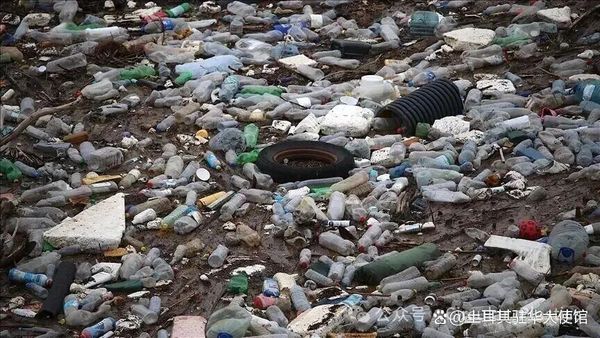
According to the Embassy of Turkey in China, Turkey has decided to phase out single-use plastic products in accordance with relevant EU regulations to further advance environmental protection. The Turkish Ministry of Environment, Urbanization and Climate Change is finalizing a new regulation based on the EU’s 2019 Single-Use Plastics Directive (SUPD), which aims to prevent and mitigate the environmental and human health impacts of specific plastic products. This ban will prohibit common single-use items such as plastic cutlery (knives, forks, spoons, and chopsticks), plastic plates, straws, and plastic-stemmed cotton buds, with the goal of significantly reducing plastic pollution.
The regulation is currently in the draft stage and, after consultations with industry representatives and non-governmental organizations, is expected to come into effect by the end of the year. The policy encourages the shift towards using environmentally sustainable alternatives such as glass, ceramics, wood, and cardboard. The department estimates that this move could reduce carbon emissions by 1.5 million tons annually and save about $44 million in waste disposal costs. In the subsequent phase of the plan, stricter labeling requirements and consumption control targets will be implemented for composite beverage cups, food containers, wet wipes, and various types of transport plastic bags.
6. BASF: Another high-end TPU project commences production, focusing on robot and new-energy vehicle charging pile cables.
Recently, BASF's Shanghai thermoplastic polyurethane (TPU) production facility has obtained the production qualification for Elastollan® FR TPU and can now supply the full range of flame-retardant solutions, including Elastollan® FHF and Elastollan® FR grades.
BASF's TPU production facility in Shanghai has successfully achieved localized supply of a range of Elastollan® FHF product specifications in 2023. The official mass production of the flame-retardant Elastollan® FR product in Shanghai now offers customers materials with improved flame resistance and adapted to more demanding application conditions.
Meanwhile, with the localization of FHF and FR product specifications, BASF’s Shanghai TPU plant is now able to offer a complete portfolio of flame-retardant TPU products to the Asia-Pacific market, supporting key cable application customers in three high-growth sectors—industrial automation, robotics, and new-energy vehicle (NEV) charging stations—to comply effectively with local regulatory requirements and respond with greater flexibility and reliability to diverse, specialized local flame-retardancy needs.
7. German machinery manufacturer Arburg has put its U.S. expansion plans on hold and is prioritizing investment in the Chinese market.
German machinery manufacturer Arburg GmbH + Co. KG has announced that, due to economic uncertainty and fluctuations in the trade environment, it has decided to delay its production expansion plans in the United States. The company's CEO, Volker Nilles, stated that the company will prioritize necessary capacity expansion and equipment upgrades, and closely monitor market developments.
While postponing the expansion of its U.S. production, Arburg continues to advance its long-term internationalization strategy, adhering to the “local-to-local” development model. Nilles emphasized that, given the unique demands of the Chinese market, China remains a key focus area for the company’s assembly operations.

8. Evonik launches a toughened modified polyamide 6 material suitable for rotomolding tank linings.
Overseas Macroeconomic Market
The Israel Defense Forces (IDF) stated on March 16 that its 91st Division has recently launched a "limited and targeted" ground operation against key Hezbollah positions in southern Lebanon. The statement said the operation involved destroying Hezbollah infrastructure and "eliminating terrorists operating in the area," aiming to establish and strengthen forward defenses to ensure the security of residents in northern Israel.
On March 15, Iranian Foreign Minister Alaghazadeh, in an interview with CBS's "Face the Nation" program, responded to questions about "Iran's attacks on civilian facilities in Gulf countries." Alaghazadeh emphasized that Iran "targets only American assets, facilities, and military bases," and that U.S. forces are using the land of these countries to attack Iran. When asked about the four Americans detained by Iran, Alaghazadeh said that if the U.S. and Israel do not attack Iran's prisons, they will be safe.
President Trump said, "After solving Iran, the next one is Cuba." U.S. President Trump said on the 15th that the U.S. might quickly reach an agreement with Cuba or take other actions. "Cuba also wants to reach an agreement, and I think both sides will quickly reach an agreement or do what we must do," Trump said during an interview with media on Air Force One. "We are talking with Cuba, but we will deal with Iran first, then Cuba." Cuban President Diaz-Canel said last week that Cuban officials have recently held talks with U.S. government representatives.
[UK Media: Number of Vessels Passing Through Strait of Hormuz Drops to Zero for the First Time] The UK's Daily Telegraph reported on the 16th that no ships passed through the Strait of Hormuz, a global energy shipping chokepoint, on the 14th. This is the first time since the U.S. and Israel launched military operations against Iran. The report, citing data from maritime analytics service Windward, wrote: "On the 14th, the number of vessels passing through the Strait of Hormuz dropped to zero for the first time since the conflict began. Before the war, an average of 77 ships passed through the strait daily."
National Bureau of Statistics: February commodity residential housing Prices of new commercial housing in first-tier cities declined by 2.2% year-on-year in February, with the decline widening by 0.1 percentage point from the previous month. Among them, Shanghai saw an increase of 4.2%, while Beijing, Guangzhou, and Shenzhen recorded declines of 2.3%, 5.1%, and 5.5%, respectively. Prices in second- and third-tier cities fell by 3.1% and 4.0% year-on-year, with the declines widening by 0.2 and 0.1 percentage points, respectively.
A Japanese public opinion poll conducted on March 14–15 revealed that 82% of respondents opposed U.S. military strikes against Iran, while only 9% supported such action. Regarding Prime Minister Sanae Takaichi’s failure to state whether the military operation is legally problematic, 51% of respondents expressed disapproval, surpassing the 34% who approved.
Price Information:
Upstream Raw Material USD Market Price
On March 13, the CFR Northeast Asia ethylene price was $1,150/ton, up by $150/ton, and the CFR Southeast Asia ethylene price was $1,150/ton, up by $180/ton.
The FOB Korea average price of propylene in Northeast Asia rose to 1110 USD/ton, up 40 USD/ton. The CFR China average price rose to 1125 USD/ton, up 55 USD/ton.
North Asia CFR prices: propane at $885–891/ton; butane at $885–891/ton.
China South China frozen cargo arrival price in early April: propane at USD 940–950 per ton; butane at USD 935–945 per ton.
Taiwan region's CIF price for frozen goods, propane 885-891 USD/ton; butane 885-891 USD/ton.
[LLDPE USD market price]
Film: USD 1,300 per metric ton (CFR Huangpu)
Injection molding: USD 1,450 per metric ton (CFR Dongguan);
Hollow: USD 1,250 per metric ton (CFR Huangpu)
Coating: No quotation.
【Copyright and Disclaimer】This article is the property of PlastMatch. For business cooperation, media interviews, article reprints, or suggestions, please call the PlastMatch customer service hotline at +86-18030158354 or via email at service@zhuansushijie.com. The information and data provided by PlastMatch are for reference only and do not constitute direct advice for client decision-making. Any decisions made by clients based on such information and data, and all resulting direct or indirect losses and legal consequences, shall be borne by the clients themselves and are unrelated to PlastMatch. Unauthorized reprinting is strictly prohibited.
Most Popular
-
Supply Extremely Tight! LG Chem Declares Force Majeure on Export Contracts for Di-Octyl Terephthalate (DOTP)
-
Deadly Impact: Hormuz Strait Blockade Sparks Shortage of Plastic Raw Materials, Threatening Shutdowns at Japanese and Korean Chemical Plants
-
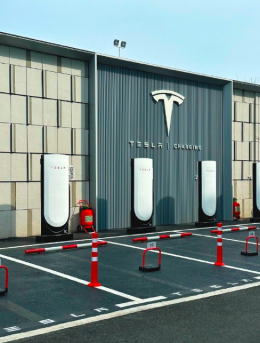
Tao Lin: Tesla’s Supercharger Stations in China Surpass 2,500
-
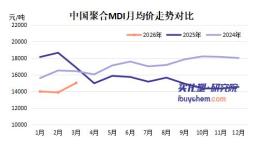
Huntsman Introduces “War Surcharge” Amid Shipping Disruption and Soaring Energy Costs, Global MDI Prices Continue to Rise
-
Catl “wins big”: Beyond Batteries, What Else Can It Sell?


