Mdi tariff slashed from 511% to 85%—can wanhua reenter u.s. market?
On April 8, 2026, the U.S. Department of Commerce officially announced the final ruling of the anti-dumping case on Chinese methylene diphenyl diisocyanate (MDI), which modifies the preliminary ruling.376.12% to 511.75% antidumping rates were significantly reduced, with the tariff for leading companies such as Wanhua Chemical and Covestro China set at 85.11%.Other Chinese enterprises shall apply the same regulations.159.04%The involved products correspond to U.S. tariff classification numbers 2929.10.8010 and 3909.31.0000.
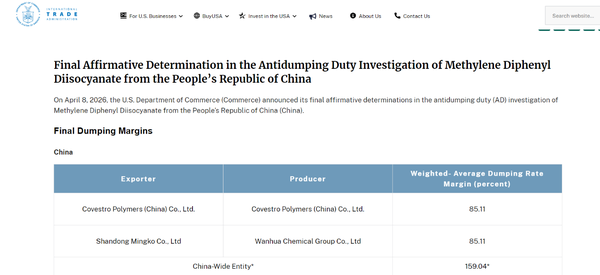
Image source: U.S. Department of Commerce
Although the final ruling did not overturn the dumping determination, the reduction in the tariff rate by more than 350 percentage points has provided a breathing space for China's MDI industry, which has been mired in trade gloom. Plastics Vision will review the event, analyze the value and competitive landscape of the MDI industry, and assess the short-term impact and long-term strategic implications for leaders such as Wanhua, providing a reference for professionals in the plastics industry.
I. Final Ruling Implemented: From a 511% Sky-High Tariff to 85%—What Exactly Happened?
This final determination is a critical milestone in the U.S. trade remedy investigation on Chinese MDI, marking the transition of the 14-month investigation into the implementation phase, with tariff adjustments directly rewriting expectations for U.S.-China MDI trade.
(1) Review the complete process from case initiation to final arbitration
Case InitiationOn February 12, 2025, the U.S. Department of Commerce and the U.S. International Trade Commission (USITC) simultaneously initiated antidumping and countervailing duty investigations upon application by the U.S. MDI Fair Trade Coalition, led by BASF and Dow. The applicants estimated the dumping margins.305.81%—507.13%It directly points to the low-price impact of Chinese products on the U.S. market.
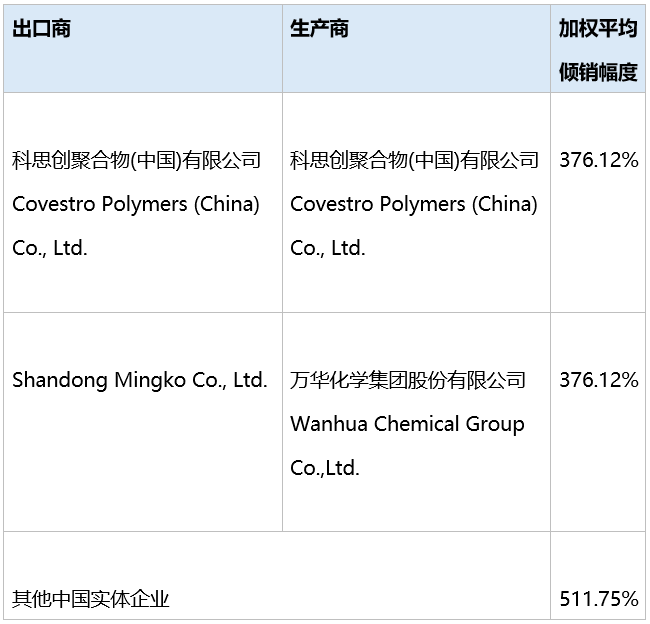
Preliminary determination pressureSeptember 11, 2025, the U.S. Department of Commerce preliminarily ruled to impose high dumping margins, applying to Wanhua and Covestro China.376.12%, other Chinese enterprises511.75%The U.S. customs collects cash deposit according to this tariff rate, and China's exports to the U.S. are immediately frozen.
Process delayDue to the impact of the U.S. federal government shutdown, the final ruling originally scheduled for January 23, 2026, has been postponed to April 8, and the hearing has been rescheduled to April 2. During this period, market uncertainty continues to suppress corporate export decisions.
Final ruling takes effectApril 8, 2026, the final tariff rate was significantly reduced, with leading enterprises dropping to.85.11%Other enterprises159.04%The dumping determination was upheld, but the tax burden was significantly alleviated, and market expectations are gradually recovering.
(2) Tax Rate Adjustment: Uncertainty Resolved but Tax Burden Remains High
The core value of the final ruling isEliminate extreme tax rate risksAvoiding the complete exclusion of Chinese MDI from the US market. Coupled with the existing US tariff system (basic tariff of 6.5% + Section 301 tariff of 25% + an additional 10% tariff), the overall tariff burden on Chinese MDI exports to the US remains above 30%.126%, there is still a noticeable tariff premium compared to competitors such as South Korea and Germany.
Data shows that the United States was once the largest export market for China'sMDI, accounting for 2024 of China's total export volume. It seems there might have been a typo in the provided text. Assuming "2024" should be a percentage or a specific volume, the corrected translation would be: Data shows that the United States was once the largest export market for China'sMDI, accounting for 20.24% of China's total export volume. However, if "MDI" is a specific product name or abbreviation, it's typically left untranslated in English. Thus, the translation would be: Data shows that the United States was once the largest export market for China'sMDI, accounting for 20.24% of China's total export volume. Please confirm the exact meaning of "2024" and "MDI" for a more accurate translation.22.26%; Hit by investigations, China's exports to the U.S. plummeted sharply in January–October 2025.82.6%, the scale of exports has nearly halved. After the final ruling, the tariff rate has been reduced from a "ban-level" to a "pressure-level," providing room for companies to reassess their trade strategies with the U.S., but it is difficult to recover to the pre-adjustment level in the short term.Pre-test level.
II. Why is MDI the “hard currency” of the chemical industry, and who holds the global authority?
MDI is categorized into polymeric MDI and pure MDI based on whether it contains modified additives. In industrial production, about 30% pure MDI and 70% polymeric MDI are obtained from crude MDI after processing. Polymeric MDI is used for insulation in refrigerators and freezers, energy-saving building panels, adhesives, and lightweight automotive components. Pure MDI is mainly used for synthetic leather, spandex, and high-performance elastomers, serving as a key raw material in the textile and high-end manufacturing industries.
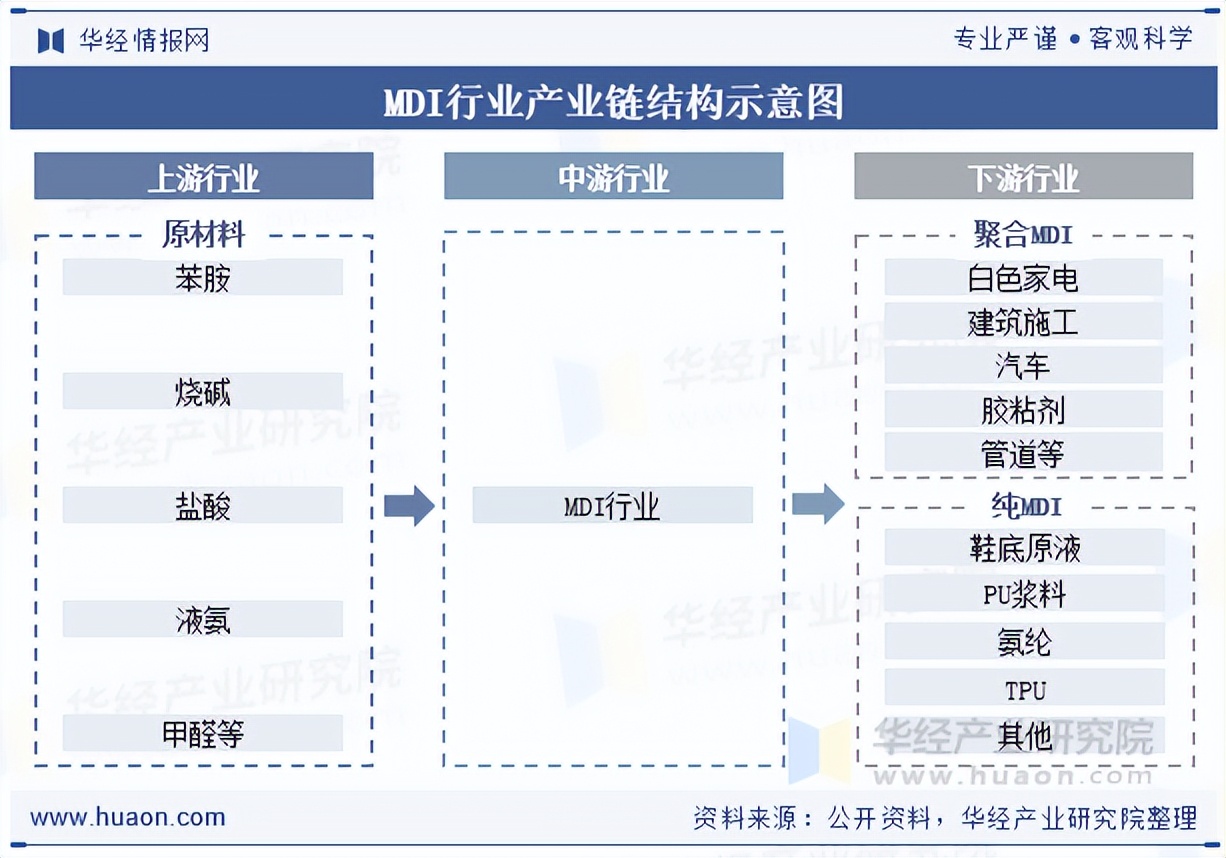
Source: Huajing Industry Institute
The MDI industry exists.Technology, capital, environment, safetyFour high barriers to entry; only five companies worldwideWanhua Chemical, BASF, Covestro, Dow, HuntsmanMaster large-scale production processes, forming a highly monopolized market structure.
China was once the largest source of MDI imports for the United States.From 2021 to 2024, Chinese-origin goods accounted for 50%–60% of U.S. imports of polymeric MDI., reaching a peak in 202372.7%, 2024 is still53.4%This is also the core cause of the current trade dispute—competitors are using trade protectionism to squeeze China's market share and reshape the global supply chain landscape.
III. Leading players like Wanhua face short-term pressures, but this will drive long-term globalization upgrades.
In this anti-dumping case, Wanhua Chemical, as the global MDI leader, is the central entity involved, and the final ruling will have limited short-term impact but profound long-term strategic implications for the company and the industry.

Image source: Wanhua Chemical
From a long-term perspective, this anti-dumping case will profoundly promote the comprehensive upgrading of Wanhua Chemical's global strategy, competitive model, and risk control system. In terms of global production layout, Wanhua has already established four production bases in Yantai, Ningbo, Fujian, and Hungary, and will further accelerate its pace in the future.Localization of overseas production capacityBy leveraging Hungary and other overseas bases, the company circumvents regional trade barriers and fundamentally reduces its dependence on any single market; simultaneously, it accelerates expansion into alternative markets—including Europe, Southeast Asia, and the Middle East—to achieve a diversified global sales network and effectively mitigate geopolitical risks. In terms of its core competitive model, the company will completely abandon the traditional “cost-plus-scale” growth path and shift toward…Technology, Value, and Supply ChainEnhance overall competitiveness, increase R&D investment in high-value-added products such as high-end MDI and modified MDI, to break away from the label of low-price competition; simultaneously, perfect the international trade compliance system, and continuously improve the professional response capability to trade frictions such as anti-dumping and countervailing duties.
As the U.S. market share declines, the global MDI trade flow is rapidly restructuring. Wanhua will lead the shift of China’s MDI industry focus toward emerging markets such as the Asia-Pacific region, the Middle East, and Latin America. This transition will also drive industry consolidation and accelerate the elimination of outdated, small-scale production capacity, thereby further consolidating Wanhua’s position as a global leader.
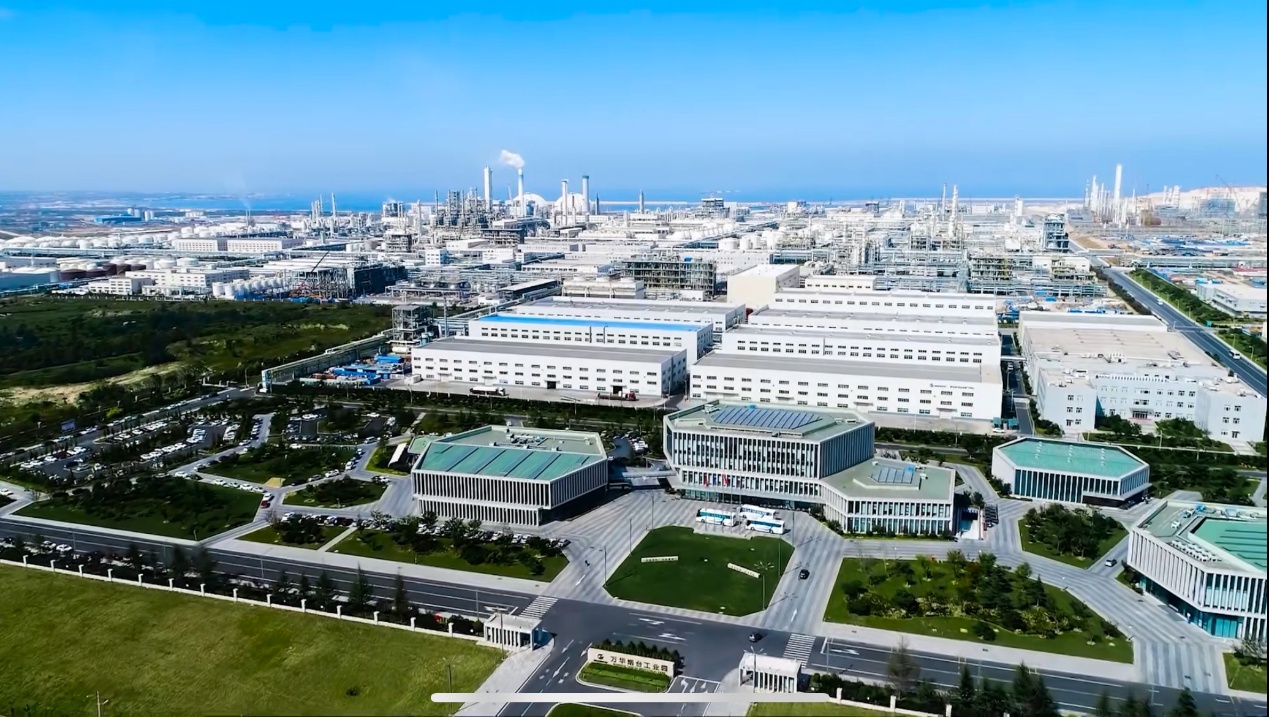
Image source: Wanhua Chemical
It is noteworthy that during the anti-dumping investigation,BASF Korea, Kumho Mitsui Chemicals, and Covestro EuropeAs companies rapidly expand their exports to the U.S., filling the market gap left by Chinese companies, these companies, without the pressure of additional tariffs, see their cost advantages become more prominent. In the short term, they will become the main suppliers in the U.S. market, and in the long term, this may solidify the supply chain structure, increasing the difficulty for Chinese companies to return.
IV. Conclusion: With trade protectionism inevitable, what path should China's MDI industry take?
The final ruling of the US anti-dumping investigation on Chinese MDI is a microcosm of the global chemical industry chain game and trade protectionism. The tariff rate is from511.75% decreased to 85.11%The essence is a balance between industrial dependency and trade protection by the US side—suppressing Chinese companies with high tariffs while avoiding completely cutting off supplies, which would lead to a loss of control over costs for downstream US industries.
For China's MDI industry, this incident isChallenges are also opportunities for transformation.
From an industrial perspective, MDI, as a strategic material with inelastic demand, is unlikely to experience long-term distortion of its global supply-demand balance due to trade barriers. As the world’s largest MDI producer, China accounts for over [X]% of global capacity.40%With a well-established industrial chain, independent and controllable technology, and irreplaceable core competitiveness, short-term trade frictions will only alter trade flows and cannot reverse the global advantages of China's MDI industry.
In the future, Chinese MDI companies need to adhere to three major directions: one isGlobal Capacity LayoutImplement localized production to avoid tariffs; secondly,Technological Innovation Driven, increasing the proportion of high-value-added products; thirdlyCompliance Capability BuildingBuild a regular system for responding to trade frictions. Only in this way can we steadily advance in the changing global trade landscape, and move from a "major producer of production capacity" to a "strong industrial power."
This final ruling marks a new phase in the trade dispute over MDI from China. The reduction in tariffs sends a positive signal, but high tariffs remain. Chinese enterprises need to stay vigilant, adopt a long-term perspective to cope with short-term fluctuations, find a new balance in globalization and compliance, and promote high-quality industrial development.
Editor: Lily
【Copyright and Disclaimer】This article is the property of PlastMatch. For business cooperation, media interviews, article reprints, or suggestions, please call the PlastMatch customer service hotline at +86-18030158354 or via email at service@zhuansushijie.com. The information and data provided by PlastMatch are for reference only and do not constitute direct advice for client decision-making. Any decisions made by clients based on such information and data, and all resulting direct or indirect losses and legal consequences, shall be borne by the clients themselves and are unrelated to PlastMatch. Unauthorized reprinting is strictly prohibited.
Most Popular
-

Raw Material Supply Shortage! INEOS Phenol Declares Force Majeure on Phenol and Acetone Businesses
-
Lantiche Group To Shut Down Italian Adipic Acid Production Plant
-

Resin Market Trends Diverge: Buyers' Bargaining Advantage Hit by Geopolitical Uncertainty
-
AI Computing Power Demand Ignites Electronic Fabrics! China Jushi Hits Limit Up! Domestic Substitution Welcomes Golden Window
-
Strait of Hormuz Blocked Again, Supply-Demand Mismatch in Polyolefin Market Set to Intensify!