



Large amounts of automotive materials added to restricted and prohibited list, auto manufacturers face comprehensive compliance challenges for exports to the eu
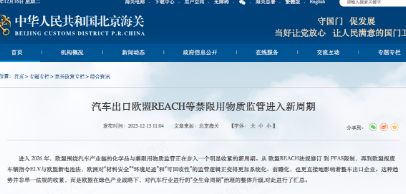
Recently, Beijing Customs announced that the European Union is its regulations on chemicals and restricted substances in the automotive supply chain. From the revision of the REACH (Registration, Evaluation, Authorisation and Restriction of Chemicals) regulation to the countdown for the comprehensive restriction of PFAS (per- and polyfluoroalkyl substances), as well as the advancement of the EU End-of-Life Vehicles Directive (ELA) and the new Battery Regulation, the EU is systematically enhancing requirements for automotive material safety, environmental footprint, and recyclability based on the principle of "full lifecycle" governance.
The new material regulations present three major changes: First, regulation has shifted from individual restrictions to "substance family-level" regulation, such as the full-category restriction on PFAS (per- and polyfluoroalkyl substances). Second, material prohibitions and recycling standards have been incorporated into a unified framework. Third, compliance focus has shifted from "product limit values" to the environmental impact of the "entire vehicle material system" and the "transparency of the entire supply chain." Overall, the impact of these regulations is no longer limited to "interior or certain plastic parts," but will cover major automotive components such as power batteries, electronic control systems, and interior and exterior textiles.
Since 2023, the European Union has been continuously upgrading its environmental regulations for automobiles. This year, the list of restricted substances has rapidly expanded. The latest batch was announced on November 18, with the European Chemicals Agency recommending the inclusion of four high-risk substances, including barium metaborate and melamine, in the restricted list. This move is expected to have a direct impact on the automotive manufacturing industry, as these four materials are widely used as rust and corrosion-resistant coatings, flame retardants, engine lubricants, interior encapsulation coatings, and foam additives for car seats.
The most concerning issue is the EU's restrictions on the PFAS (per- and polyfluoroalkyl substances) family. Although these substances are typical persistent organic pollutants, they are often used in automotive sealing materials, key battery components, and core automotive parts such as airbags and brake sensors due to their excellent chemical stability and other characteristics. Although the use of environmentally friendly and non-toxic materials in the domestic automotive sector has been steadily increasing in recent years, if the EU finalizes comprehensive restrictions on PFAS, many key components will still need to have their material systems revalidated and undergo process adjustments. In August 2025, the European Chemicals Agency released a proposal for PFAS restrictions, which has not yet become formal legislation. However, restrictions on its use in firefighting foam have already come into effect this October.
Environmental protection, efficiency, and safety are inevitable directions for the automotive industry. Nowadays, this transition is accelerating, presenting both challenges and opportunities for the Chinese automotive sector. Overall, the industry will face pressure due to insufficient supply chain transparency and the reshaping of alternative technology routes, with smaller suppliers particularly at risk of being eliminated. However, companies that complete material compliance ahead of schedule are expected to enter the European mainstream market more quickly; especially, battery companies that lead in material innovation will gain an advantage in international competition.
Experts remind that automotive companies exporting to the EU must accelerate material substitution and establish a transparent and traceable supply chain material management system to systematically comply with the new thresholds for green trade. In fact, over the past year, various domestic ministries and industry departments have been strengthening the regulatory oversight of material compliance and have repeatedly warned about export compliance risks. In April of this year, domestic automotive industry organizations also held discussions and solicited proposals regarding PFAS substitution technologies.
【Copyright and Disclaimer】The above information is collected and organized by PlastMatch. The copyright belongs to the original author. This article is reprinted for the purpose of providing more information, and it does not imply that PlastMatch endorses the views expressed in the article or guarantees its accuracy. If there are any errors in the source attribution or if your legitimate rights have been infringed, please contact us, and we will promptly correct or remove the content. If other media, websites, or individuals use the aforementioned content, they must clearly indicate the original source and origin of the work and assume legal responsibility on their own.
Most Popular
-

Layoffs, Divestments, Plant Closures While Pouring Billions: BASF Undergoes Major Transformation!
-
Ascend Adipic Acid Hit By Force Majeure, Market Expects Supply Resumption In Mid-September
-

Raw Material Supply Shortage! INEOS Phenol Declares Force Majeure on Phenol and Acetone Businesses
-
South Korea initiates anti-dumping investigation against Chinese PVC suspension resin! The target is Tianjin Bohua and Wanhua Chemical. How to break through?
-

Sixth national procurement set to be implemented: A “Reshuffling” Moment for the $10-Billion Medical Device Market


