



International Oil Prices Plunge, Gain Recovers to 13 Percent, Silver Surges Higher
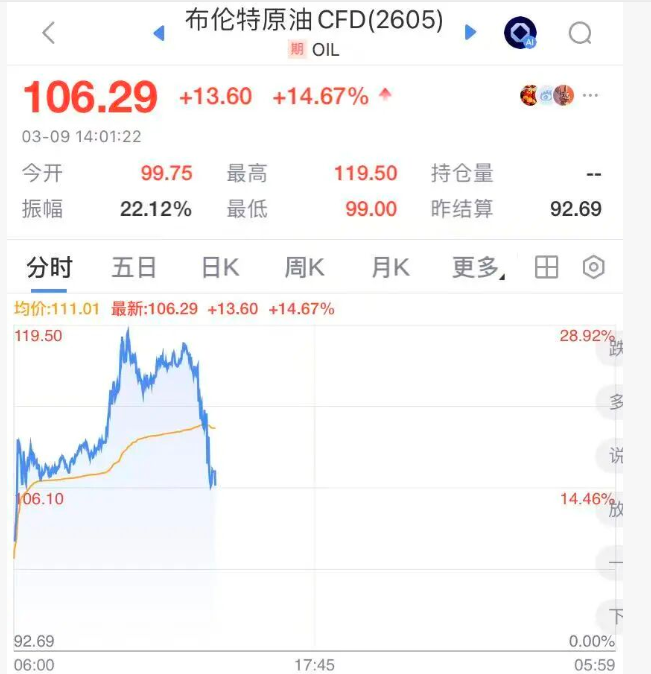
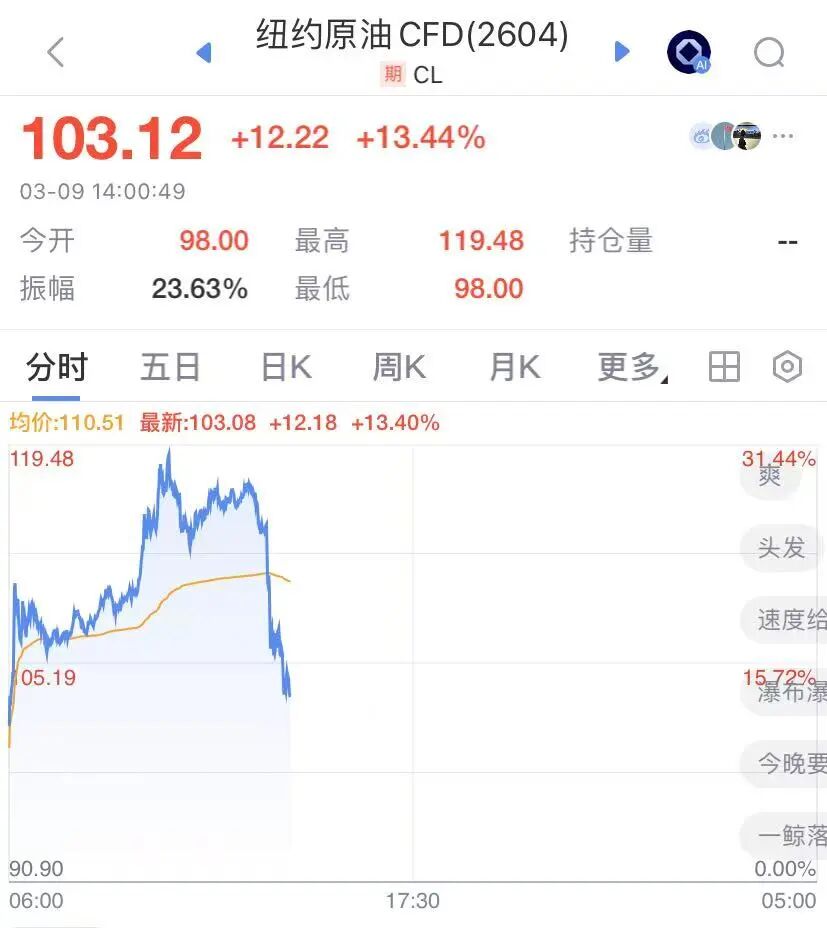
On March 9, both Brent and WTI crude oil prices surged by approximately 30% at one point, nearing the $120 per barrel mark, marking a gain of over 60% within seven trading days. In the afternoon, international oil prices quickly retreated, with both experiencing volatility exceeding 20%. As of 14:00 Beijing time, Brent crude futures fell below $107 per barrel, narrowing the day's gain to 14.67%. WTI crude futures dropped below $104 per barrel, with the day's gain narrowing to 13.44%, according to Caixin.The G-7 will discuss a joint release of emergency oil reserves.
This morning’s sharp surge in oil prices initially triggered a sell-off in global stock markets, with Japanese and Korean stock indices both plunging over 7%. U.S. stock index futures also fell sharply. So far, the declines have somewhat eased: the Nikkei 225 Index’s intraday loss has narrowed to around 5%, while the KOSPI Index has fallen approximately 6%.S&P 500 futures, Dow Jones Industrial Average futures, and Nasdaq 100 futures all fell more than 1.5%.
The A-share and H-share oil & gas sectors saw their gains narrow. In the A-share market, CNOOC briefly hit the daily trading limit but its gain has now narrowed to around 6%; in the H-share market, Shandong Molong surged 28% to HK$10.63, having earlier reached a high of HK$16.33—nearly doubling from its previous close; Baiqin Oilfield Services rose 30%, while Sinopec Oilfield Service gained 5%.
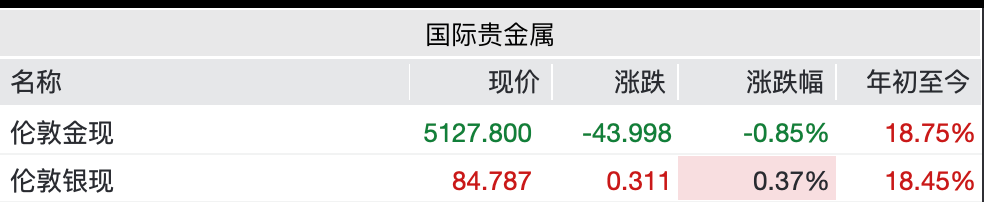
Gold and silver rebounded, as of around 14:20 Beijing time, the intra-day decline of spot gold narrowed to 0.85%, with prices back above 5,120 USD per ounce, while spot silver turned positive, fluctuating around 84 USD per ounce.
The production halt storm is intensifying.
Behind the rapid surge in international oil prices to over $110 per barrel, more major Middle Eastern oil producers are facing production constraints, and the Strait of Hormuz remains almost entirely closed.
Since the United States and Israel launched air strikes on Iran more than a week ago, the situation in the Middle East has not shown signs of cooling down. The Strait of Hormuz, a narrow waterway, carries 20% of global oil shipments. Disruptions in shipping and attacks on energy infrastructure have pushed up the prices of crude oil and natural gas.
Due to the near-stagnation of oil tanker transportation, a large amount of crude oil is accumulating in the Middle East, unable to be transported out. As storage space is gradually exhausted, Gulf oil-producing countries are forced to reduce production.
JPMorgan said that if the Strait of Hormuz remains impassable,By the 8th day, the global oil production cut had risen to 3.3 million barrels per day, by the 15th day it had increased to 3.8 million barrels per day, and by the 18th day it had reached 4.7 million barrels per day.Governments in various countries, especially in Asia, have already taken actions to protect domestic fuel supplies.
The scale of the supply shock is unprecedented.The current supply shock is 17 times the peak impact on Russia's production in April 2022.The resulting potential rate of inventory drawdown could lead markets to price in demand destruction more quickly. Additionally, consumer hoarding behavior and reduced refined petroleum product exports from non-OECD countries could further accelerate the depletion of OECD oil inventories.
Oil prices may surge to $150?
The key to the future lies in how long the tensions in the Middle East continue.
The International Energy Agency stated that it stands ready to coordinate a global release of strategic reserves if the disruption persists, and it needs to monitor whether the closure of the Strait of Hormuz becomes prolonged.
The United States has temporarily eased sanctions on Russian oil shipments destined for India prior to April 4. Urals crude from Russia arriving in India between March and early April is now trading at a $4–5 per barrel premium to Brent on a delivered basis, reversing the $13 per barrel discount seen in February. The U.S. is evaluating a range of options to address a potential energy crisis, including waiving fuel blending requirements, providing insurance guarantees, and offering naval escorts.
Natasha Kaneva, JPMorgan’s Chief Commodities Strategist, noted that while a series of U.S. government reassurances has helped reduce part of the risk premium in the oil market, these assurances alone are unlikely to restore tanker traffic through the Strait, as the prerequisite conditions for commercial confidence have not yet been fully established.
Goldman Sachs estimates that oil flow through the Strait of Hormuz has decreased by 18 million barrels per day, with the current flow roughly equivalent to 10% of normal levels, lower than its earlier assumption of 15%. The risks around Goldman Sachs' base case assumptions have further shifted towards the scenario of shipping flows remaining at lower levels for a longer period.
Vikas Devi, Macquarie’s Global Energy Strategist, statedIf the Strait of Hormuz were closed for several weeks, it would trigger a series of chain reactions, possibly pushing oil prices to $150 per barrel or higher.
Looking ahead, Goldman Sachs pointed out that the reduction of physical shipping risks is likely a necessary condition for the significant recovery of shipping traffic through the Strait of Hormuz.There are three potential paths: an overall de-escalation of the conflict; the U.S. providing strong protection for oil tankers; Iran allowing safe passage for oil tankers from specific origins/destinations.
【Copyright and Disclaimer】The above information is collected and organized by PlastMatch. The copyright belongs to the original author. This article is reprinted for the purpose of providing more information, and it does not imply that PlastMatch endorses the views expressed in the article or guarantees its accuracy. If there are any errors in the source attribution or if your legitimate rights have been infringed, please contact us, and we will promptly correct or remove the content. If other media, websites, or individuals use the aforementioned content, they must clearly indicate the original source and origin of the work and assume legal responsibility on their own.
Most Popular
-
Supply Extremely Tight! LG Chem Declares Force Majeure on Export Contracts for Di-Octyl Terephthalate (DOTP)
-
Huntsman Introduces “War Surcharge” Amid Shipping Disruption and Soaring Energy Costs, Global MDI Prices Continue to Rise
-
Deadly Impact: Hormuz Strait Blockade Sparks Shortage of Plastic Raw Materials, Threatening Shutdowns at Japanese and Korean Chemical Plants
-

LG Chem Declares Force Majeure on DOTP Exports! SABIC Joins Five Giants to Redefine EV Safety
-
Tao Lin: Tesla’s Supercharger Stations in China Surpass 2,500


