HuaWei Qian Kun 896 Line Lidar Solves What Problem
At the Harmony Intelligent Mobility Technology Launch Event on March 4, Huawei's Qiankun unveiled a new perception hardware—the next-generation dual-optical-path imaging-grade LiDAR. What makes this "next-generation" LiDAR truly "new"? And what problems can this 896-line LiDAR actually solve?
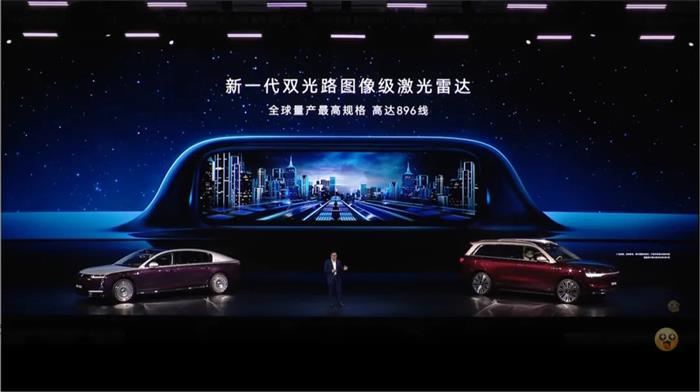
In autonomous driving systems, a vehicle's understanding of the external environment relies on various sensors, among which LiDAR provides three-dimensional spatial information, commonly known as point clouds. Simply put, LiDAR continuously emits laser beams, and each reflection back forms a spatial point. These points, when combined, form the three-dimensional world that the vehicle "sees."
If there are few points, the image will look like a low-resolution picture, with blurred object outlines and small objects hard to recognize. If there are enough points, the environment structure becomes more clear, even approaching a realistic 3D image.
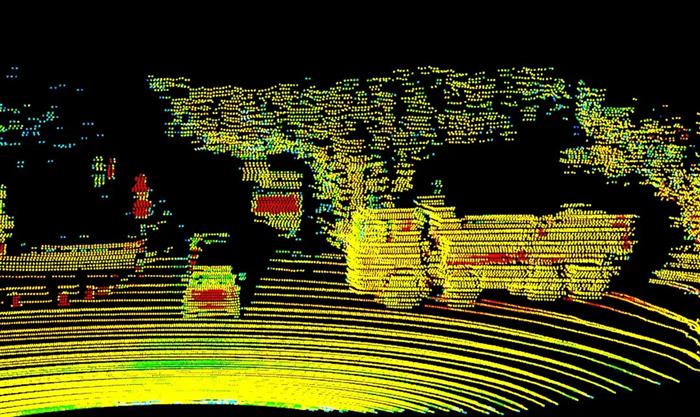
This is an image captured by a mainstream 128-line LiDAR at night. It is barely possible to see a truck in the upper right corner of the image, and a car is possibly in front of the truck. What other objects are around them? The outlines are not clear. It would take a long time to guess with the naked eye, and it would be even more difficult for a model to understand.
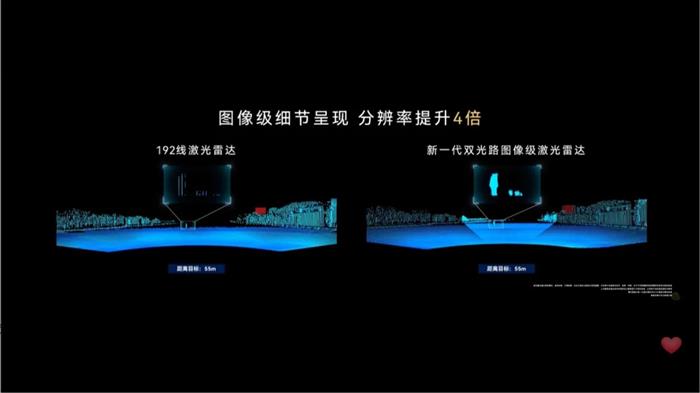
This is an image captured by an 896-line LiDAR, also at night. In addition to fully displaying pedestrians, it even captures the subtle detail of a pet dog wagging its tail 55 meters away. The environmental perception is gradually moving from traditional point cloud outlines to higher-precision 3D imaging, comparable to the imaging effect of a JPG image, making it easier for models to quickly identify and understand.
So, after the point cloud density is significantly increased, the most direct change is that small targets are easier to be identified.
In real-world road environments, high-risk objects are not large obstacles, but rather small, complex-shaped items such as cardboard boxes scattered on highways, overturned traffic cones, or tire debris left on the road. These objects often have low reflectivity and small size; if the number of laser points hitting them is insufficient, the system struggles to achieve stable detection.
As point cloud density increases, the probability of laser beams hitting an object also rises, making it easier for the system to detect small targets. This is the significance of increasing the number of LiDAR channels.
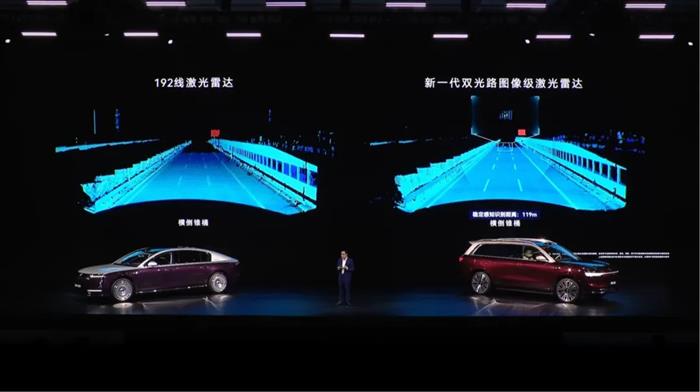
If point cloud density addresses the issue of “seeing clearly,” then detection range addresses another issue: whether the system can detect risks earlier.
In high-speed scenarios, this is very critical. For example, at 120km/h, the vehicle travels approximately 33 meters per second. If the system only identifies an obstacle at 100 meters, the time left for the system to make a decision and execute is only about 3 seconds. However, if the recognition distance reaches around 160 meters, the reaction time increases to nearly 5 seconds.
This extra time often allows the system to decelerate or maneuver more smoothly, rather than applying emergency braking when a hazard is imminent.
In terms of small-object detection capability, the Huawei Qiankun 896-line LiDAR demonstrates a noticeable improvement.
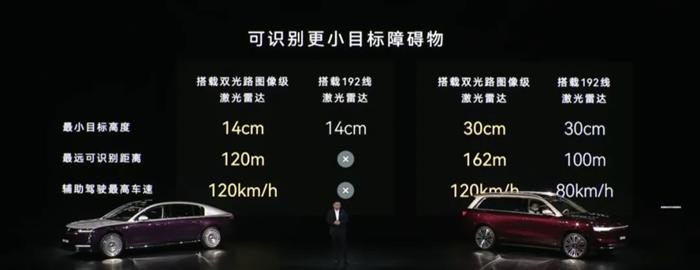
For example, under 10% reflectivity conditions, the system can detect a 30 cm tall obstacle at a maximum distance of 162 meters and supports stable detection at vehicle speeds up to 120 km/h. For smaller targets, such as a 14 cm tall obstacle (close to the ground clearance of most vehicle undercarriages), the system can also achieve stable detection at a distance of 120 meters.
For comparison, Huawei’s Qiankun 192-line LiDAR can detect a 30-cm obstacle at a distance of 100 meters, corresponding to a vehicle speed of 80 km/h. However, for smaller targets measuring only 14 cm in height, detection stability is compromised due to limited point cloud density, resulting in a potential risk of missing such obstacles. In other words, a higher number of laser lines yields greater point cloud density, thereby reducing the likelihood of missing obstacles and enhancing safety in high-speed scenarios.
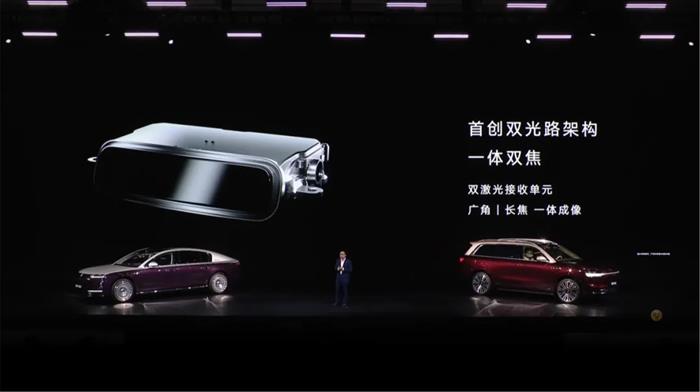
In addition to increased channel count, this generation of LiDAR features a key design innovation: a dual optical path structure—this is the primary aspect that highlights its "newness" this time.
In simple terms, it means integrating two receiver systems with different focal lengths within a single LiDAR unit: one wide-angle optical path to cover a broader forward field of view, and one telephoto optical path to focus on details of distant targets.
The wide-angle lens captures overall environmental information, while the telephoto lens enhances recognition of distant small targets. Combining both creates a "picture-in-picture"-like imaging effect, enabling the system to maintain awareness of the entire road environment while preserving sufficient resolution for distant details.
From a technical logic perspective, these upgrades ultimately aim at the same goal: expanding the perception safety boundary of the intelligent driving system.
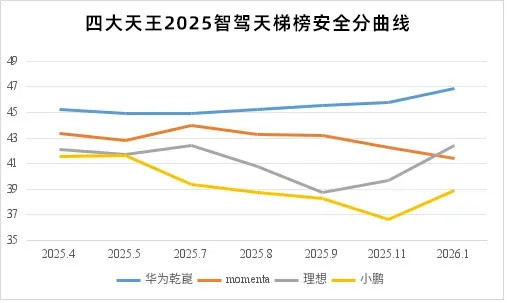
In the 2025 China Intelligent Driving Sky Ladder Ranking, Huawei Qiankun won the championship. Despite the significant increase in competition difficulty since May 2025, Huawei Qiankun's intelligent driving safety performance continued to improve steadily, with an annual total score exceeding 45.5 points (out of 50). In January 2026, the score approached 47 points, clearly widening the gap with the second-place competitor.
On a 100-point scale, Huawei is the only player in 2025 to achieve a safety score above 90, and it continues to widen its lead. This result primarily reflects the system's comprehensive capabilities in risk identification, proactive safety, and perception redundancy.
In this context, the continuous upgrade of perception capabilities becomes particularly crucial. Higher density point clouds enable the system to understand the environment more accurately, longer recognition distances provide the system with more reaction time, and the dual-focus structure allows for the simultaneous consideration of distant details and the overall view.
When these capabilities are combined, the safety redundancy of the autonomous driving system in nighttime, highway, and complex environments will also be enhanced.
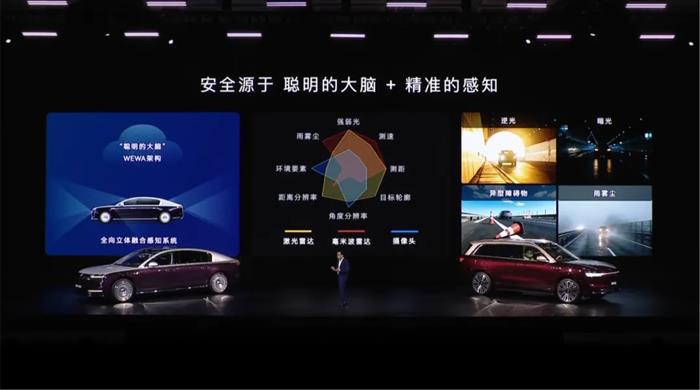
The development of autonomous driving is essentially a technological process aimed at continuously raising the upper limit of safety. Algorithms, computing power, and data are all continuously advancing, but in many critical scenarios, what truly determines the system's capability boundaries is its ability to see potential dangers in a timely and accurate manner.
From this perspective, the Huawei Qiankun 896-line LiDAR solves a relatively straightforward problem: enabling the system to see farther and more clearly.
When the system can identify risks earlier, it gains more time to make judgments and take actions. In high-speed driving, complex traffic, and extreme weather conditions, this "lead time" itself is part of the safety redundancy.
For the industry, such technological upgrades may not immediately change the form of autonomous driving, but they are gradually raising the safety threshold of intelligent driving systems, allowing autonomous driving technology to operate more stably in a wider range of complex scenarios.
【Copyright and Disclaimer】The above information is collected and organized by PlastMatch. The copyright belongs to the original author. This article is reprinted for the purpose of providing more information, and it does not imply that PlastMatch endorses the views expressed in the article or guarantees its accuracy. If there are any errors in the source attribution or if your legitimate rights have been infringed, please contact us, and we will promptly correct or remove the content. If other media, websites, or individuals use the aforementioned content, they must clearly indicate the original source and origin of the work and assume legal responsibility on their own.
Most Popular
-
Supply Extremely Tight! LG Chem Declares Force Majeure on Export Contracts for Di-Octyl Terephthalate (DOTP)
-
Huntsman Introduces “War Surcharge” Amid Shipping Disruption and Soaring Energy Costs, Global MDI Prices Continue to Rise
-
Deadly Impact: Hormuz Strait Blockade Sparks Shortage of Plastic Raw Materials, Threatening Shutdowns at Japanese and Korean Chemical Plants
-

LG Chem Declares Force Majeure on DOTP Exports! SABIC Joins Five Giants to Redefine EV Safety
-
Tao Lin: Tesla’s Supercharger Stations in China Surpass 2,500