How To Achieve Low-Temperature And UV Resistance In Modified Nylon: Reference Formula Included
To make nylon material possess excellent low-temperature and ultraviolet resistance performance simultaneously, a single approach is difficult to achieve, and a combination of methods is needed.Designing the formulation comprehensively from three dimensions: base resin, toughening system, and weathering resistance system.Currently, there are already mature patents and technical approaches available for reference in the industry.
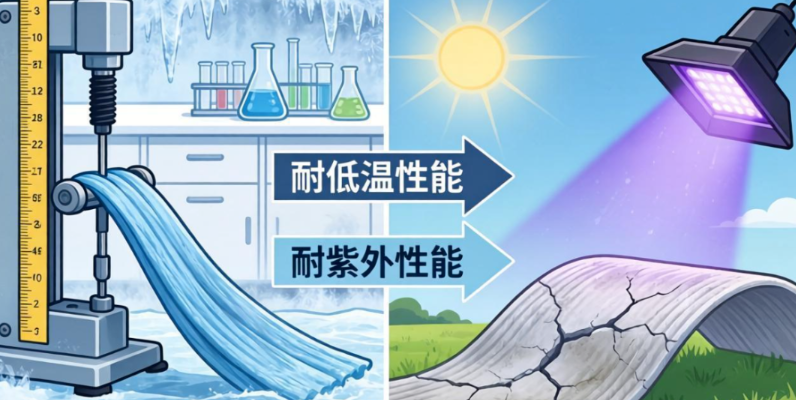
Core technology path: Synergistic system of toughening and photostabilization
The core idea of achieving both low-temperature and UV resistance is:Toughening via elastomers ensures low-temperature toughness, while a composite photostabilization system provides resistance to UV degradation, with both systems designed to remain mutually non-interfering during processing and service, thereby achieving synergistic effects.
The specific solution can be divided into three key components:
1. Matrix Resin Selection: Copolymer Modification Offers an Inherent Advantage
Designing from the molecular structure perspective is the foundation for achieving high performance. Copolyamide, due to the disruption of regularity in its molecular chain, has a lower glass transition temperature (Tg), inherently offering better low-temperature toughness compared to homopolyamides (such as PA6, PA66). Meanwhile, copolymer modification can adjust the molecular chain structure, reducing its sensitivity to oxygen and ultraviolet light, thereby providing a good foundation for subsequent additive modification.
2. Toughening System Construction: Ensuring Low-Temperature Impact Resistance
To achieve excellent low-temperature toughness, toughening agents must be added. An effective toughening system is typically composite.
Primary toughening agent: Select polymers bearing highly reactive functional groups (e.g., maleic anhydride), such as POE-g-MAH, to chemically interact with the nylon matrix, thereby enhancing interfacial adhesion and effectively absorbing impact energy at low temperatures.
Secondary toughening agent/chain extender: Addition of polymers or crosslinking chain extenders bearing epoxy functional groups. Such additives not only assist in toughening but also increase the molecular weight and melt strength of nylon, improve processability, and enhance material density and structural stability—thereby positively influencing long-term weather resistance.
3. Weather Resistance System Construction: Comprehensive Defense Against UV and Thermal-Oxygen Aging
This is the core of ultraviolet resistance, requiring the use of multiple additives in combination to form a multi-level protection system.
✅ Light stabilizer: This is the main component of the weather resistance system.
→ UV Absorbers: e.g., benzotriazole-based and triazine-based compounds. They absorb high-energy UV radiation and convert it into harmless heat, thereby reducing UV absorption by nylon molecules at the source.
→ Hindered amine light stabilizers: These additives efficiently scavenge free radicals generated by UV radiation, interrupting the degradation chain reaction and thereby preventing surface cracking and chalking of the material.
✅ Antioxidants: Heat and oxygen accelerate photodegradation. Adding primary and secondary antioxidants can prevent thermal oxidation aging of materials during high-temperature processing and use, and synergize with light stabilizers to provide comprehensive protection for the material.
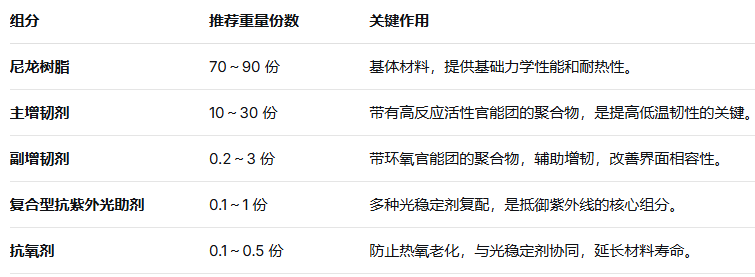
Practical Reference: A Mature Formula Example
The following is recorded in a publicly available patent and has been verified to haveA nylon alloy formula with excellent low-temperature impact resistance and UV aging resistance, which can be used as a development reference:
Balance points to note
The amount of additives: the dosage of toughening agents and light stabilizers needs to be precisely controlled. Excessive toughening agents can reduce the strength and modulus of the material.Excessive addition of light stabilizers (especially certain UV absorbers) may cause the material to develop an initial yellowing, affecting its appearance.
Additive Selection: Some conventional light stabilizers (e.g., HALS-1) may accelerate yellowing of nylon at elevated temperatures; therefore, specially designed light stabilizers compatible with nylon systems—such as Eversorb® PA3 cited in the literature—should be selected. Eversorb® PA3 delivers excellent weatherability while exerting minimal impact on the initial color and high-temperature heat resistance of nylon.
【Copyright and Disclaimer】The above information is collected and organized by PlastMatch. The copyright belongs to the original author. This article is reprinted for the purpose of providing more information, and it does not imply that PlastMatch endorses the views expressed in the article or guarantees its accuracy. If there are any errors in the source attribution or if your legitimate rights have been infringed, please contact us, and we will promptly correct or remove the content. If other media, websites, or individuals use the aforementioned content, they must clearly indicate the original source and origin of the work and assume legal responsibility on their own.
Most Popular
-
Supply Extremely Tight! LG Chem Declares Force Majeure on Export Contracts for Di-Octyl Terephthalate (DOTP)
-
Huntsman Introduces “War Surcharge” Amid Shipping Disruption and Soaring Energy Costs, Global MDI Prices Continue to Rise
-
Middle East Tensions Escalate Sharply: How Polyolefins Respond Amid Soaring Risk Premium
-
Deadly Impact: Hormuz Strait Blockade Sparks Shortage of Plastic Raw Materials, Threatening Shutdowns at Japanese and Korean Chemical Plants
-

LG Chem Declares Force Majeure on DOTP Exports! SABIC Joins Five Giants to Redefine EV Safety