



Freight cost $400,000 per day, new energy vehicles sell 360,000 more units? csr’s gains and losses in the middle east battlefield
In 2025, China's auto exports exceeded 7 million units for the first time, with the Middle East contributing an impressive increase of about 1.39 million units, accounting for nearly 20%.
When the domestic price war is in full swing, the vast blue ocean of the Middle East market is undoubtedly a "profit cow" and "growth engine" for Chinese automakers.
However, the sudden escalation of the Middle Eastern geopolitical conflict at the end of February 2026, like an unexpected hard brake. The Strait of Hormuz — this global energy and trade artery, instantly fell into stagnation.
The “oil route” to Persia has been severed. For the global automotive industry, which is advancing vigorously along this shipping route, this is not merely a logistical delay, but an extreme stress test of corporate strategic resilience, supply chain security, and the very rules governing global survival.
When the war breaks out across the strait, ro-ro ships loaded with vehicles are forced to drift at sea, and the global automotive industry is facing a major test. At the same time, under the war, the story of Chinese automakers' globalization is undergoing the harshest "coming-of-age" trial. How will China's automotive industry's "export strategy" stop the bleeding? And how will it turn around?
Automakers’ “Pressure Index” Amid the Turmoil in the Middle East
In the Middle East, the joys and sorrows of Chinese car companies are not shared. When risks arise, the differences in business structures determine their respective pressure indices.
Geshi Auto CEO Zhou Xiaoying pointed out that the extent to which a given entity is affected by the Middle East situation can be assessed through a core logical framework, which can be simplified as follows: Degree of Impact ≈ (Middle East’s Share of Its Exports / Scale Magnitude) × (Whether It Highly Relies on Gulf Ports/Transshipment Hubs) × (Whether It Maintains a Local “After-Sales Parts/Rotation Parts” System) × (Exposure to Financial Settlement and Insurance).
This logic can clearly quantify the potential impact levels faced by different entities.
Meanwhile, according to Zhou Xiaoying's assessment, the common direct losses that have occurred or are most likely to occur mainly fall into three categories:
Firstly, in-transit delivery delays or cancellations. Affected by the "effective shutdown" of cross-strait shipping, shipping companies have suspended or significantly adjusted related routes, directly disrupting the arrival schedule at the dealer end. Multiple logistics and shipping institutions have already issued clear warnings that current cross-strait commercial shipping is essentially at a standstill, with related route bookings suspended.
Second, freight and insurance costs have surged dramatically. VLCC freight rates on the Middle East–China route have reached extreme levels of $400,000 per day, and risk premiums have directly driven up the entire transportation cost structure. This is typically accompanied by increases—or even cancellation—of war risk insurance, further intensifying operational cost pressures.
Third, after-sales parts risks, which can cause far more damage to the brand than delayed vehicle delivery. While delayed vehicle delivery only affects the user's pickup schedule, the disruption of critical after-sales parts (such as accident repair parts, common wear-and-tear parts, electronic parts, etc.) can directly undermine brand reputation, causing irreparable damage to the brand image.
According to the Gasgoo Automotive Research Institute analysis, the main Chinese automakers exporting to the Middle East include Chery, BYD, SAIC, Changan, Geely, etc.
According to the Gasgoo Automotive Research Institute, from January to November 2025, Chery Automobile ranked first in the "Top 10 Chinese Passenger Car Exporters to the Middle East" with an export volume of 263,679 units.
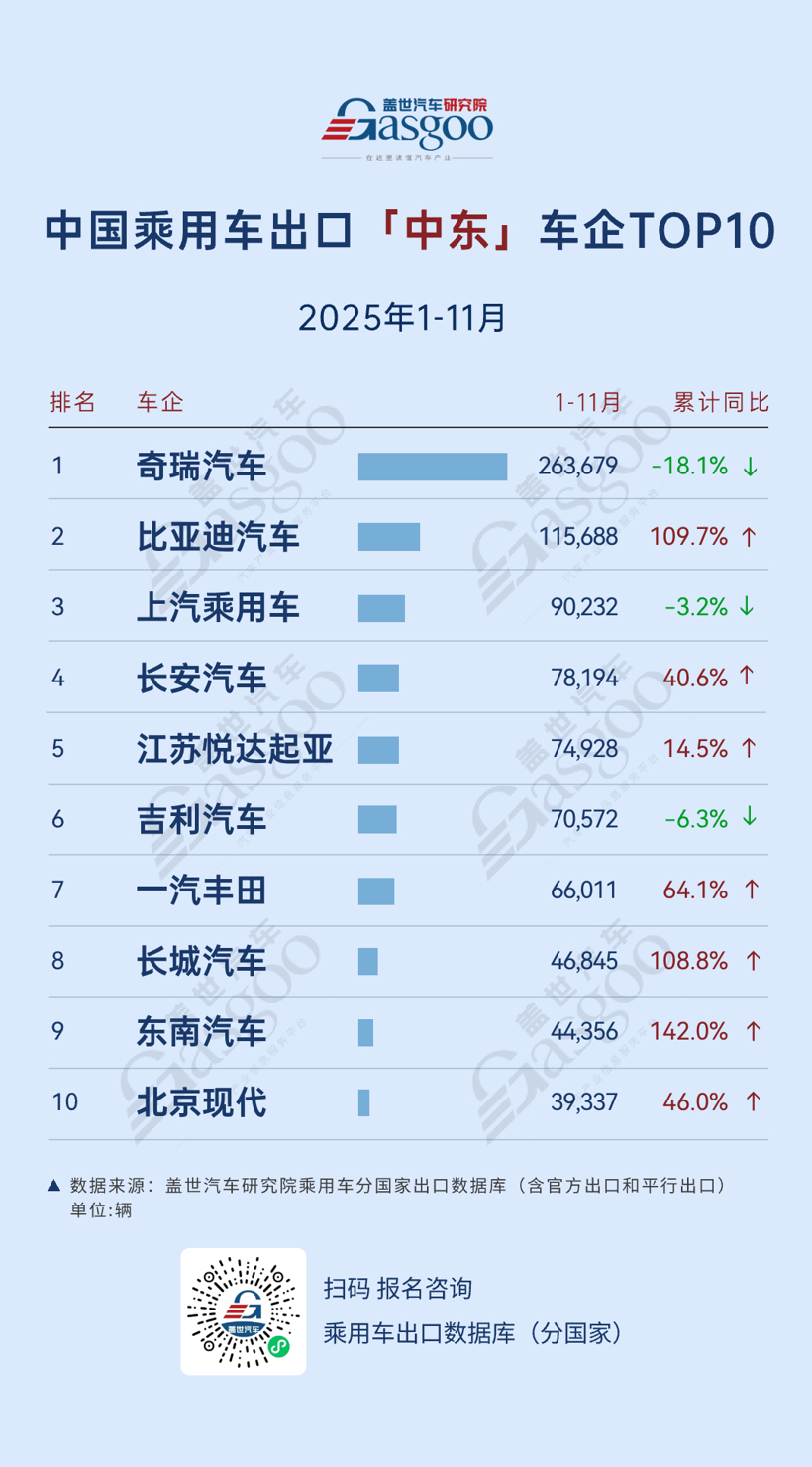
From the perspective of the current industry changes, the impact on Chery is of typical reference significance.
Chery is the Chinese automaker with the largest business scale in the Middle East, and it is highly concentrated in Iran.
"Chery has the largest business in the Middle East, and it is highly concentrated in Iran," said Chen Weiyue, analyst at Gasgoo Research Institute. Chery mainly conducts its business in Iran by providing local partners with CKD parts for assembly. After the outbreak of the war, the foreign exchange quotas originally approved by the Iranian central bank for purchasing automotive supply chain components may be significantly tightened, prioritizing support for the war, which could lead to a reduction in business scale.
He added: The blockade of the Strait of Hormuz would also lead to the obstruction of Chery's KD parts and whole vehicle exports to the UAE, which could not be delivered in the short term.
Export routes to Saudi Arabia are only partially blocked. Changan, SAIC, and Geely's Middle Eastern businesses are mainly concentrated in Saudi Arabia, and they can bypass the Red Sea by transporting through Jeddah Port on the western side of Saudi Arabia (this route accounts for 2/3 of Saudi Arabia's automobile import capacity). Although land transportation costs in the local area will increase, this can partially offset the impact of the Hormuz Strait blockade.
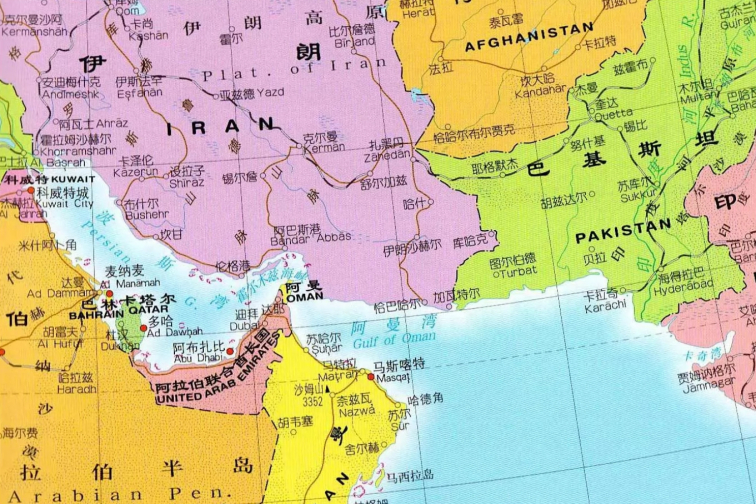
SAIC Motor’s MG brand faces challenges primarily centered on logistics dependency and inventory imbalance. As a leading Chinese brand in Gulf markets such as the UAE, MG’s market performance heavily relies on regional logistics order, with its end-to-end “port-to-dealership” supply chain tightly integrated and highly dependent on key transshipment hubs like Jebel Ali Port in Dubai.
It is reported that Jebel Ali Port, located in Jebel Ali, Dubai, United Arab Emirates, is a deep-water port and also the largest and busiest port in the Middle East. As a key hub port of the New International Land-Sea Trade Corridor, Beibu Gulf Port is actively promoting the opening of trade routes to the Middle East.
Zhou Xiaoying emphasized: "Once the transfer hub is blocked, delivery delays and imbalanced inventory structure will become more apparent more quickly."
For Great Wall Motor, its main SUV and pickup truck models, due to their larger and heavier bodies, are more sensitive to shipping costs and insurance expenses. When freight and insurance costs surge, the increase in landed cost per vehicle will directly erode its cost-performance advantage. More importantly, users of these off-road vehicles have high demands for after-sales support; "critical parts supply disruption" can directly damage its reputation.
Compared with the “growing pains” experienced by earlier companies, BYD faces a different kind of loss: misalignment of time and strategic timing.
According to Zhou Xiaoying's statement in a public interview in November 2025, a BYD executive mentioned that the company is discussing/advancing the establishment of a distribution center targeting the GCC, and called it a "huge investment," expecting it to be implemented the following year (i.e., 2026 window), and proposed expanding to 10 outlets in Saudi Arabia in 2026.
For BYD, short-term “absolute sales volume” may not be the highest, but the intensifying competition could undermine dealers’ confidence in setting up new stores and delay the launch of new products.
"The disruption of the strategic window period's rhythm will affect its global development, especially the overall planning for the Middle East market," Zhou Xiaoying admitted candidly.
Oil prices break 100, freight costs surge, strontium carbonate doubles: Rewriting the cost formula for CRRC's overseas expansion
If the loss at the enterprise level is the visible iceberg, then the upstream transmission effect of the industrial chain is the ice shelf beneath the water that is capable of grounding a giant ship.
Methanol: 55% Dependence on the "Skeletal Material" Crisis
Iran is the world’s second-largest methanol producer, with an annual production capacity of 17.16 million tons, accounting for 9.2% of the global total capacity. As Iran’s methanol facilities are highly concentrated along the Persian Gulf coast, exports are heavily dependent on maritime transport; thus, supply is highly vulnerable to disruption in the event of escalating conflict.
China is precisely the largest buyer of Iranian methanol. In 2025, China imported over 7.92 million tons of methanol from Iran, accounting for more than 55% of the total imports.
Methanol is not merely a fuel; it is also a fundamental raw material for synthesizing high-performance polymers and chemical products. From instrument panel interior components and seat foam materials to body-mounted engineering plastics, adhesives, and coatings, the entire production chain is deeply dependent on a stable supply of methanol.
The chemical industry team at Tianfeng Securities pointed out that Iran, as a key methanol-producing country in the Middle East, may directly transmit the uncertainty of its geopolitical situation to China's methanol import market, thereby affecting the downstream automotive industry.
Celestite: 85% of Global Reserves and the “Achilles’ Heel” of Electric Vehicles
Iran is the main country with high-grade celestite reserves and supply in the world. Iran accounts for about 85% of the world's proven high-grade celestite reserves, and has an absolute dominant position in supply. About 60%-70% of China's celestite imports come from Iran.
This means that any disruption to Iran’s lapis lazuli supply will pose a risk of raw material shortages for the domestic strontium salt industry and, consequently, for downstream automobile motor production.
What is even more concerning is the inventory situation. Some analyses suggest that, due to the disruption in shipping, the domestic celestite inventory can only support for 3 months.
In fact, the port shutdown caused by the June 2025 explosion at Bandar Abbas Port in Iran has further exacerbated the global strontium carbonate supply shortage, driving the price of strontium carbonate from 8,000 RMB per ton in September 2024 to 16,000 RMB per ton in June 2025—a 100% increase.
The analysis suggests that the comprehensive disruption of shipping in the Strait of Hormuz may lead to production cuts or delivery delays in the supply chain of high-grade celestine-dependent permanent magnet materials and electric vehicle models.
Iran is China's third-largest oil supplier, after Russia and Saudi Arabia. According to industry estimates, by 2025, China's imports of crude oil from Iran will be about 1.5 million barrels per day, with an annual total of about 550 million barrels (equivalent to 75 million tons).
Analysts predict that if the situation in Iran continues to escalate and affects the energy facilities of Gulf Arab states, international oil prices could break through $150 per barrel.
This is a heavy blow to gasoline vehicles.
Huatai Securities conducted a fitting calculation based on historical oil price patterns, estimating that when crude oil prices are USD 80/barrel and USD 100/barrel, the retail price of 92-octane gasoline is RMB 7.1/liter and RMB 7.6/liter, respectively.
It further analyzed the fluctuations of oil prices and passenger vehicle sales from 2013 to 2018, concluding that a 1 yuan/L change in gasoline price affects oil vehicle sales by 7.5-8.5 million units. Based on this, we estimate that if oil prices stabilize at 80 or 100 dollars per barrel from March to September 2026, the marginal increase in oil prices will lead to a yearly sales decline of 1.7 or 6.8 million units for fuel vehicles in China.
Yet the flip side is the opportunity presented by new energy vehicles.
Huatai Securities estimates that when crude oil prices rise to $100 per barrel, it is equivalent to an indirect price reduction of 1.7%–3.7% for new energy vehicles, which could boost their sales by 1.7%–4.5%, thereby shifting 100,000–360,000 vehicle purchases to the new energy vehicle market.
The "shutdown" of logistics hubs
Once the blockade order was issued, international shipping giants quickly made risk-avoidance adjustments.
Mediterranean Shipping Company (MSC), the world's largest in terms of capacity, has suspended global bookings for shipments to the Middle East; CMA CGM has halted all Suez Canal transits, with related vessels rerouted via the Cape of Good Hope; Hapag-Lloyd has announced the suspension of all vessel passages through the Strait of Hormuz.
The closure of the Strait of Hormuz has completely shattered the hope for a large-scale return of container shipping to the Red Sea in 2026. Taking the Africa's Cape of Good Hope has become the only option for Asia-to-Europe and America routes, which will increase the voyage by 10 to 14 days.
Crisis is not only a litmus test for a company’s true quality but also a catalyst for industrial evolution.

Image source: Toyota Motor Corporation
【Copyright and Disclaimer】The above information is collected and organized by PlastMatch. The copyright belongs to the original author. This article is reprinted for the purpose of providing more information, and it does not imply that PlastMatch endorses the views expressed in the article or guarantees its accuracy. If there are any errors in the source attribution or if your legitimate rights have been infringed, please contact us, and we will promptly correct or remove the content. If other media, websites, or individuals use the aforementioned content, they must clearly indicate the original source and origin of the work and assume legal responsibility on their own.
Most Popular
-
Supply Extremely Tight! LG Chem Declares Force Majeure on Export Contracts for Di-Octyl Terephthalate (DOTP)
-
Huntsman Introduces “War Surcharge” Amid Shipping Disruption and Soaring Energy Costs, Global MDI Prices Continue to Rise
-
Middle East Tensions Escalate Sharply: How Polyolefins Respond Amid Soaring Risk Premium
-
Deadly Impact: Hormuz Strait Blockade Sparks Shortage of Plastic Raw Materials, Threatening Shutdowns at Japanese and Korean Chemical Plants
-

LG Chem Declares Force Majeure on DOTP Exports! SABIC Joins Five Giants to Redefine EV Safety


