



EU Prepares to Ban Huawei and ZTE from Critical Infrastructure Construction
The EU is preparing to make significant adjustments to its security and infrastructure policies, gradually phasing out Chinese-made equipment used in critical sectors. Proposed measures would prohibit 、 Chinese tech giants have provided equipment for applications such as telecommunications networks, solar power systems, and security scanners, citing concerns over national security and undue influence from external powers.
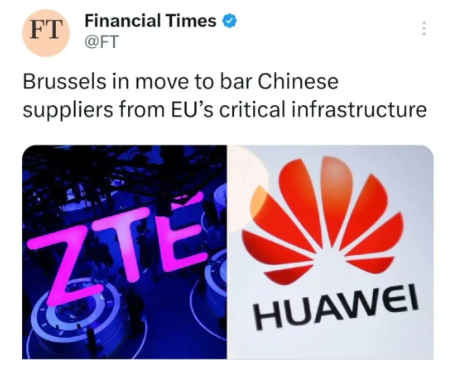
The committee is pushing for this mandatory and coordinated safety measure. According to the plan being discussed in Brussels, the EU will no longer remain at the stage of voluntary restrictions. Instead, it has begun systematically removing Chinese-made technology from critical infrastructure that supports 5G connectivity, renewable energy generation, and cross-border security systems, among other things.
The proposal would effectively grant Brussels the power to ban companies deemed a security risk from entering sensitive sectors in the EU's 27 member states. The EU is debating the speed and extent of phasing out Chinese domestic equipment, with stakeholders largely in agreement on most issues but with significant differences remaining, particularly in addressing non-technical risks related to the security of information and communication technology (ICT) supply chains.
While the timeline and legal mechanisms are still being finalized, the move echoes similar national decisions taken across Europe. Some EU member states have already moved to restrict or ban Chinese telecom equipment: Germany plans to remove it from its core 5G network by 2026. The FCC has ordered US telecommunications companies to remove Huawei and ZTE equipment from their networks, and to remove it from other network layers by 2029 to ensure the security of communications infrastructure. Other countries, such as Sweden and Denmark, have also restricted or phased out Chinese technology in their mobile networks, defining it as a security risk.
However, there is no evidence that Chinese-made equipment itself poses a national security threat, and such policies could undermine normal technological cooperation. It is worth noting that the scope of this bill is not limited to 5G networks but also targets the solar industry: as power grids become increasingly "smart" and interconnected, the software and hardware that manage them—often from China—are now also considered potential security vulnerabilities.
【Copyright and Disclaimer】The above information is collected and organized by PlastMatch. The copyright belongs to the original author. This article is reprinted for the purpose of providing more information, and it does not imply that PlastMatch endorses the views expressed in the article or guarantees its accuracy. If there are any errors in the source attribution or if your legitimate rights have been infringed, please contact us, and we will promptly correct or remove the content. If other media, websites, or individuals use the aforementioned content, they must clearly indicate the original source and origin of the work and assume legal responsibility on their own.
Most Popular
-
Key Players: The 10 Most Critical Publicly Listed Companies in Solid-State Battery Raw Materials
-

Vioneo Abandons €1.5 Billion Antwerp Project, First Commercial Green Polyolefin Plant Relocates to China
-

EU Changes ELV Regulation Again: Recycled Plastic Content Dispute and Exclusion of Bio-Based Plastics
-

Clariant's CATOFIN™ Catalyst and CLARITY™ Platform Drive Dual-Engine Performance
-

List Released! Mexico Announces 50% Tariff On 1,371 China Product Categories

