Escalating Geopolitical Conflict And Middle East War Impact On China’s Polyethylene Market
With Israel announcing its attack on Iran and U.S. President Trump confirming that U.S. military forces have launched a military strike against Iran, the Middle East’s geopolitical situation has escalated sharply. As a major global exporter of crude oil and chemical products, Iran’s involvement has immediately triggered market concerns regarding energy and chemical supply chains. Based on the critical 2025 data showing China’s imports of polyethylene (PE) from Iran totaling 1.125 million tons, this article provides a brief analysis of the actual impact on China’s market.
I. The Structural Position of Iran in China's PE Imports
According to the 2025 import data, China imported a total of 1.125 million tons of polyethylene from Iran, accounting for 8.39% of China's total PE imports. The dependency varies significantly across different categories.
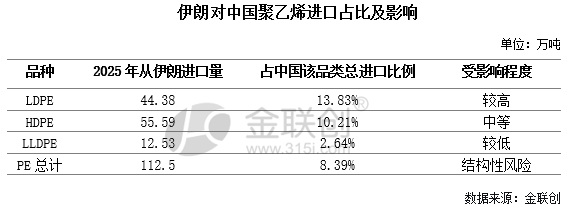
From the 2025 China polyethylene import data, Iran is the fourth largest import source, with an annual import volume of 1.125 million tons. Among these, the proportion of low-density polyethylene (LDPE) is the highest. Considering that China's LDPE import dependence is as high as 50% (2025 data), Iran's position in this specific area is crucial. This also means that if a conflict were to escalate, its impact on the market would exhibit a clear structural characteristic.
II. Three Core Channels of Transmission
Cost-driven: Soaring crude oil prices bring imported inflation
Military strikes directly push international oil prices higher. Polyethylene (PE), as a downstream petrochemical product, has production costs highly correlated with crude oil prices. As of the end of February 2026, China's oil-based polyethylene capacity stood at 25.585 million tons, accounting for approximately 64% of China's total polyethylene capacity. Rising oil prices will provide strong cost-driven support for PE prices and may trigger bullish market sentiment, leading traders to withhold offers or raise quotations.
Supply risk: Possibility of Iranian supply disruption
Iran's domestic petrochemical facilities are facing security threats and may be forced to shut down. Additionally, the Strait of Hormuz, as a key waterway, if shipping risks increase and insurance rates soar, will directly impact the arrival of Iranian supplies to China's coastal areas. Particularly for high-pressure and low-pressure categories, if the supply disruption lasts for a longer period, it might alter the domestic supply-demand balance. These are the core variables affecting the Chinese market.
Market Sentiment: Increased Volatility and Bull-Bear Competition
China's current PE market is caught in a tug-of-war between high post-holiday inventories and the traditional demand peak in March. The outbreak of geopolitical conflicts has injected significant uncertainty into the market. On one hand, it serves as a short-term bullish catalyst for speculative buying; on the other hand, whether prices can sustainably rise still hinges on the pace of domestic inventory drawdown and the actual recovery of downstream demand.
III. Conclusion and Prospects
In summary, the recent military strikes by Israel and U.S. forces against Iran have provided clear bullish support to China's polyethylene market, primarily through sentiment and cost factors. In the short term, market volatility will intensify, and prices are likely to gain upward momentum alongside crude oil. High-pressure (LDPE) grades, given their higher reliance on imported feedstock, may exhibit relatively stronger performance. In the medium to long term, market trends will revert to fundamentals. If the conflict persists or escalates, leading to a prolonged disruption of Iranian supply, coupled with the realization of robust domestic demand during the March peak season, a genuine supply-demand gap could emerge. Conversely, if the conflict quickly subsides, market focus will shift back to the process of digesting high domestic inventories. Market participants are advised to closely monitor developments in the Middle East, crude oil price fluctuations, and actual vessel loading activities at Iranian ports.
【Copyright and Disclaimer】The above information is collected and organized by PlastMatch. The copyright belongs to the original author. This article is reprinted for the purpose of providing more information, and it does not imply that PlastMatch endorses the views expressed in the article or guarantees its accuracy. If there are any errors in the source attribution or if your legitimate rights have been infringed, please contact us, and we will promptly correct or remove the content. If other media, websites, or individuals use the aforementioned content, they must clearly indicate the original source and origin of the work and assume legal responsibility on their own.
Most Popular
-
Supply Extremely Tight! LG Chem Declares Force Majeure on Export Contracts for Di-Octyl Terephthalate (DOTP)
-
Huntsman Introduces “War Surcharge” Amid Shipping Disruption and Soaring Energy Costs, Global MDI Prices Continue to Rise
-
Deadly Impact: Hormuz Strait Blockade Sparks Shortage of Plastic Raw Materials, Threatening Shutdowns at Japanese and Korean Chemical Plants
-

LG Chem Declares Force Majeure on DOTP Exports! SABIC Joins Five Giants to Redefine EV Safety
-
Tao Lin: Tesla’s Supercharger Stations in China Surpass 2,500