Chip costs force another automaker to hike prices
On April 30, Changan Qiyuan released a price adjustment notice through its official channels.
The announcement states that, due to a significant global increase in the cost of automotive-grade chips, the official MSRP of the Qiyuan Q07—specifically the Tian Shu Intelligent LiDAR Edition, a mid-size new-energy SUV—will be raised by RMB 3,000 effective 00:00 on May 7. This price adjustment applies to three trims: the 215 LiDAR Premium, the 215 LiDAR Flagship, and the 215 LiDAR Flagship PLUS, with revised prices of RMB 159,800, RMB 169,800, and RMB 179,800, respectively.
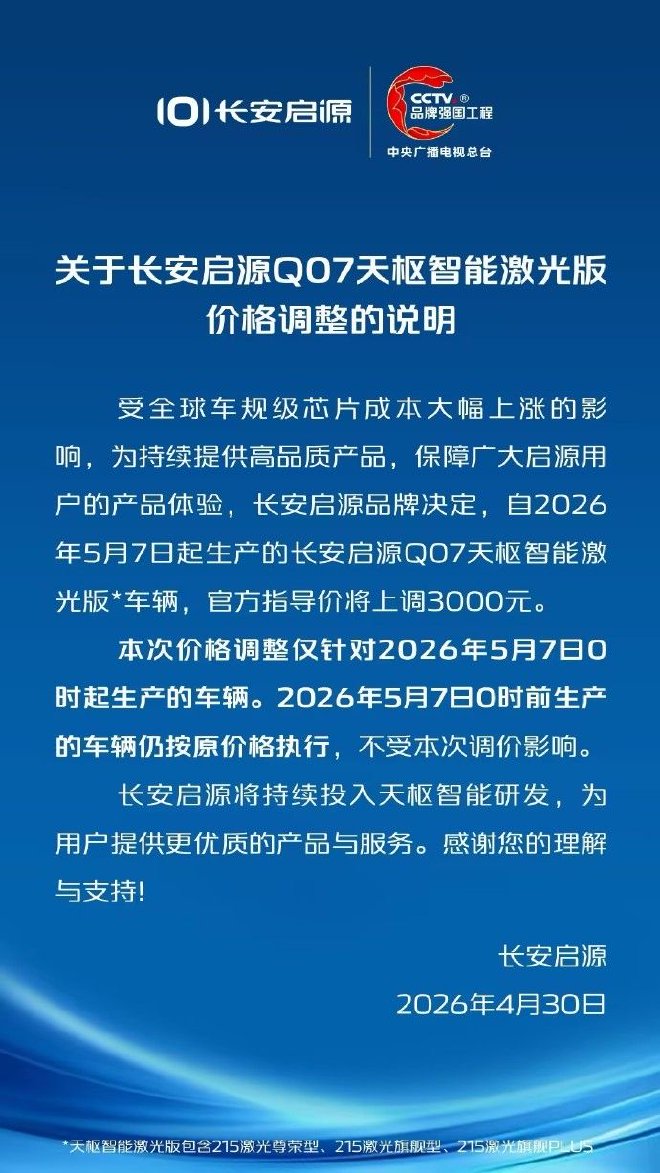
Image source: Changan Qiyuan
This price adjustment has a clear boundary: vehicles produced before May 7 will still be sold at the original price. In the short term, this may encourage consumers to visit dealerships to purchase cars during the May Day holiday.
And just two days ago, on the evening of April 28, BYD also issued a similar announcement, stating that the optional price for the "God's Eye B Advanced Driving Assistance LiDAR Edition" on selected models from its Dynasty Network, Ocean Network, and Fangchengbao would increase from RMB 9,900 to RMB 12,000—an increase of RMB 2,100—effective May 1.
BYD cited the same reason, pointing to the supply chain: a significant global increase in storage hardware costs.
Several automakers have already raised prices.
Let’s rewind the timeline a bit. In March, Chery’s premium brand Exeed was the first to signal a price increase: the high-end LiDAR-equipped Intelligent Premium Edition of the Exeed ET5 saw its official guide price raised by RMB 5,000 to RMB 164,900. The new Xiaomi SU7 across all trims increased in price by RMB 4,000. Multiple models under Huawei’s Harmony Intelligent Driving brand also saw price hikes, following upgrades to their LiDAR configurations. In April, the list of automakers implementing price adjustments expanded further.
This round of price increases shares a common label: "Laser Edition." All the models affected by the price adjustment—whether the Changan Qiyuan Q07 Tianshu Intelligent Laser Edition or the BYD "God's Eye" B Laser Edition—feature an advanced intelligent driving system equipped with a LiDAR-based solution.
These systems rely far more heavily on memory chips than conventional vehicles—real-time processing of LiDAR point cloud data and running on-board large models require high-capacity, high-speed DRAM chips.
The BYD Tian Shen Zhi Yan B model uses the NVIDIA Orin X chip, with a computing power of about 254 TOPS, and is equipped with at least 16GB, up to 64GB DRAM. This has significantly increased the cost of intelligent hardware per vehicle in the current context of a sharp rise in memory chip prices.
According to TrendForce's data, in the first quarter of 2026, the quarterly price increase of general-purpose DRAM contracts has been revised upward from the previously expected 55%-60% to 90%-95%; the quarterly price increase of NAND Flash has also been revised upward from 33%-38% to 55%-60%, with "the possibility of further upward potential remaining."

Image source: 699pic.com
UBS report data is more straightforward: over the past three months, DRAM prices in the automotive sector have surged by 180%; among them, spot prices for high-end automotive-grade DDR5 have soared by as much as 300%.
Faced with such a situation, the internal pressure on automakers is understandable. In January this year, Li Bin, Chairman of NIO, stated bluntly: "The biggest cost pressure in the automotive industry this year isn't raw materials, but the rising prices of memory chips," estimating that this pressure could increase costs for high-end new energy vehicles by RMB 3,000 to RMB 5,000.
Lan Tu Chairman Lu Fang also expressed similar concerns. He said that the prices of batteries, chips, especially memory chips, are rapidly rising, "causing serious troubles for the supply chain, and making cost control for factories a huge challenge." He further estimated that if the cost pressure continues to be transmitted, "a general increase in vehicle prices is highly likely."
In response, Voyah’s strategy consists of three tiers: internal cost reduction through potential optimization, scaling up operations to offset costs, and advancing supply chain localization and domestic substitution.
This might just be the beginning.
What makes the industry even more painful is that the pressure of this round of price increases shows no signs of subsiding in the short term.
Unlike the chip shortage in 2021, which was mainly caused by production imbalances due to the pandemic, representing a cyclical supply-demand mismatch; this time, the root cause lies in the continuous pull of semiconductor capacity by the AI industry.
As the application of large models accelerates, the demand for high-bandwidth memory in data centers is growing exponentially. The advanced production capacities of memory giants like Samsung, SK Hynix, and Micron are increasingly being directed towards AI, leading to a tightening supply of automotive-grade memory chips for the automotive industry.
In the case where the supply satisfaction rate of automotive-grade storage chips is less than 50%, some automakers have to accept the suppliers' requirement of "increased prices for supply" to ensure production and delivery.
Beijing Ingenic has clearly stated that its products are "in very short supply, and prices are rising, with no room for negotiation on price reductions," and anticipates that the supply-demand imbalance for automotive DRAM chips will persist, viewing price increases as the core driver of its performance. The company's remarks, to some extent, also reflect the upstream industry's outlook on the overall trend.
Image source: SK hynix
Cui Dongshu, Secretary General of the Passenger Car Association, described another evolving pressure point—power batteries. He stated, "The global AI boom is driving a surge in demand for electric energy storage, causing a sharp rise in the prices of non-ferrous metals like copper, which is putting significant cost pressure on automakers." He also noted that with the continuous surge in new energy vehicle sales over the past two years, soaring prices of resources such as lithium carbonate have intensified the tensions between upstream and downstream players.
Data supports this judgment: the price of battery-grade lithium carbonate rose from about 75,000 yuan per ton at the beginning of 2025 to 171,900 yuan per ton in March 2026; UBS reports further revised the lithium carbonate price forecast to about 185,000 yuan per ton, and it is expected that global lithium demand will double to 3.4 million tons by 2030. The demand growth rate is 14% in 2026 and is expected to increase further to 16% in 2027.
The cost curves for both storage chips and power batteries are rising simultaneously, almost in unison squeezing the profit margins of the entire automotive industry. Cui Dongshu stated bluntly: "The current decline in profits in the automotive industry is severe, as the cost pressure from upstream is significant, and the pressure on the automotive industry itself is becoming increasingly difficult to bear."
Against this backdrop, various institutions continue to forecast upward demand for chips. The investment cycle for AI infrastructure typically spans years, and capital expenditure disclosed by leading technology companies continues to rise, indicating that demand for computing power and storage will not decline in the short term, and competition for capacity will persist.
Meanwhile, the automotive industry holds a relatively weak position in this competition—as Li Bin stated, “The automotive industry cannot compete with AI and data centers for chips, as their investments often reach tens of billions of dollars.”
This wave of price adjustments, triggered by chip costs, has only just begun.
【Copyright and Disclaimer】The above information is collected and organized by PlastMatch. The copyright belongs to the original author. This article is reprinted for the purpose of providing more information, and it does not imply that PlastMatch endorses the views expressed in the article or guarantees its accuracy. If there are any errors in the source attribution or if your legitimate rights have been infringed, please contact us, and we will promptly correct or remove the content. If other media, websites, or individuals use the aforementioned content, they must clearly indicate the original source and origin of the work and assume legal responsibility on their own.
Most Popular
-
Continental Plans to Begin Sale of ContiTech in Early 2026
-

BASF Delivers First Batch of Innovative Cathode Materials for Semi-Solid-State Batteries to Weilan New Energy
-
First Time Surpassing $3 Billion! First Time Surpassing 100,000 Tons! Cathay Biotech’s 2025 Performance: Chemical Production Fully Phased Out, Biological Method Wins
-

Recycled PE/PP Morning Outlook: Market Expected to Remain Weak Within Range
-
Completion And Commissioning! Evonik’s Four Major Projects Officially Launched