



Casi Chemistry Makes Progress in High-Performance Organic Thermoelectric Materials for Flexible Power Generation and Cooling Devices
With the rapid development of emerging industries such as wearable electronics and adherent Internet of Things, the technical demands for flexible energy and portable refrigeration are becoming increasingly urgent. Flexible thermoelectric devices, which can generate electricity from thermal energy in the human body or the environment and also achieve film cooling in reverse, are one of the key technologies to meet these needs. Organic thermoelectric materials, with their inherent flexibility and solution processability, are an important system for flexible thermoelectric materials, but have long faced the dual challenges of low performance and complex processing techniques. Utilizing chemical principles to synergistically regulate the electrical and thermal transport properties of short-range ordered molecular assemblies holds promise for overcoming these challenges and promoting the practical application of organic thermoelectric materials.
Supported by the National Natural Science Foundation of China, the Chinese Academy of Sciences, and the Beijing Municipal Government, the research team of Zhu Daoben/Di Chong'an from the Organic Solids Laboratory at the Institute of Chemistry, Chinese Academy of Sciences, in collaboration with Zhang Deqing's group, proposed and constructed an irregular multi-scale porous thermoelectric polymer (IHP-TEP) material. By developing a critical phase separation control method for polymers, the IHP-TEP film exhibits a "disordered pores - ordered channels" structural feature, where the pore structure shows a multi-scale disordered distribution ranging from sub-10 nm to micrometer scales, while the regions between the pores exhibit ordered molecular assembly characteristics. This structure significantly suppresses thermal vibration propagation and remarkably enhances carrier mobility, leading to a significant improvement in the thermoelectric performance of the film.
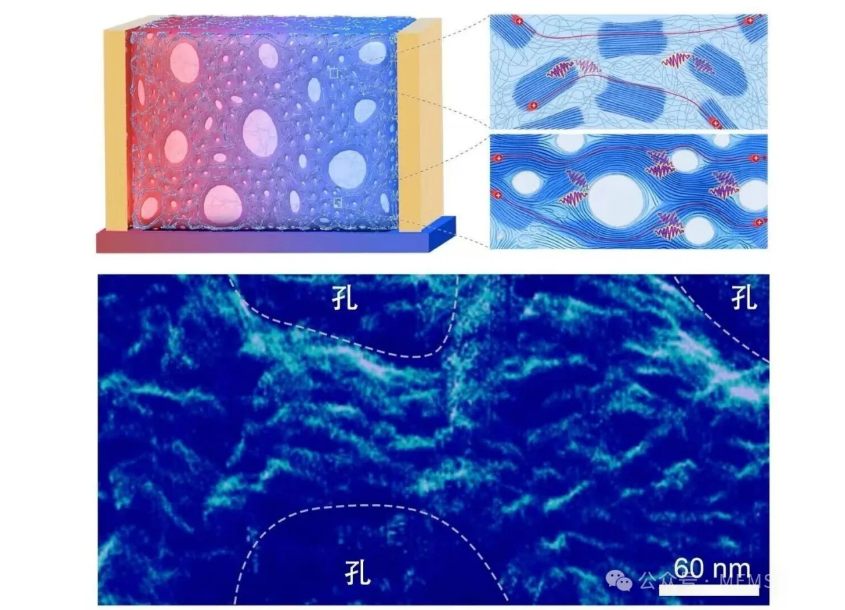
Multilevel porous thermoelectric polymer materialsDesign philosophy and representation results
“Phonon-glass electron-crystal” is an ideal model for thermoelectric materials, imposing contradictory requirements on material disorder and order. Previously, this team proposed the multi-periodic heterogeneous assembly concept, achieving a significant enhancement in thermoelectric performance by introducing disordered heterogeneous interfaces into relatively ordered aggregates. However, this concept fails to synergistically optimize multiple thermoelectric parameters, making it difficult to approach the intrinsic performance limits of molecular materials. The research team has now proposed a novel strategy—“creating order within disorder”—and developed a dual-regulation mechanism comprising “disorder-induced pore enhancement of phonon scattering” and “confinement-enhanced molecular ordered assembly.” By leveraging phase separation between the polymers PDPPSe-12 and PS, they fabricated thin films featuring distinct porous structural characteristics. The study reveals that this porous architecture exhibits multiple phonon scattering mechanisms—including phonon–boundary scattering, phonon–phonon interactions, and size effects—reducing thermal conductivity by up to 72%. Simultaneously, the confinement effect during phase separation enhances the ordered assembly of the polymers, increasing carrier mobility by up to 52%. The optimized thin films achieve a maximum power factor of 772 μW·m⁻¹·K⁻².⁻¹·K⁻²With a minimum thermal conductivity of 0.16 W·m⁻¹·K⁻¹, the material achieved a maximum ZT value of 1.64 at 343 K, marking a new breakthrough in polymer thermoelectric materials. Moreover, this structured film can be fabricated over large areas using spray coating technology, showing significant application potential in low-cost flexible power generation and cooling devices.
The above research has established a new approach for decoupled regulation of charge transport and phonon scattering in polymer thermoelectric materials, providing a new pathway for continuous breakthroughs in thermoelectric plastics and their flexible thermoelectric devices. The related research results were published in the journal Science. This research received technical support from the Huairou Research Center of the Institute of Chemistry, Chinese Academy of Sciences.
Paper information: Translate the above content into English, directly output the translation result, no explanation needed.
DOI: 10.1126/science.adx9237
【Copyright and Disclaimer】The above information is collected and organized by PlastMatch. The copyright belongs to the original author. This article is reprinted for the purpose of providing more information, and it does not imply that PlastMatch endorses the views expressed in the article or guarantees its accuracy. If there are any errors in the source attribution or if your legitimate rights have been infringed, please contact us, and we will promptly correct or remove the content. If other media, websites, or individuals use the aforementioned content, they must clearly indicate the original source and origin of the work and assume legal responsibility on their own.
Most Popular
-
Supply Extremely Tight! LG Chem Declares Force Majeure on Export Contracts for Di-Octyl Terephthalate (DOTP)
-
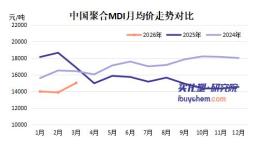
Huntsman Introduces “War Surcharge” Amid Shipping Disruption and Soaring Energy Costs, Global MDI Prices Continue to Rise
-
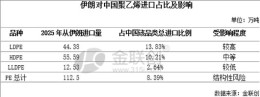
Middle East Tensions Escalate Sharply: How Polyolefins Respond Amid Soaring Risk Premium
-

Deadly Impact: Hormuz Strait Blockade Sparks Shortage of Plastic Raw Materials, Threatening Shutdowns at Japanese and Korean Chemical Plants
-

LG Chem Declares Force Majeure on DOTP Exports! SABIC Joins Five Giants to Redefine EV Safety


