



CAPCHEM Files for Listing on HKEX! Recent Overseas Production Capacity Layout in Electrolytes
Capchem has submitted an application to The Stock Exchange of Hong Kong Limited on January 27, 2026, for the issuance and listing of its offshore listed foreign shares (H-shares) on the Main Board of the Hong Kong Stock Exchange.
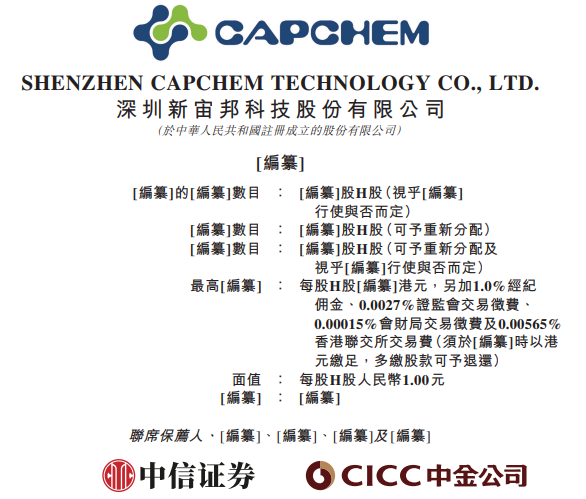
On January 28th, midday, CAPCHEM (603026) announced that the company submitted an application to The Stock Exchange of Hong Kong Limited on January 27, 2026, for the issuance of overseas listed foreign shares (H shares) and listing on the Main Board of the Hong Kong Stock Exchange. The company also published the application materials for this issuance and listing on the website of the Hong Kong Stock Exchange on the same day.
Battery Network noted that overseas electrolyte capacity expansion has been frequent recently.
On January 19th, Nolato Technology (Malaysia) Sdn Bhd ("Nolato Malaysia"), a core member of Shenzhen Capchem Technology Co., Ltd., held a groundbreaking ceremony for its new battery electrolyte production base in Kulim Hi-Tech Park, Kedah, Malaysia. The new production base is expected to officially begin production in the fourth quarter of 2026, with a first-phase production capacity of 30,000 tons.
On December 31, 2025, Capchem officially announced the expansion of its production capacity in Poland and Saudi Arabia. Specifically, Capchem plans to utilize its majority-owned subsidiary, Capchem Poland Sp. z o.o. ("Capchem Poland"), as the project implementation entity to invest in and construct Phase II of the Capchem Poland Lithium-ion Battery Material Project in the Śrem Industrial Park. The total planned investment for the project is not to exceed RMB 200 million (the final total investment amount will be subject to the actual construction conditions).
From the project content, the first phase of the Poland CAPCHEM Lithium-Ion Battery Material Project involves a partial technical upgrade of the lithium-ion battery electrolyte production tank farm and the construction of a new electrolyte production workshop. This will achieve an additional production capacity of 50,000 tons/year of lithium battery electrolyte, along with supporting public utilities and auxiliary facilities, including tank farms, warehouses, storage yards, solid feeding stations, pipe racks, office buildings, logistics gates, and loading/unloading facilities.
On the same day (December 31, 2025), Capchem also announced that the company intends to use its current wholly-owned subsidiary, Capchem Middle East Company (hereinafter referred to as "Capchem Middle East"), as the project implementation entity to invest in and construct the Capchem Middle East Lithium-ion Battery Materials Project in the Yanbu Industrial City, Saudi Arabia. The planned total investment for the project is approximately US$260 million (the final total investment amount will be subject to the actual construction conditions). Should it be necessary to adjust the implementation entity or shareholding structure in the future due to the introduction of joint venture partners or other reasons, the company will perform the corresponding legal procedures and make timely disclosures.
From the perspective of construction content, the project plans to build a production line with an annual output of 200,000 tons of carbonate solvents and a co-production of 100,000 tons of ethylene glycol, along with supporting public utilities, environmental treatment facilities, warehousing and logistics systems, and safety protection facilities.
According to Shenzhen Capchem, in recent years, the European new energy vehicle and energy storage industries have maintained steady growth, North American market demand has continued to be released, and the Southeast Asian lithium battery industry has flourished. Leading battery companies continue to lay out production bases, and capacity planning is being released in an orderly manner, driving the continuous increase in demand for lithium batteries and core supporting materials overseas, with broad market space. Currently, the local electrolyte solvent production capacity in overseas regions is limited and cannot fully match the growth in market demand, resulting in a significant supply gap. Increasing overseas project construction is a reasonable layout to respond to market development and fill regional supply gaps.
Recently, research institutions EVTank and Ivey Economic Research Institute, together with the China Battery Industry Research Institute, jointly released the "White Paper on the Development of China's Lithium-ion Battery Electrolyte Industry (2026)". EVTank statistics show that global lithium-ion battery electrolyte shipments will increase by 44.5% year-on-year in 2025, reaching 2.402 million tons, of which China's actual electrolyte shipments will reach 2.235 million tons, increasing its share of the global electrolyte market to 93.05%. In the TOP10 companies in China's lithium-ion battery electrolyte shipments in 2025, Shenzhen Capchem remains firmly in third place with a market share of 13%.
【Copyright and Disclaimer】The above information is collected and organized by PlastMatch. The copyright belongs to the original author. This article is reprinted for the purpose of providing more information, and it does not imply that PlastMatch endorses the views expressed in the article or guarantees its accuracy. If there are any errors in the source attribution or if your legitimate rights have been infringed, please contact us, and we will promptly correct or remove the content. If other media, websites, or individuals use the aforementioned content, they must clearly indicate the original source and origin of the work and assume legal responsibility on their own.
Most Popular
-
Key Players: The 10 Most Critical Publicly Listed Companies in Solid-State Battery Raw Materials
-
Vioneo Abandons €1.5 Billion Antwerp Project, First Commercial Green Polyolefin Plant Relocates to China
-

EU Changes ELV Regulation Again: Recycled Plastic Content Dispute and Exclusion of Bio-Based Plastics
-
Clariant's CATOFIN™ Catalyst and CLARITY™ Platform Drive Dual-Engine Performance
-
New 3D Printing Extrusion System Arrives, May Replace Traditional Extruders, Already Producing Car Bumpers

