After The Blackout, Autonomous Driving Reveals Its True Colors? Waymo Stalls, Musk Mocks
Autonomous driving can cause significant trouble; a power outage exposes all of its vulnerabilities.
Yesterday, a large-scale power outage occurred in San Francisco, causing all traffic lights in the affected area to fail.
This paralysis is not a big deal, but autonomous driving is facing an unexpected stress test.
When traffic lights fail and basic traffic rules are absent, how should autonomous vehicles operate?
As a result, Waymo's Robotaxi—Waymo Driver performed a "textbook" example of a negative case: it simply went on strike in place.
Waymo becomes the target of public criticism.
After the traffic lights malfunctioned, due to being unable to recognize the traffic lights, dozens of Waymo Drivers stopped operating, turned on their hazard lights, and directly turned into roadblocks.
No matter if it's a quiet roadside or a busy intersection, the Waymo Driver stops whenever it says so.
Causing congestion is secondary; if people or vehicles fail to react in time, the recklessness of the Waymo Driver could very likely lead to traffic accidents that shouldn't have happened.
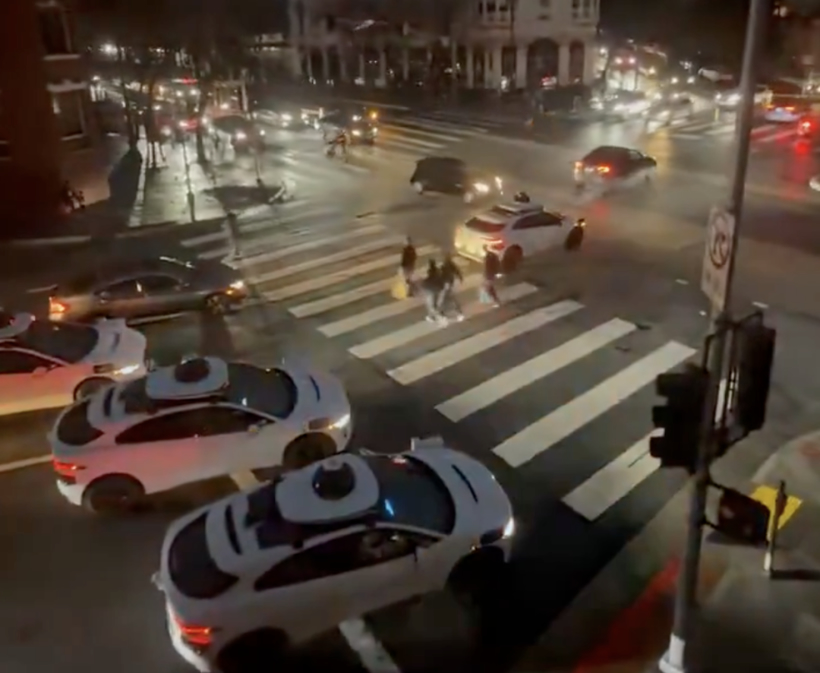
The situation was already chaotic when the power outage caused the traffic lights to malfunction. With the Waymo Driver adding to the mess, it not only caused more congestion on the road but also frustrated others.
As a result, a lot of criticism was directed at Waymo, with some sharply mocking the company by saying that all its Robotaxis are at a loss after traffic lights are turned off, leading to traffic paralysis at intersections. It seems they need to reread page 34 of the California Driver's Handbook.
When the traffic light is off, you should stop at the stop sign and then proceed with caution.
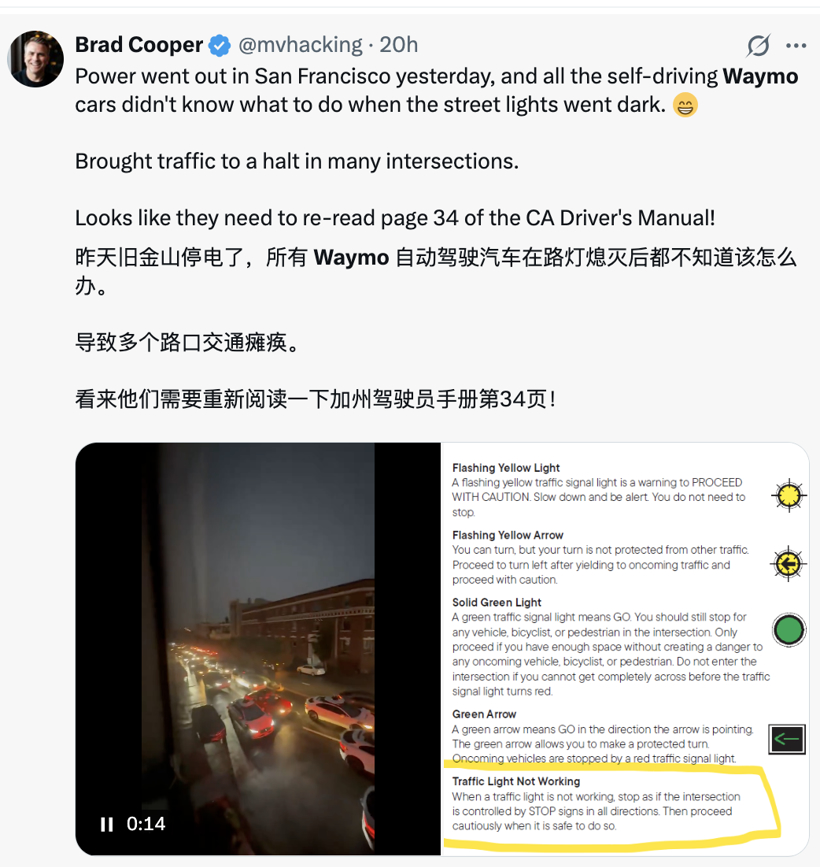
Clearly, the Waymo Driver currently does not understand such basic rules.
After the scandal, Waymo urgently suspended the Waymo Driver service in San Francisco.
Waymo spokesperson Suzanne Philion also responded, stating that Waymo is working closely with municipal departments to restore operations as soon as possible.
Tesla has always been dismissive of Waymo's autonomous driving, and Waymo has become the target of public criticism for a while, which inadvertently handed Tesla the knife to cut its own flesh.
Aiming at the Waymo scandal, Teala AI takes the lead and states, "FSD has been trained over billions of miles in real-world conditions, including power outage scenarios."
"The phrase 'including power outages' is really a bit heart-wrenching."
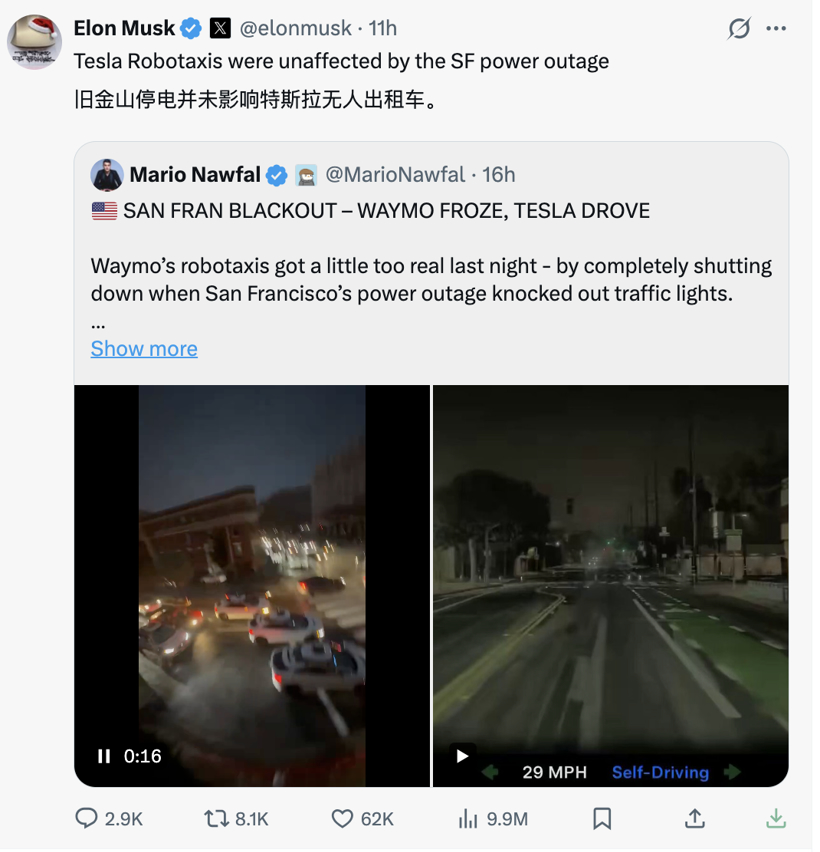
Immediately after, Musk also came out to showcase his prowess as an "old yin-yang master."
Musk reposted the Waymo incident on his personal X account, captioning it, "The power outage in San Francisco did not affect Tesla's autonomous taxis."
Waymo has indeed suffered both a loss of reputation and a setback, not only getting embroiled in a scandal themselves but also inadvertently providing a "wedding dress" for their competitor Tesla—offering free publicity for FSD.
Facing the paralyzed traffic lights at the intersection, FSD's performance was calm and composed, sharply contrasting with Waymo's complete standstill.
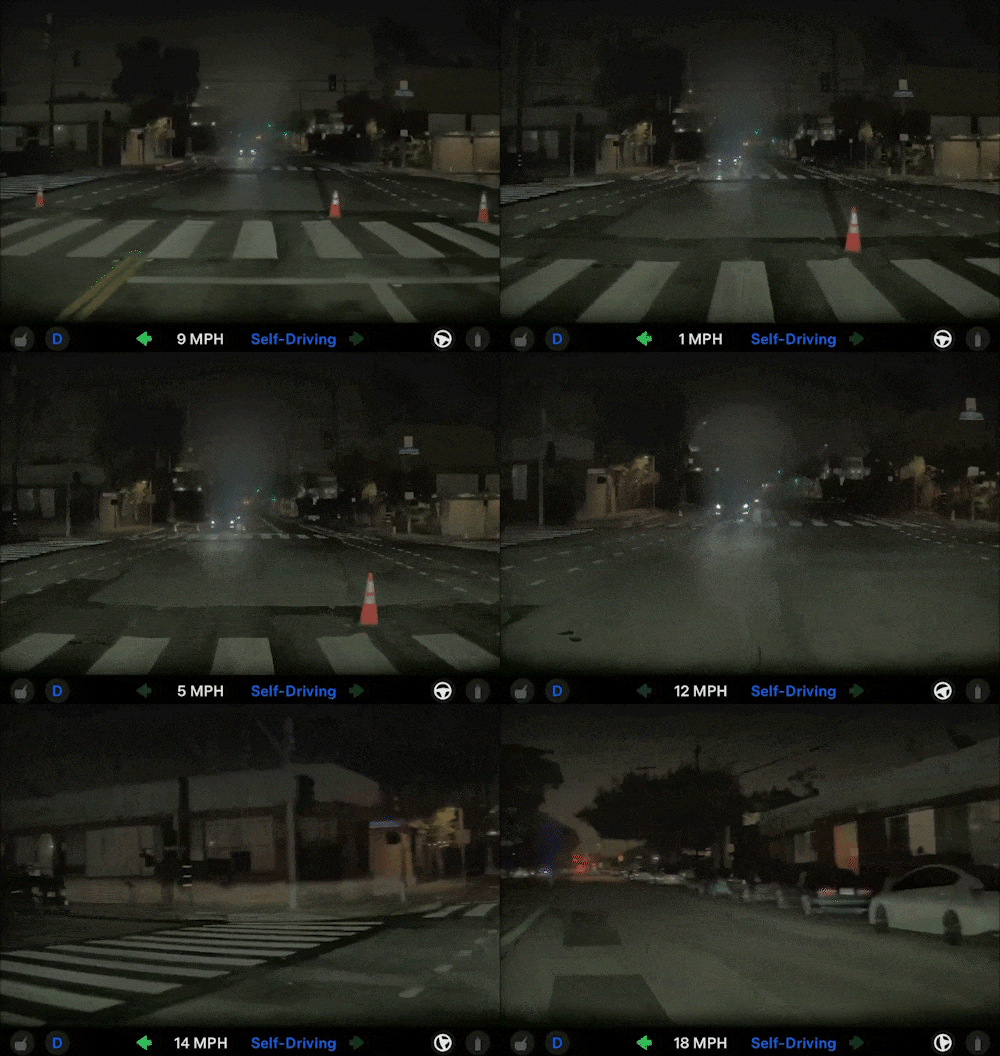
For example, when the traffic lights are off and FSD needs to make a left turn while there are oncoming vehicles going straight, it follows the rule described on page 34 of the California Driver Handbook: first, it stops at the intersection, then completes the left turn in one go before the oncoming vehicles reach the intersection.
One is at a standstill, the other is accomplished in one go. If Waymo is not criticized, who will be?
Will Tesla take the lead after lagging behind?
Musk recently made a bold statement, saying, "Waymo never had a chance to compete with Tesla from the start."
Sure enough, Waymo has just run into Musk's crosshairs.
The stark contrast between Tesla and Waymo's autonomous driving ultimately stems from the fact that Waymo and Tesla adhere to different technological and business logics.
Waymo's robotaxi is equipped with cameras, rooftop lidar, and various other sensors, relying on centimeter-level high-precision maps, while simultaneously considering manual rules and cloud-based training, aiming straight for L4 and L5 autonomy.
As for market implementation, Waymo has chosen to operate in a refined manner within designated areas.
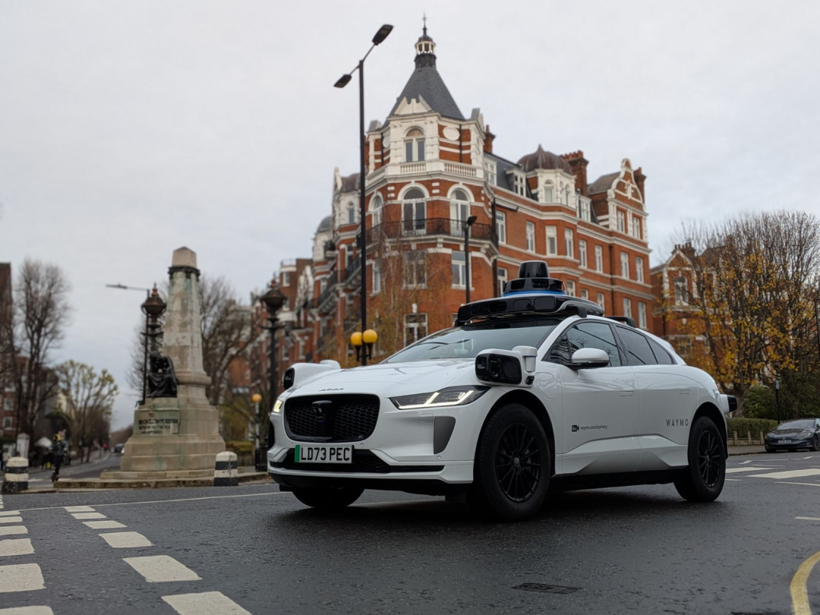
Therefore, Waymo's path is very heavy, taking one step at a time, and each step is very deep.
Although this approach has a relatively high cost and slower ODD generalization, it can ensure that Robotaxi has sufficient safety even without a safety operator, allowing it to be launched into the market and realize commercial value.
Tesla has chosen a lighter and more gradual approach.
It does not use lidar, nor does it rely on high-definition maps. Instead, it completes environmental perception solely through cameras, and by utilizing an end-to-end neural network to mimic human driving behavior, it ultimately achieves autonomous driving.
In terms of landing strategy, Tesla has chosen to start from basic L2 and gradually progress to L4, aiming for a system that can serve both passenger cars and Robotaxis simultaneously, hoping to leverage stronger generalization capabilities to capture a large market share.
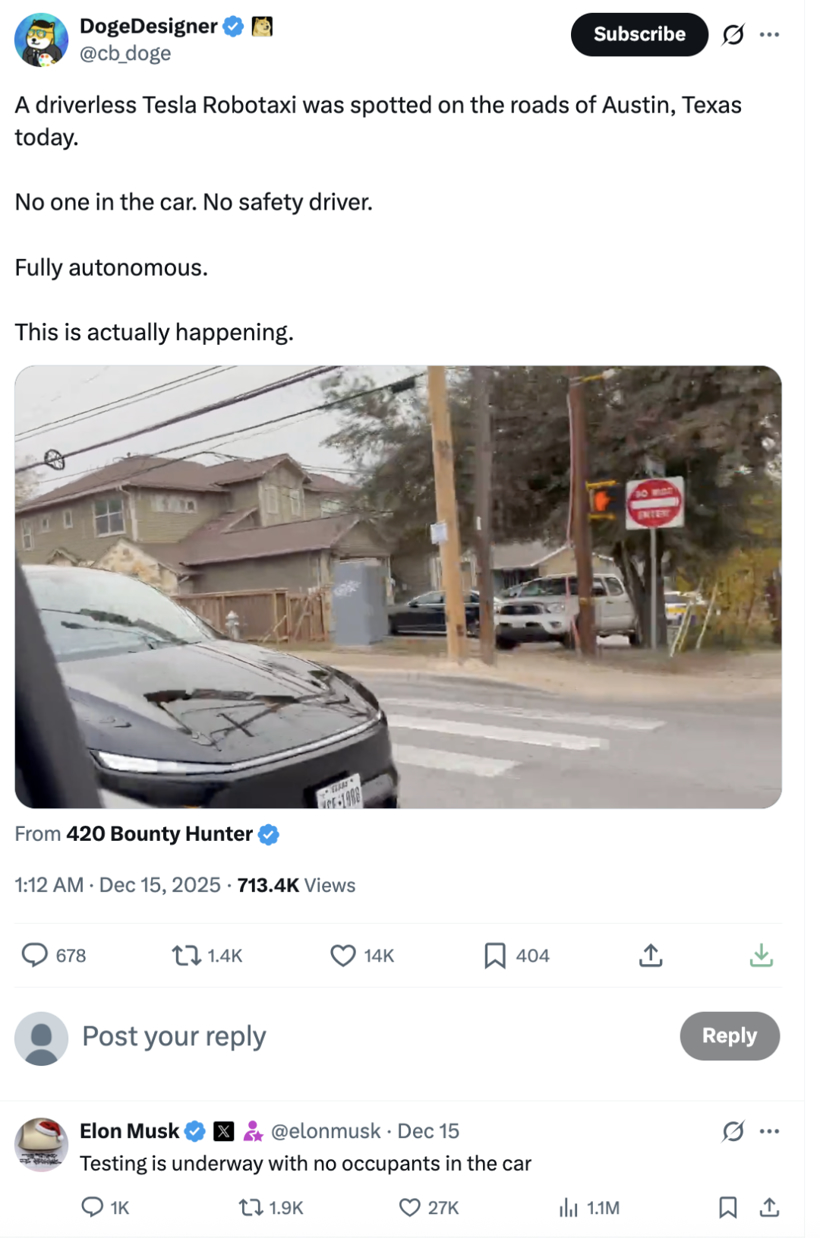
In this power outage incident, Tesla indeed demonstrated a stronger ability to handle atypical scenarios such as traffic light failures, while Waymo was completely defeated.
However, it is important to note that in the Robotaxi market, Tesla is still using the Model Y for trial operations and has not removed the safety driver.
Overall, in the race against Waymo, Tesla's autonomous driving shows significantly greater flexibility in handling "corner cases," but its commercialization has indeed lagged behind.
However, reality does not allow Waymo any room for relaxation.
After all, the pressure exerted by Tesla is continuously increasing. Besides the autonomous driving capability itself, the driverless Model Y has been confirmed by Musk to be undergoing road testing.
Tesla's true ace for competing in the Robotaxi market—the Cybercab—has already hit the testing road.
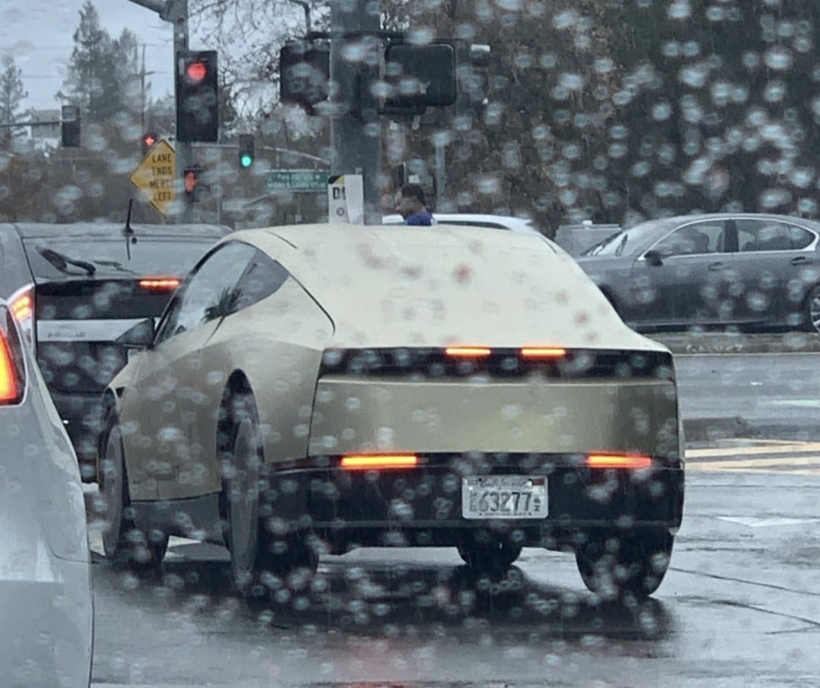
From this perspective, it seems that Tesla's Robotaxi, removing the safety driver, is poised to fully compete with Waymo for the Robotaxi market, and the showdown may be just around the corner.
In the Robotaxi market, will Waymo continue to maintain its leading advantage, or will Tesla catch up and surpass it?
Regarding the Waymo matter, Horizon Robotics CEO Yu Kai also came out to share his thoughts.
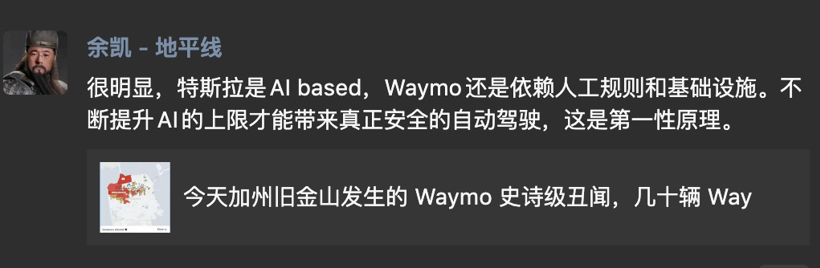
He said, "It is obvious that Tesla is AI-based, while Waymo still relies on manual rules and infrastructure. Continuously improving the upper limit of AI is the key to achieving truly safe autonomous driving, which is the first principle."
Yu Kai's point is that Waymo's technical paradigm is still rule-based, which is less flexible, and to truly achieve autonomous driving, we need to rely on AI. Tesla's FSD is the correct technical paradigm.
Written at the End
Waymo's awkward encounter this time belongs to a corner case for Robotaxi, which strictly follows rule-based algorithms for autonomous driving.
This inevitably makes us think of three or four years ago when domestic intelligent driving players also evolved from rule-based systems.
Changes in high-precision map data can cause assisted driving systems to immediately "shut down," and even obstacles need to be constantly "cleared" to be manageable.
Is achieving autonomous driving a gradual process or will it be a breakthrough through the development of Robotaxis?
We don't want to make early judgments about the development and final outcomes of these two paths, but we can see that domestic players are all trying to cross the river by feeling the stones, just like Tesla.
More and more autonomous driving companies and car manufacturers are recognizing the role of AI in the development of smart driving, embracing end-to-end, VLA, and world models.
【Copyright and Disclaimer】The above information is collected and organized by PlastMatch. The copyright belongs to the original author. This article is reprinted for the purpose of providing more information, and it does not imply that PlastMatch endorses the views expressed in the article or guarantees its accuracy. If there are any errors in the source attribution or if your legitimate rights have been infringed, please contact us, and we will promptly correct or remove the content. If other media, websites, or individuals use the aforementioned content, they must clearly indicate the original source and origin of the work and assume legal responsibility on their own.
Most Popular
-
Layoffs, Divestments, Plant Closures While Pouring Billions: BASF Undergoes Major Transformation!
-
Ascend Adipic Acid Hit By Force Majeure, Market Expects Supply Resumption In Mid-September
-
Raw Material Supply Shortage! INEOS Phenol Declares Force Majeure on Phenol and Acetone Businesses
-
South Korea initiates anti-dumping investigation against Chinese PVC suspension resin! The target is Tianjin Bohua and Wanhua Chemical. How to break through?
-

Sixth national procurement set to be implemented: A “Reshuffling” Moment for the $10-Billion Medical Device Market