



2026, Chinese Auto Parts Suppliers See M&A Surge
Currently, the Chinese automotive industry is moving from high-speed expansion to a stage of high-quality competition, and deep integration of the industrial chain has become the main theme. In the first two months of 2026, Berthel, Ruixin Technology, and Tianqi Mold successively announced controlling equity acquisition plans, accurately addressing the shortcomings in the industrial chain. The intensive integration activities have led the industry to ask: Is this just the beginning? Will the wave of mergers and acquisitions in the domestic automotive parts industry intensify further in 2026?
, Integrated Signal
In 2026, the curtain of mergers and acquisitions in the automotive parts industry was first raised by three controlling acquisitions. Bortel is planning to acquire the controlling stake in Yubei Steering, Rixin Technology aims to obtain 51% equity in Deheng Equipment, and Tianqi Simulation plans to purchase 60% of Dongshi Shares. Although they are engaged in different niche segments, all of them focus on reinforcing the industrial chain, promoting deep integration through the controlling model.
On February 26, BERTHOLD announced a major acquisition plan, proposing to acquire up to 50.9727% of Yubei Steering’s shares for no more than RMB 1.1214 billion, thereby securing controlling interest. As one of the few domestic braking system enterprises capable of competing with international Tier 1 suppliers, BERTHOLD boasts mature technologies in mechanical braking and electronic braking systems. Yubei Steering, meanwhile, is a leading domestic steering system supplier, holding top market shares in commercial vehicle steering and electric power steering (EPS), and possessing in-house R&D capabilities for EPS core electronic control units (ECUs). The combination of the two companies will achieve critical complementarity between braking and steering—the two key chassis safety systems.
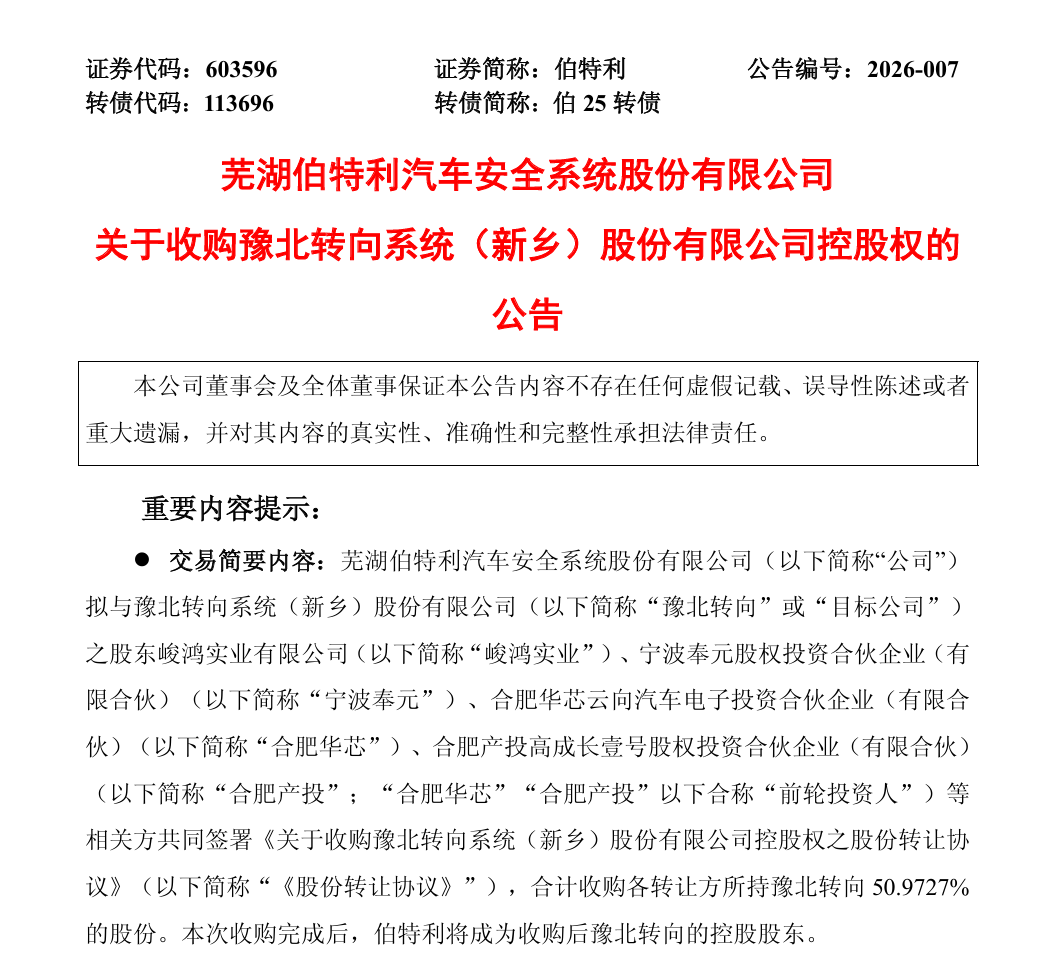
Source: Screenshot from Berti's announcement
After this acquisition, BTL will form an "integrated braking and steering solution," upgrading from a single component supplier to a system-level supplier, significantly enhancing the value of its offerings to OEMs. Additionally, the combination of both parties' customer resources will enable cross-selling and one-stop supply, expanding the market reach.
On February 27, Ruixin Technology swiftly followed up with its acquisition proposal, planning to acquire a 51% stake in Deheng Equipment. Ruixin Technology is a core enterprise specializing in high-end precision aluminum components and has entered the supply chains of companies such as BYD and Vitesco Technologies. However, it faces performance pressure and a clear growth bottleneck due to its single-business focus. In contrast, Deheng Equipment specializes in automotive stamping and welding components as well as intelligent equipment, with projected 2025 revenue of RMB 9.22 billion and net profit attributable to shareholders of RMB 752.073 million—significantly surpassing Ruixin Technology in profitability. Deheng’s core products directly serve mainstream OEMs including Chery, Leapmotor, and JAC Motors. This acquisition would enable complementary synergies in both products and customers.
On the product side, Ruixin Technology's lightweighting and thermal management components, combined with Deheng Equipment's stamping and welding assemblies, create an integrated one-stop supply capability aligned with automakers' procurement needs. On the client side, the transaction enables complementary resource utilization and further expansion of the business footprint. Upon completion of the transaction, Deheng Equipment will become a wholly-owned subsidiary of Ruixin Technology, and the two companies will collaborate across multiple dimensions—including production, R&D, and sales channels—to help Ruixin Technology rapidly enter the automotive body structural components market and improve its profit structure.
As early as February 11, Tianqi Mould had already signaled integration intentions by releasing its restructuring proposal, under which the company plans to acquire a 60% stake in Dongshi Co., Ltd. Tianqi Mould, a manufacturer specializing in automotive body panel dies, boasts outstanding design and manufacturing capabilities but has a relatively narrow business scope. In contrast, Dongshi is a major automotive component supplier serving both commercial and passenger vehicle segments, with products spanning body structures, chassis, and powertrain systems, and holds significant advantages in lightweighting and integration. More importantly, the two companies have collaborated for over a decade, creating natural synergies that enhance the feasibility of this acquisition. Upon completion of the transaction, Tianqi Mould will achieve vertical integration along the industrial chain and significantly boost profitability through shared customer resources and centralized procurement.
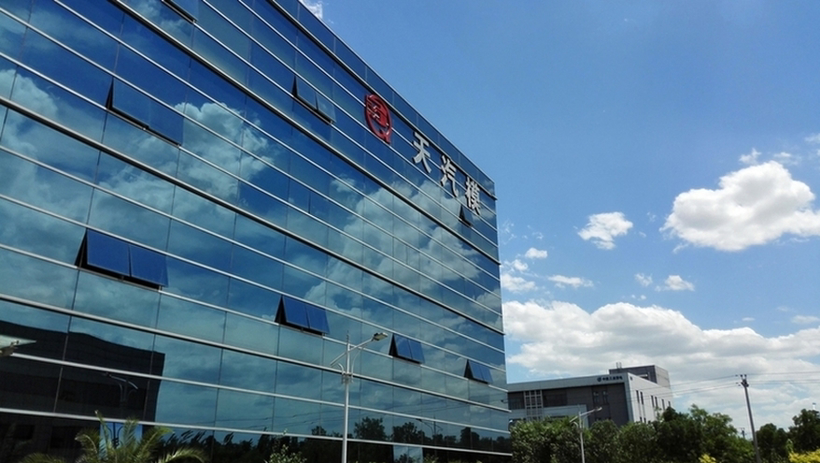
Image Source: Tianqi Mold
These three cases are merely a microcosm of industry consolidation. Over the past two years, consolidation activities in China’s auto parts industry have emerged across multiple niche sectors, consistently exhibiting characteristics of controlling-stake acquisitions, capability gap-filling, and enhanced synergies—for instance, CATL increased its equity stake in Jiangxi Shenghua to 51% through multiple capital increases by the end of 2025; and NavInfo announced in September 2025 that it would become the largest shareholder of JZ Robotics via capital increases and asset injections.
A series of cases collectively send a clear signal: the integration of China’s automotive parts industry has entered a deep-water phase; the logic behind mergers and acquisitions is shifting from simple scale expansion to precise industrial chain complementarity and lean collaboration. Given its ability to achieve deep integration across research & development, production, and sales, the controlling-stake model has become the preferred path for many enterprises seeking industrial chain upgrading.
Behind the M&A, multiple factors work together to drive it
The intensive M&A activities since the beginning of the year are by no means coincidental, but rather an inevitable result of the combined effects of multiple factors at the industrial, market, and capital levels. In the view of industry insiders, now is the golden window for mergers and acquisitions among automotive parts companies.
Zhou Xiaoying, CEO and Editor-in-Chief of Gasgoo, stated frankly that the current timing for mergers and acquisitions is relatively favorable: enterprise valuations are low, while rapid market iteration and intensifying competition are increasingly driving companies to seek mutual support through consolidation. Moreover, industrial development is gradually maturing, entering a phase characterized by the elimination of inefficient production capacity and resources.
From an industrial perspective, the transformation and upgrading of the new energy vehicle (NEV) industry chain is compelling component manufacturers to accelerate integration, and the industry’s shift toward “centralization and high-end development” from “fragmented competition” is irreversible. On one hand, OEMs’ requirements for component suppliers have evolved from mere single-product supply to system-level delivery, one-stop supporting services, and technical integration capabilities. Large-scale component groups capable of providing comprehensive system solutions are increasingly favored, while single-product, small-scale suppliers face mounting pressure to transform or be acquired. Consequently, industry entry barriers continue to rise.
On the other hand, the "Four New Trends" have significantly raised the technological barriers in the automotive components industry. R&D investments related to electrification and intelligence are high and entail long development cycles, making it difficult for any single company to cover all technological aspects. Acquiring core technologies, R&D teams, and industrialization capabilities through mergers and acquisitions has become an effective way for companies to reduce R&D costs and accelerate technology commercialization. Meanwhile, the industry has entered a phase of eliminating inefficient capacity, making it increasingly difficult for smaller and mid-tier enterprises to survive, thereby providing ample high-quality acquisition targets for leading companies seeking consolidation.
Image source: SheTu.com
More fundamentally, domestic auto parts companies are increasingly determined to break the monopoly of international giants and achieve supply chain autonomy and control. Bertell's acquisition of Yubei Steering represents a key horizontal integration by a domestic player in the core chassis systems sector and a significant attempt to counter international giants. As Bertell Chairman Yuan Yongbin stated in a social media post, revealing the strategic intent behind such industry consolidation: "China is the world's largest automobile producer, manufacturing three times as many vehicles as the United States, which ranks second. Yet among the world's top 20 automotive suppliers, only one is Chinese. Chinese companies must quickly grow stronger through horizontal alliances to enhance their competitiveness."
From a market perspective, intensifying competition and the transmission of vehicle price wars have placed component manufacturers under dual pressure—squeezed profit margins and volatile orders—making industry-wide collaboration a shared consensus. Currently, competition in China’s automobile market has reached a fever pitch; automakers continue launching new models to capture market share, driving downward pressure on prices. This pressure is steadily transmitting down the supply chain, continuously eroding component manufacturers’ gross margins—particularly for small and medium-sized enterprises.
Meanwhile, the rapid technological iteration of new energy vehicles has shortened the model update cycle, increasing the risk of order fluctuations for component enterprises. Only companies that are scaled and diversified can have sufficient resources to hedge against project risks. Additionally, the acceleration of exports has raised higher requirements for component enterprises' global delivery and localized service capabilities. Domestic enterprises must achieve scale expansion and capability enhancement through mergers and acquisitions to keep up with the overseas expansion of companies.
From the capital perspective, the continued policy support and the low valuation level of enterprises provide a favorable capital environment for M&A integration.
In recent years, relevant national authorities have intensively introduced policies encouraging listed companies to promote industry consolidation through mergers and acquisitions (M&A). In 2024, the China Securities Regulatory Commission (CSRC) successively issued the "Opinions on Strengthening the Supervision of Listed Companies (for Trial Implementation)" and the "Opinions on Deepening Reforms in the M&A Market for Listed Companies." Other national agencies have also rolled out related policies, explicitly supporting listed companies in traditional sectors to acquire assets within the same industry or along their upstream and downstream supply chains, and encouraging the use of instruments such as shares, cash, and convertible bonds to carry out M&A activities. These policies have removed institutional barriers for M&A and integration among component manufacturers.
Meanwhile, valuations of enterprises in the current component industry are relatively low, enabling leading companies to complete mergers and acquisitions at reasonable costs and reduce integration expenses. Capital markets respond favorably to M&A activities demonstrating synergies, further stimulating companies’ willingness to pursue such transactions. Moreover, participation by industrial funds, private equity funds, and other capital sources provides ample financial support for M&A and integration.
,Will it be more frequent?
The flurry of mergers and acquisitions at the start of the year has fueled market expectations for M&A trends in the auto parts industry heading into 2026, yet controversy has also emerged: Can controlling-stake and capability-gap-filling acquisitions be sustained? Will the industry truly see even more frequent M&A surges?
Based on the current industry landscape and expert opinions, the frequency of M&A activities in China’s automotive parts industry is highly likely to continue rising in 2026, with controlling-stake acquisitions and capability-gap-filling mergers becoming the dominant types in the near term. However, M&A quality—rather than quantity—will become the central focus, and integration capability will determine the ultimate success or failure of such transactions.
In Zhou Xiaoying's view, an era of industry consolidation is coming. "The competition in the Chinese market is extremely fierce, with automakers and brands continuously investing in new models entering the market, leading to ongoing price declines and significant operating pressure on the supply chain. In a way, only large-scale companies can remain at the table, with sufficient resources to offset project risks. Enterprises below the middle tier are increasingly struggling to survive, while those above the middle tier need greater scale and capabilities to move upward, thus opening the window for mergers and acquisitions."

Image source: Shetuwang
From a segment-specific perspective, in addition to the chassis and equipment sectors highlighted in the early-year cases, sectors closely tied to the “Four New Trends” (electrification, connectivity, intelligence, and sharing)—including the “three-electric” systems (battery, motor, and electronic control), intelligent cockpits, lightweighting, and steer-by-wire chassis—will become the next M&A hotspots. These sectors feature high technological barriers and substantial R&D investment, placing significant pressure on SMEs’ survival. Meanwhile, leading enterprises, aiming to address technological gaps and strengthen their product portfolios, will accelerate M&A and integration activities.
Zhou Xiaoying pointed out that strategic emerging industries and key sectors will create more merger and acquisition opportunities. Additionally, "foreign enterprises operating in China, if their performance fails to meet the expectations of their headquarters, may become acquisition targets for Chinese enterprises. Foreign companies can cash out, while Chinese enterprises can obtain new markets and customer resources, which can be a new win-win situation."
From the perspective of M&A models, Zhou Xiaoying believes that controlling-stake acquisitions and gap-filling acquisitions will be the dominant models in the transitional phase of 2026.
This aligns closely with the current industry's development needs. Compared to minority equity investments, a controlling stake enables the acquirer to gain actual control over the target company, allowing for deep integration across R&D, production, sales, and management, thereby maximizing synergies in products, customers, and technology—precisely the core requirement for automotive component suppliers to achieve system-level delivery capabilities.
Instead of blind scale expansion, "complementing weaknesses" through mergers and acquisitions can more accurately enhance a company's core competitiveness and achieve lean synergy, which aligns with the industry's trend of shifting from "scale expansion" to "quality competition." Whether it is Bertley complementing its shortcomings in the steering system or Ruixin Technology addressing its gaps in body structure components, these are typical examples of this logic, and such a merger strategy will become more common among other enterprises.
However, it cannot be ignored that the integration risks after mergers and acquisitions have become a focus of market attention. Mergers of parts companies are not simply about equity consolidation, but rather a comprehensive integration of corporate culture, management teams, technical systems, supply chains, and sales channels. Any disconnection in any link may turn synergy effects into "paper promises".
Particularly “interesting” is the fact that domestic and foreign component companies are currently exhibiting markedly divergent development trends: while domestic firms are accelerating mergers and acquisitions, international component giants such as SKF and Aptiv are instead actively pursuing business spin-offs. Regarding this, Zhou Xiaoying stated: “The business spin-offs undertaken by international component giants fundamentally aim to realign corporate organizational structures with the technological pace and competitive logic amid the electrification and intelligence.”
She pointed out that today's automotive parts giants often simultaneously carry three completely different business logics within the same company: the traditional manufacturing business that emphasizes scale, efficiency, and stable delivery, the heavily asset-intensive and relatively clear electrification-related business, and the highly uncertain, long R&D cycle, and high failure rate intelligent and software business. "When technology, products, and the business itself have already been decomposed into different tracks, facing completely different ecological environments, competition rhythms, resource inputs, and returns, continuing to use a single organizational form to carry them, conflicts are almost inevitable. And in the nearly decade-long electrification and intelligence wave, the speed of technological deconstruction in the automotive industry has been astonishing. The organizational structure of enterprises, in fact, is a lagging response, and is being forced to catch up."
Overall, the frequency of mergers and acquisitions in China's automotive parts industry is likely to continue increasing in 2026, and the pace of industry consolidation will further accelerate. Controlling acquisitions and acquisition-oriented strategies aimed at addressing weaknesses will become the dominant model in the short term. More leading companies in specialized segments will use acquisitions to complete their industrial chains and enhance core competitiveness. However, at the same time, the ability to integrate after acquisitions, compliance with policies, and the reasonableness of valuations will become key challenges for companies.
【Copyright and Disclaimer】The above information is collected and organized by PlastMatch. The copyright belongs to the original author. This article is reprinted for the purpose of providing more information, and it does not imply that PlastMatch endorses the views expressed in the article or guarantees its accuracy. If there are any errors in the source attribution or if your legitimate rights have been infringed, please contact us, and we will promptly correct or remove the content. If other media, websites, or individuals use the aforementioned content, they must clearly indicate the original source and origin of the work and assume legal responsibility on their own.
Most Popular
-
Supply Extremely Tight! LG Chem Declares Force Majeure on Export Contracts for Di-Octyl Terephthalate (DOTP)
-
Huntsman Introduces “War Surcharge” Amid Shipping Disruption and Soaring Energy Costs, Global MDI Prices Continue to Rise
-

Deadly Impact: Hormuz Strait Blockade Sparks Shortage of Plastic Raw Materials, Threatening Shutdowns at Japanese and Korean Chemical Plants
-

LG Chem Declares Force Majeure on DOTP Exports! SABIC Joins Five Giants to Redefine EV Safety
-

Tao Lin: Tesla’s Supercharger Stations in China Surpass 2,500


