$2.2 billion financing: Can NIO, XPENG, and Li Auto’s Chip Strategy Break Through?
Recently, NIO Group announced that its chip subsidiary, Anhui Shenji Technology Co., Ltd., has signed the agreement for its Series A equity financing round, raising RMB 2.257 billion, with a post-money valuation nearing RMB 10 billion. This financing round attracted participation from multiple investors, including Hefei State-owned Capital Investment Holding Group, Hefei Hengtai Group, IDG Capital, SMIC Capital, and Yuanhe Puhua.
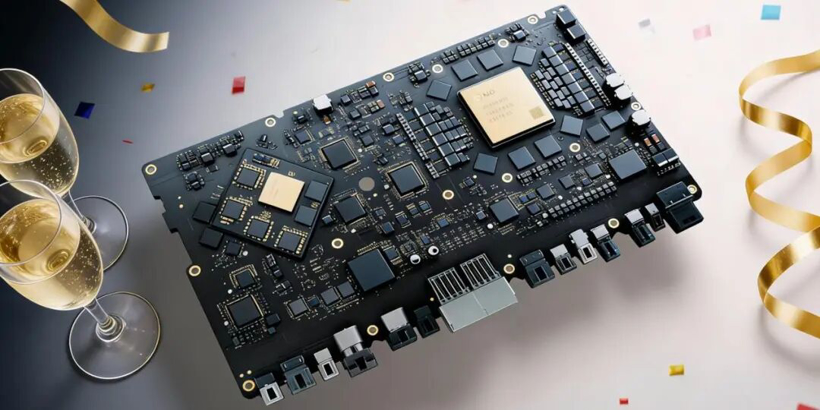
Over the past three years, the intelligent driving industry has undergone a seemingly prosperous yet crisis-laden "computing power race." Automakers have rushed to adopt NVIDIA's Orin-X chips, rapidly deploying smart driving features by piling up general-purpose computing power, only to fall into a quagmire of homogenized competition.
However, as end-to-end large models take over urban autonomous driving in 2025, the power efficiency drawbacks of general-purpose chips become fully exposed: high power consumption directly affects the range of electric vehicles; the software stack and the underlying heterogeneous architecture are difficult to align, leading to the inability of large model inference latency to achieve human-like millisecond response. It is against this backdrop that the self-developed chip seed sown by NIO in 2021 finally reaped concentrated rewards in 2026.
This article will briefly analyze the capital logic, technological breakthroughs, and business transformations behind NIO's chip subsidiary's fundraising event, explore how this financing reshapes the competitive landscape of China's automotive-grade chips, and forecast three definitive trends for the era of intelligent vehicle "computing sovereignty" from 2026 to 2030.
01 2.2 Billion in Financing: The Capital Logic
Anhui Shenji Technology Co., Ltd. was established in June 2025 as an independent entity following NIO’s spin-off of its in-house chip development business. Its legal representative is Bai Jian, Senior Vice President of NIO and Head of Intelligent Hardware. The company’s flagship product is the Shenji NX9031, an advanced automotive-grade intelligent driving chip fabricated on a 5-nanometer process. Since entering mass production in 2024, over 150,000 units have been shipped, and the chip has been successfully deployed across NIO’s entire vehicle lineup.
This round of financing reached 2.257 billion yuan, with a post-investment valuation nearing 10 billion yuan, featuring a characteristic of diverse capital participation. In terms of the composition of investors, there are both local state-owned capitals (Hefei State Investment, Hefei Haiheng), as well as funds with a semiconductor industry chain background (SMIC Capital, Oriza Fuisin), and well-known market-oriented institutions (IDG Capital).
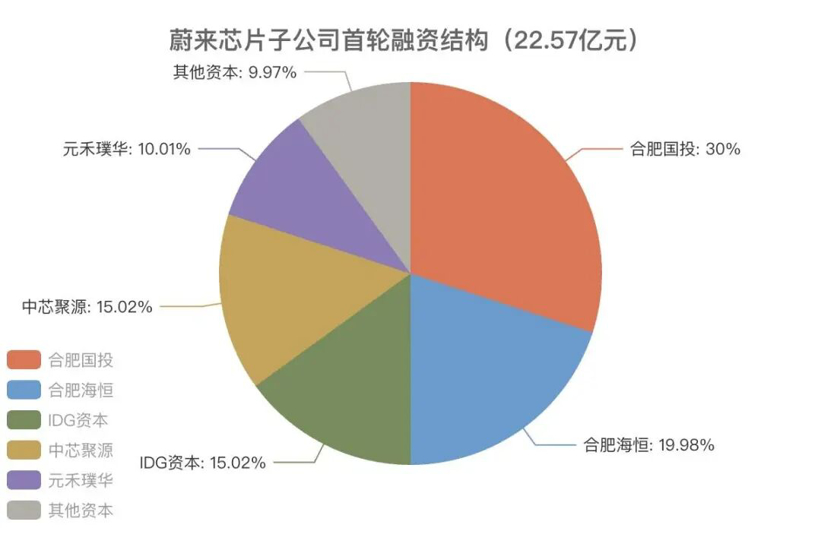
Data source: NIO announcements and public information, for reference only.
Guest Professor Zhang Xiang of Huanghe Science and Technology College once stated in an interview: "The fact that Shenji was able to complete its first round of financing with a high threshold demonstrates the capital market's recognition of its technical approach, mass production capabilities, and progress in application implementation."
Meanwhile, the participation of local state-owned capital also aligns with Hefei's recent intensified efforts to bolster its integrated circuit industry. As a key hub for China's integrated circuit sector, Hefei has established a complete industrial chain spanning design, manufacturing, and packaging/testing. Shengji's establishment and fundraising further solidify Hefei's leading position in the automotive-grade chip segment.
From a financial perspective, this round of financing marks the transition of NIO's chip business from the 'internal incubation stage' to a 'new phase of pursuing return on investment'.William Li, founder of NIO, once revealed that the R&D cost of the Shenji NX9031 is equivalent to building 1,500 battery-swapping stations; based on an estimated cost of RMB 1.5–2 million per station, the total investment amounts to between RMB 2.25 billion and RMB 3 billion.
Bringing in external investment not only helps alleviate NIO's capital pressure but also enables deep strategic alignment with partners through equity-level collaboration, allowing them to jointly share the high costs and tape-out risks associated with chip development.
What's more noteworthy is that Shengji's independent financing has opened up a channel for NIO to reshape its valuation outside of the secondary market. The independent chip entity has the potential to become a 'Chinese version of Mobileye,' which, in the context of increasingly fierce competition in the smart car market and pressure on the gross margin of whole vehicles, provides NIO with a new growth narrative.
02Can Shenji replace Nvidia?
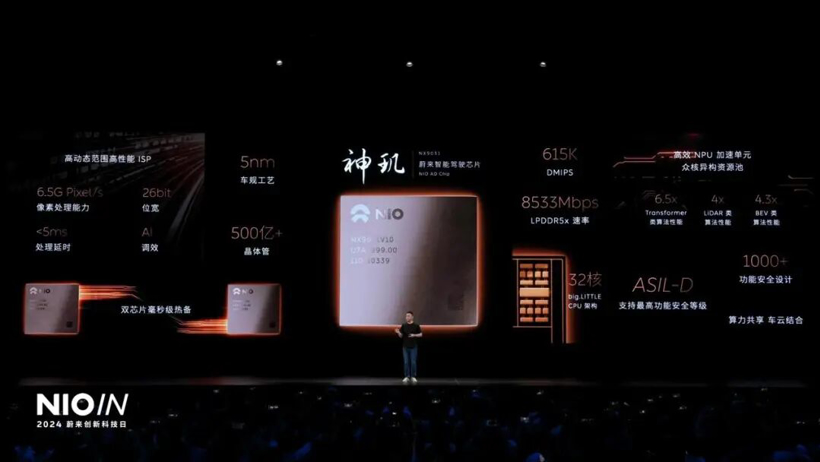
Ji Ji NX9031 is the world's first mass-produced intelligent driving chip to adopt 5nm automotive-grade process technology.Since its commissioning in 2024, it has shipped over 150,000 units cumulatively and is fully deployed across NIO’s entire vehicle lineup, including the ET9, ES6, EC6, and the all-new ES8.The core value of this chip lies not in simply stacking computing power, but in architecture-level optimization tailored for autonomous driving scenarios, achieved through a proprietary image signal processor (ISP) and neural processing unit (NPU).
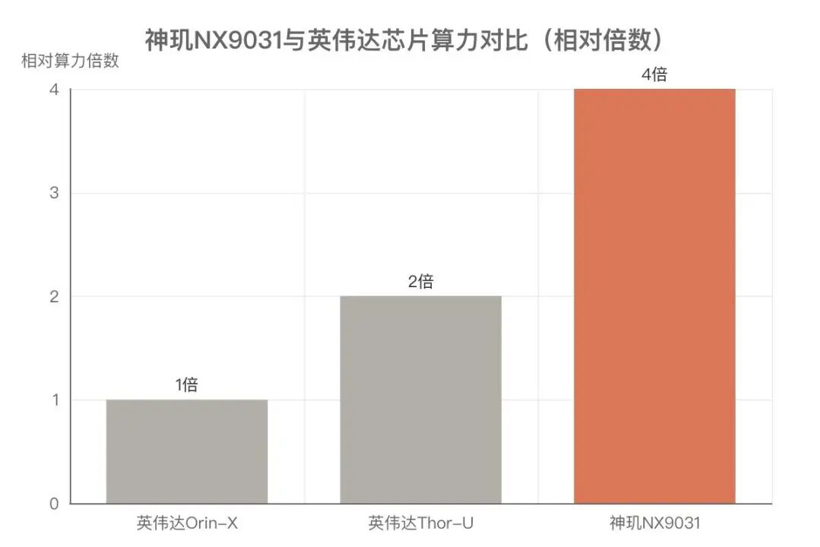
Data source: NIO official technical documentation, for reference only
In processing ultra-high-resolution BEV (Bird's Eye View) algorithms, the efficiency of the Jinyi chip is more than three times that of the same-generation general-purpose chips. This is attributed to its heterogeneous multi-core resource pool architecture, which supports concurrent multi-task processing and covers various application scenarios such as perception, planning and control, and cabin computing. Zhang Danyu, the chip design director at NIO, introduced in May 2025 that the chip's key performance indicators exceed those of industry general-purpose chips, and its mass production time is earlier than that of NVIDIA's next-generation intelligent driving chip Thor-U.
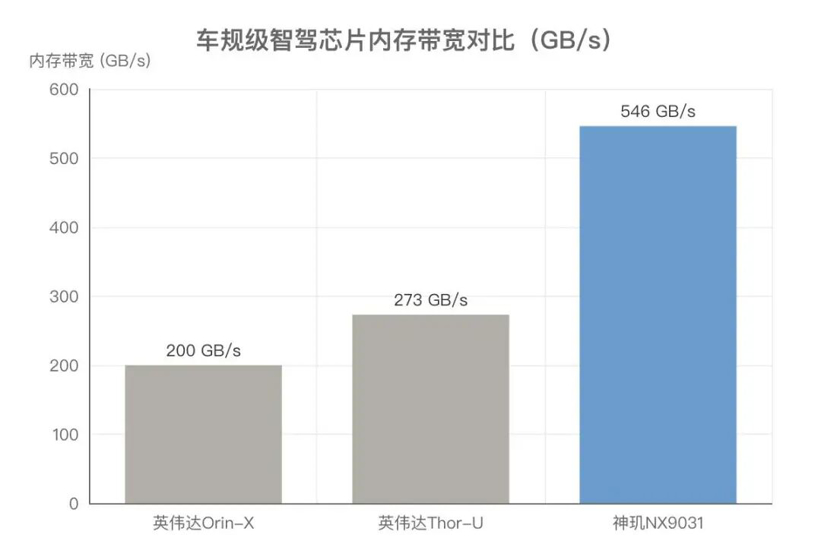
Data source: Official NIO data and industry research, for reference only.
In addition to its computational power advantage, the Shenji NX9031 has also achieved a breakthrough in the critical metric of memory bandwidth.According to NIO’s official data, the chip’s memory bandwidth reaches 546 GB/s, twice that of NVIDIA’s Thor-U (approximately 273 GB/s).Higher memory bandwidth allows the chip to access information more quickly when processing large volumes of visual data, thereby reducing inference latency and enhancing the real-time response capability of the intelligent driving system.
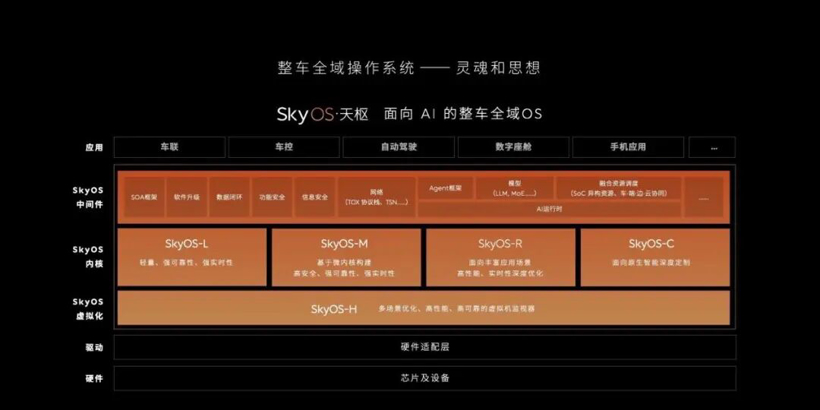
Looking back at the history of the Shenji chip, NIO started its self-research and development project in 2021, completing the entire process from design, research and development, wafer fabrication, testing to mass production in four years. More importantly, the Shenji chip is deeply integrated with NIO's self-developed full-stack vehicle-wide operating system, SkyOS·Tianshu, from instruction set to memory scheduling, fully self-developed, allowing the advantages of the 5nm process to be fully utilized. Clearly, the vertical integration capability of the 'chip-operating system-algorithm' trinity is becoming the core moat for NIO in the second half of the intelligent driving competition.
From 'Cost Center' to 'Profit Engine'
In traditional perception, in-house chip development is a "cost center" for automotive companies — high R&D investment, long return cycles, and dual uncertainties in technology and market make most automakers hesitate. However, by commercializing the NIO Chip on a large scale and securing independent financing, NIO is transforming its chip business from a "cost center" into a "profit engine," redefining the value chain of intelligent vehicles.
Li Bin revealed that NIO spent billions of yuan on purchasing third-party chips in 2024 alone. After adopting its self-developed chips, the per-vehicle cost was significantly optimized. According to Li Bin’s estimate, the Shenji NX9031 chip delivers approximately RMB 10,000 in cost savings per vehicle.With a sales volume of 179,000 units in 2025, chip cost reduction alone contributed nearly 1.8 billion yuan in gross profit margin.This is precisely the key driver behind NIO achieving Non-GAAP profitability in Q4 2025, effectively locking in the gains.
However, NIO's ambition goes beyond that. The independent financing and market expansion of Shenji mark the second upgrade of NIO's chip strategy: shifting from 'internal cost reduction' to 'external profitability.' Lin Shi, Secretary General of the Intelligent Connected Vehicle Branch of the China-Europe Association for Technical and Economic Cooperation, once stated: 'Splitting the chip business and introducing external capital can help clarify the relationship between R&D investment and commercial returns.' For automobile manufacturers, self-developing core chips not only enhances the autonomy of the supply chain but also provides greater flexibility in cost control and product definition.
Shenji Company is actively expanding its emerging businesses in embodied robotics and agent reasoning, aiming to become a leading supplier of general-purpose intelligent hardware chips and solutions in the AGI era. In November 2025, Anhui Shenji, AIXIPIC, and OmniVision jointly established the joint venture “Chongqing Chuangyuan Zhihang Technology Co., Ltd.” with a registered capital of RMB 100 million. The joint venture is positioned to “de-emphasize the NIO brand identity” and serve as the primary vehicle for expanding business with non-NIO customers, thereby facilitating the market-oriented expansion of the chip business.
NIO founder Li Bin has mentioned multiple times the external sales and licensing plans for the Shenji NX9031.At the China Electric Vehicle Hundred People Forum in March 2025, Li Bin announced: “If anyone wants to buy the best chips, they can contact NIO.”This open approach stands in stark contrast to the closed mindset of traditional automakers, who view core technologies as exclusive competitive advantages. NIO is attempting to use chips as a starting point to transform itself from a vehicle manufacturer into a "semiconductor technology company with an automotive business."
04The Survival Logic Behind Path Divergence
The completion of Shenji's 2.2 billion yuan financing is not an isolated event, but a typical microcosm of the 'chip watershed' in China's intelligent vehicle industry in 2026. On the same timeline, Li Auto's self-developed chip M100 is entering the final countdown for mass production and delivery, while Xpeng Motors has formed a deep partnership with the Volkswagen Group through technology export.
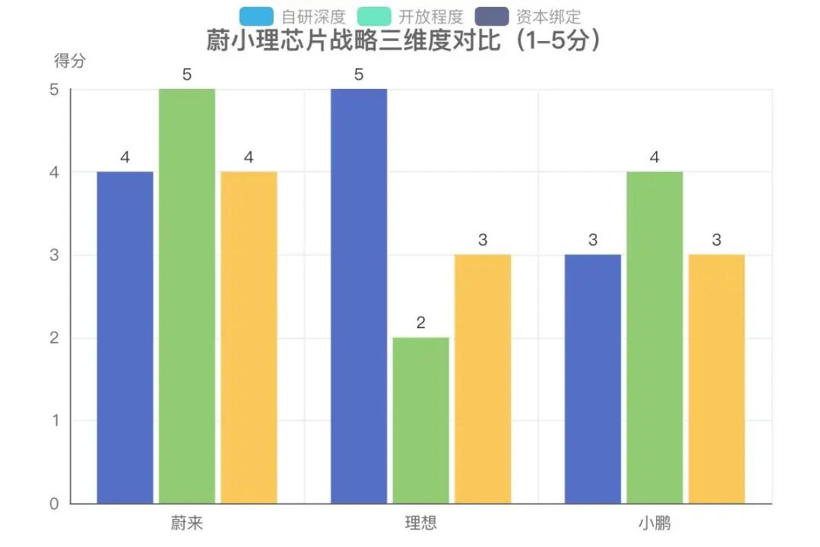
Data source: Industry analysis and public information, for reference only.
The differentiation in chip strategies among the three leading new energy vehicle companies, NIO, XPeng, and Li Auto, reveals three future survival paths for the intelligent automobile industry.
-
NIO Model:Capital + Socialization Integration. The core lies in “shared responsibility”: introducing external capital and external customers to transform chips into an independently profitable pillar industry. The advantage of this open model is the rapid amortization of R&D costs and the realization of economies of scale; the challenge lies in breaking down competitive barriers among automakers and persuading peers to adopt its chip solutions. NIO’s answer is “decoupling”—providing a foundational chip plus a basic algorithm framework, enabling customers to run their own intelligent driving solutions on top.
-
Ideal mode: Translate the above content into English, output the translation result directly, without any explanation.Administrative + vertical binding. The core lies in 'centralization,' where the chip serves as a tool for the entire vehicle, pursuing the ultimate in software-hardware integration at all costs. The R&D investment in the Li Auto M100 chip far exceeds the industry average, but its goal is not for external sales, but to provide underlying support for the 'mobile home space' experience. The advantage of this closed-loop, high-price strategy is the ability to achieve deep optimization and create exclusive competitiveness; the disadvantage is the long R&D cost recovery cycle and the difficulty in forming external scale effects.
-
Xiaopeng Model: Translate the above content into English, output the translation directly, without any explanation.Technology plus horizontal binding. The core lies in "scale," by technology output binding Volkswagen Group, solving the problem of Xpeng's relatively small sales base. Xpeng refuses to pursue heavy-asset joint ventures, instead pursuing "soft joint ventures" — that is, technology. The advantage of this alliance model is the ability to quickly expand the application of technology and enhance industry influence; the challenge lies in the potentially limited profit margin from technology output, and the risk of core technology spillover.
Behind the three models lies the same underlying logic expressed in three different ways: scale is the lifeline of chips.
In 2026, the tape-out and mass-production costs for a single advanced-process automotive-grade chip will reach several billion RMB. Whether through in-house R&D, joint ventures, or strategic partnerships, the core objective remains the same: crossing the “critical scale threshold.” NIO’s open model, Li Auto’s closed-loop premium pricing strategy, and XPeng’s technology licensing approach are, at their core, all seeking a path to amortize R&D costs and achieve commercial sustainability.
05Three certainties of automotive-grade chips in the next five years?
The 2.2 billion yuan financing of Shenji is not just a financial event, but also a signal flare for China's automotive-grade chip industry moving from 'following' to 'leading'. Based on a comprehensive analysis of current technological evolution, capital layout, and market demand, we can outline three definitive trends in the automotive-grade chip sector from 2026 to 2030.
-
Supply chain power is shifting toward OEMs (original equipment manufacturers). In the past, Tier 1 suppliers (e.g., Bosch, Continental) held core control. However, by 2026, through “in-house R&D + strategic partnerships,” NIO, XPeng, and Li Auto are redefining supply chain relationships. Automakers are no longer passive recipients of chips; instead, they actively design chips—and even supply chips back to traditional Tier 1 suppliers. The underlying logic driving this power shift is the technical complexity of autonomous driving: only OEMs possess the deepest understanding of end-to-end system requirements and thus can design chip architectures best suited to their needs.
-
Car Cloud Summary
【Copyright and Disclaimer】The above information is collected and organized by PlastMatch. The copyright belongs to the original author. This article is reprinted for the purpose of providing more information, and it does not imply that PlastMatch endorses the views expressed in the article or guarantees its accuracy. If there are any errors in the source attribution or if your legitimate rights have been infringed, please contact us, and we will promptly correct or remove the content. If other media, websites, or individuals use the aforementioned content, they must clearly indicate the original source and origin of the work and assume legal responsibility on their own.
Most Popular
-
Supply Extremely Tight! LG Chem Declares Force Majeure on Export Contracts for Di-Octyl Terephthalate (DOTP)
-
Huntsman Introduces “War Surcharge” Amid Shipping Disruption and Soaring Energy Costs, Global MDI Prices Continue to Rise
-
Deadly Impact: Hormuz Strait Blockade Sparks Shortage of Plastic Raw Materials, Threatening Shutdowns at Japanese and Korean Chemical Plants
-

LG Chem Declares Force Majeure on DOTP Exports! SABIC Joins Five Giants to Redefine EV Safety
-
Tao Lin: Tesla’s Supercharger Stations in China Surpass 2,500