Us-Iran Negotiations Remain Stalled, Crude Oil Night Session Rises, High Volatility Continues! Divergent Trends in Plastic Futures
Overnight Crude Oil Market Dynamics
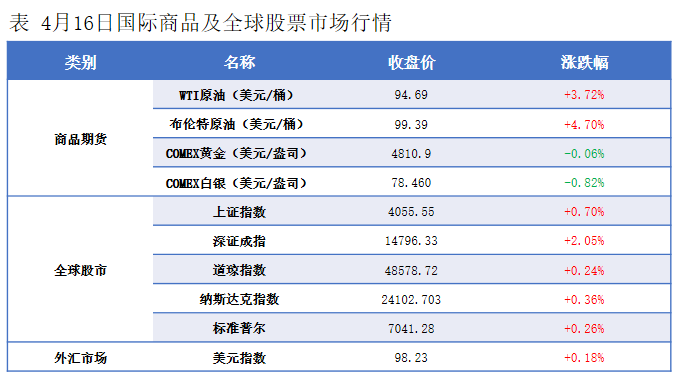
Market concerns persist regarding the prospects of U.S.-Iran negotiations, and supply risks in the Middle East remain evident, driving up international oil prices. NYMEX crude oil futures for May contract rose by $3.40 per barrel to $94.69, an increase of 3.72% week-on-week; ICE Brent crude oil futures for June contract rose by $4.46 per barrel to $99.39, up 4.70% week-on-week. China’s INE crude oil futures for June 2026 contract declined by 0.4 to 631.3 yuan per barrel, and rose by 8.1 to 639.4 yuan per barrel during the night session.
Market Forecast
The prolonged blockade of the Strait of Hormuz and the loss of over 10 million barrels per day of crude oil supply from the Middle East are likewise key factors driving oil prices. Meanwhile, the demand-suppressing effect of high oil prices is increasingly drawing investors’ attention, with multiple institutions forecasting that global oil demand growth may stall—or even contract—in 2026 due to war-related disruptions and persistently elevated prices. Consequently, investors’ expectations continue to fluctuate amid successive waves of news, resulting in sustained high volatility in oil prices. In the short term, progress in ceasefire negotiations remains the market’s top focal point; in the medium to long term, however, shifts on both the supply and demand sides will remain the core drivers of oil prices. Tight supply conditions in the second quarter constitute a highly certain fundamental backdrop, providing robust downside support for oil prices. Recent sharp price declines may present appropriate opportunities for selective accumulation at lower levels. Given the prevailing high volatility and substantial uncertainty in the market, enhanced risk control and cautious participation are advised.
II. Macroeconomic Developments
1. Iran situation
①Trump: Has obtained a "highly significant" statement ensuring Iran will not possess nuclear weapons, with a validity period exceeding 20 years. U.S.-Iran talks may resume this weekend. Willing to travel to Pakistan to advance the agreement.
②Trump says Lebanon and Israel agree to a 10-day ceasefire; Israeli Prime Minister says ceasefire agreed uponIt will maintain its military presence in southern Lebanon, and the Lebanese Prime Minister welcomed Trump's declaration of a ceasefire.
③ Iranian sources: U.S. and Iran scale back ambitions for a comprehensive peace deal, seeking a temporary agreement instead.
④The Foreign Ministry of Pakistan: The US and Iran are willing to hold talks, and the process is ongoing. The date for the next round of US-Iran talks has not yet been determined.
⑤ The U.S. military has expanded its blockade on Iranian shipping goods to include weapons, ammunition, crude oil, refined petroleum products, steel, and aluminum.
2、Russian forces launched large-scale air strikes on multiple cities in Ukraine, with Kyiv and Odessa suffering heavy damage.
3. U.S. Energy Secretary Wright: Will take more measures to keep gasoline prices low.
The head of the International Energy Agency warned: Europe's aviation fuel inventory is only enough for 6 weeks, and some flights are about to be canceled.
5. Federal ReserveWilliams: If inflation to 2%, cutting rates would be appropriate, but it's not yet there; Millan: cutting rates three times this year, possibly four times; As of this morning, interest rate futures are pricing a cumulative cut of approximately 9BP for the entire year.
6、TSMC's first-quarter profit surged 58%, exceeding expectations and reaching a record high.
7、China's GDP grew by 5.0% year-on-year in the first quarter.
8、The State-owned Assets Supervision and Administration Commission of the State Council held a special promotion meeting on the development of the low-altitude economy industry for central enterprises.
9, Has China conducted preliminary talks on restricting the export of advanced solar manufacturing equipment to the U.S.? Ministry of Commerce responds: Not aware of the relevant situation.
10. China’s response to Trump’s sanctions against countries purchasing Iranian oil: China consistently opposes illegal unilateral sanctions that lack a basis in international law and are not authorized by the UN Security Council.
III. Early Morning Dynamics of the Plastic Market
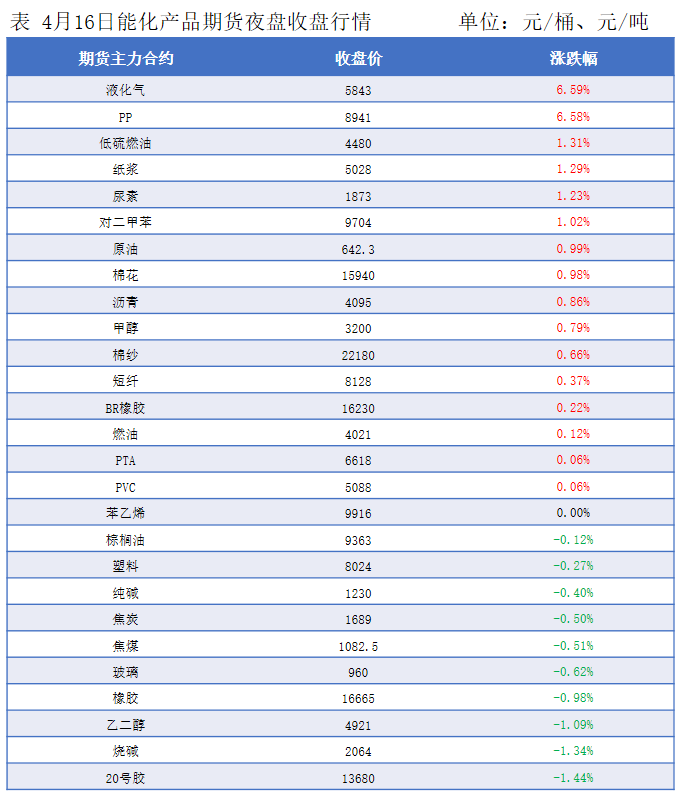
Oil prices surge! Domestic plastic futures main contracts show mixed performance.
Plastics May 2026 contract closed at RMB 8,024 per ton, down 0.27% from the previous trading day.
The PP2605 contract was reported at 8941 yuan/ton, up 6.58% from the previous trading day.
PVC2605 contract is quoted at RMB 5,088 per ton, up 0.06% from the previous trading day.
The styrene 2605 contract is reported at 9916 yuan/ton, unchanged from the previous trading day.
IV. Market Forecast
Domestically, inventory levels of major polyolefin producers in China have accumulated to 9 million tons, indicating a relatively ample supply of resources. The slow progress in inventory clearance has resulted in an abundant supply of goods in the market, further weakening the driving force for price increases. Meanwhile, downstream industries have maintained a cautious and watchful attitude, with purchasing activities primarily focused on spot demand, without any intention of centralized stockpiling or proactive inventory replenishment. As a result, overall market transactions have been insufficient, and the connection between supply and demand across the industry chain has remained unsatisfactory. Considering the overall market situation, the current polyethylene market is characterized by a more negative balance of forces, with no obvious positive factors in the fundamentals. Neither inventory, demand nor cost factors have shown any significant positive developments. It is expected that the polyethylene market will find it difficult to break through in the short term, continuing to exhibit a narrow and weak fluctuation trend. Prices lack the driving force for an upward move, and there is also no foundation for a significant decline. Overall, the market will remain within a range of fluctuations, with traders maintaining a conservative and watchful approach, and transactions mainly based on spot demand. The market is unlikely to see a trend-driven movement.
PP: The geopolitical tensions have significantly eased, and market concerns about supply tightness continue to weaken. Meanwhile, refining activity in many Asian countries remains low, and the expectation of continued Federal Reserve interest rate hikes further depresses the mood in the commodity market, continuously weakening the upward momentum of raw materials. From the perspective of the polypropylene industry itself, the situation of both supply and demand being weak is very evident. The downstream product market is struggling to pass on prices, and cannot bear the high prices of upstream raw materials. Downstream demand remains limited. Traders, under pressure to sell, are actively offering discounts to move goods, while downstream customers are only maintaining small, urgent purchases. The overall trading atmosphere in the market is quiet. In summary, in the short term, geopolitical conflicts and macroeconomic policies will continue to dominate the market, and the fundamental supply and demand situation is unlikely to show significant improvement. It is expected that the polypropylene market will maintain an oscillating and consolidating trend, with limited room for price fluctuations up or down. Overall, it will be characterized by narrow fluctuations and cautious observation, without a clear directional trend.
PVC: From the supply side, there are maintenance plans for PVC facilities recently, with both electric calcium carbide-based and ethylene-based production rates gradually declining slightly, indicating a reduction in supply. From the demand side, downstream sectors remain focused on spot purchases. After the extreme "black swan" event in March due to the conflict, demand has started to return to normal, mainly driven by spot needs. The fundamentals of PVC remain weak due to the supply and demand situation. On the international market, crude oil prices remained almost flat, with market participants waiting for more explicit information regarding U.S.-Iran negotiations, potential extension of ceasefire, and possible reopening of the Hormuz Strait. Meanwhile, U.S. crude oil and refined product inventories have both declined, which is supportive for oil prices. Overall, given the factors of supply and demand, spring maintenance, and ongoing conflicts, the short-term adjustment of PVC spot prices is expected to remain in a narrow range with limited downside potential but insufficient upward momentum.
【Copyright and Disclaimer】This article is the property of PlastMatch. For business cooperation, media interviews, article reprints, or suggestions, please call the PlastMatch customer service hotline at +86-18030158354 or via email at service@zhuansushijie.com. The information and data provided by PlastMatch are for reference only and do not constitute direct advice for client decision-making. Any decisions made by clients based on such information and data, and all resulting direct or indirect losses and legal consequences, shall be borne by the clients themselves and are unrelated to PlastMatch. Unauthorized reprinting is strictly prohibited.
Most Popular
-

BASF Delivers First Batch of Innovative Cathode Materials for Semi-Solid-State Batteries to Weilan New Energy
-
From Compliance to Competitiveness: Alpla’s Circular Design and Recycling Practices Driven by PPWR
-
Deadly Impact: Hormuz Strait Blockade Sparks Shortage of Plastic Raw Materials, Threatening Shutdowns at Japanese and Korean Chemical Plants
-

Nike: 100% Recycled Polyester Makes 2026 World Cup Jerseys
-

【Overseas News】Oil prices may surge to $120; Shell plans $83 billion acquisition of bp; Eu proposes cutting energy tax