Twice as expensive as pe, biodegradability crushing pla, why pha will explode in 2026
In June 2026, a set of data was quietly updated: the combined PHA capacity under construction and planned by four domestic companies had reached61,000 metric tons— Hubei Weiqi Biotech: 30,000 tons under construction (Yichang); Beijing MicroFactory: 20,000 tons planned (Shunyi); Ningbo Tianan: 10,000 tons planned; COFCO Biochemical: 1,000 tons planned (Yushu, Jilin).
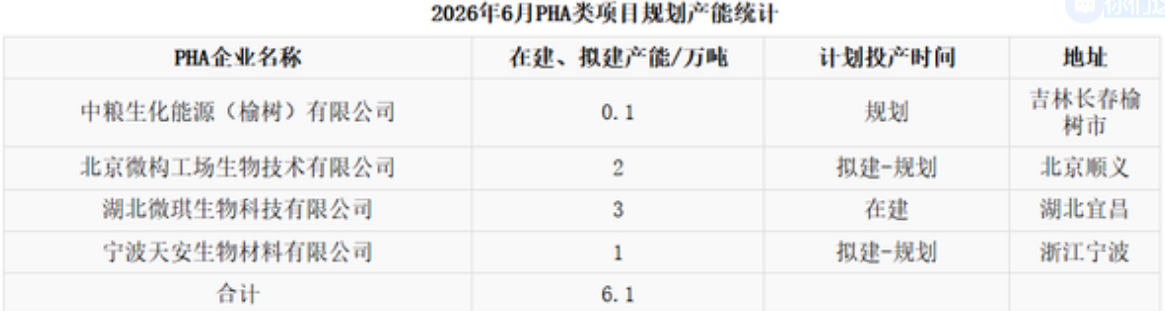
Data source: Longzhong
In early 2026, Angel Yeast, New Wave Biotech, Duber City Group, APP Group, and Hengxin Life announced in January 2026 the establishment of a full-industry-chain collaborative mechanism centered on PHA water-based barrier coatings.
This kind of “capacity explosion + giant players banding together” combination is not common. Why PHA? Why now?
I. Production Capacity from the 10,000-Ton Level to 60,000 Tons
PHA (polyhydroxyalkanoates) is a popular biodegradable bioplastic in recent years, known as the "green key" to solving the problem of plastic pollution. It is a natural polymer material produced by microbial fermentation and can be completely degraded in the natural environment.
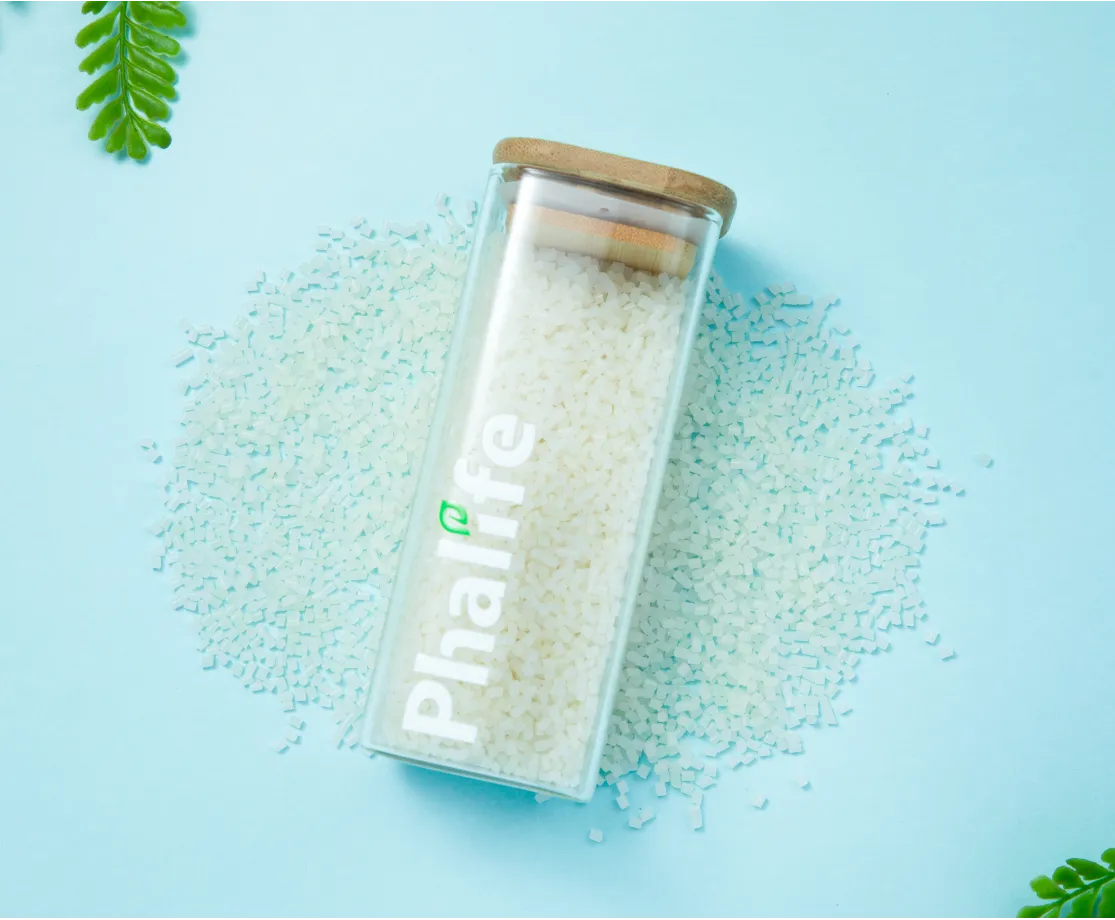
Image source: Weigou Factory official website
However, PHA is not a new concept. As early as the 1980s, Imperial Chemical Industries (ICI) in the UK attempted commercial-scale production, but the production cost at the time was as high as over US$8 per kilogram (compared with less than US$1.5 per kilogram for PET), and it ultimately withdrew from the market. For the next three decades, “PHA offers excellent degradability but is too expensive” became an industry rule of thumb.
The data for 2026, however, points to a starkly different trajectory.
Production capacity:By the end of 2025, global total PHA production capacity is expected to reach approximately 45,200 tons, of which China accounts for 14,800 tons. Meanwhile, capacity under construction and in planning has already reached 61,000 tons, exceeding the current global installed base—signaling that Chinese companies are collectively betting that PHA is on the verge of a large-scale commercialization inflection point. One of the most representative examples is the joint venture established in 2023 by Bluepha and Angel Yeast.Hubei Weiqi BiotechnologyThe first phase of the company’s 30,000-ton-per-year PHA project (with a 10,000-ton production line) was officially put into operation in 2025. With an automation rate of 90%, it has become China’s first 10,000-ton-scale PHA production line, with a total investment of RMB 1.05 billion.
Cost side:Compared with industrial biotechnology based on traditional microbial chassis (CIB), next-generation industrial biotechnology (NGIB) based on halophiles does not require sterilization, and its production process can be open and continuous. This reduces energy and freshwater consumption, lowers the complexity of biomanufacturing and the cost of equipment fabrication, and enhances the competitiveness of biomanufactured products. Professor Chen Guoqiang’s team at the School of Life Sciences, Tsinghua University, predicts that NGIB can reduce the energy consumption of traditional biomanufacturing by more than 50% while greatly improving production efficiency. Synthetic biology companies such as Bluepha, Viqi Bio, Angel Yeast, Madhava, and COFCO Biochemical have already applied the latest NGIB technologies to large-scale biomanufacturing.
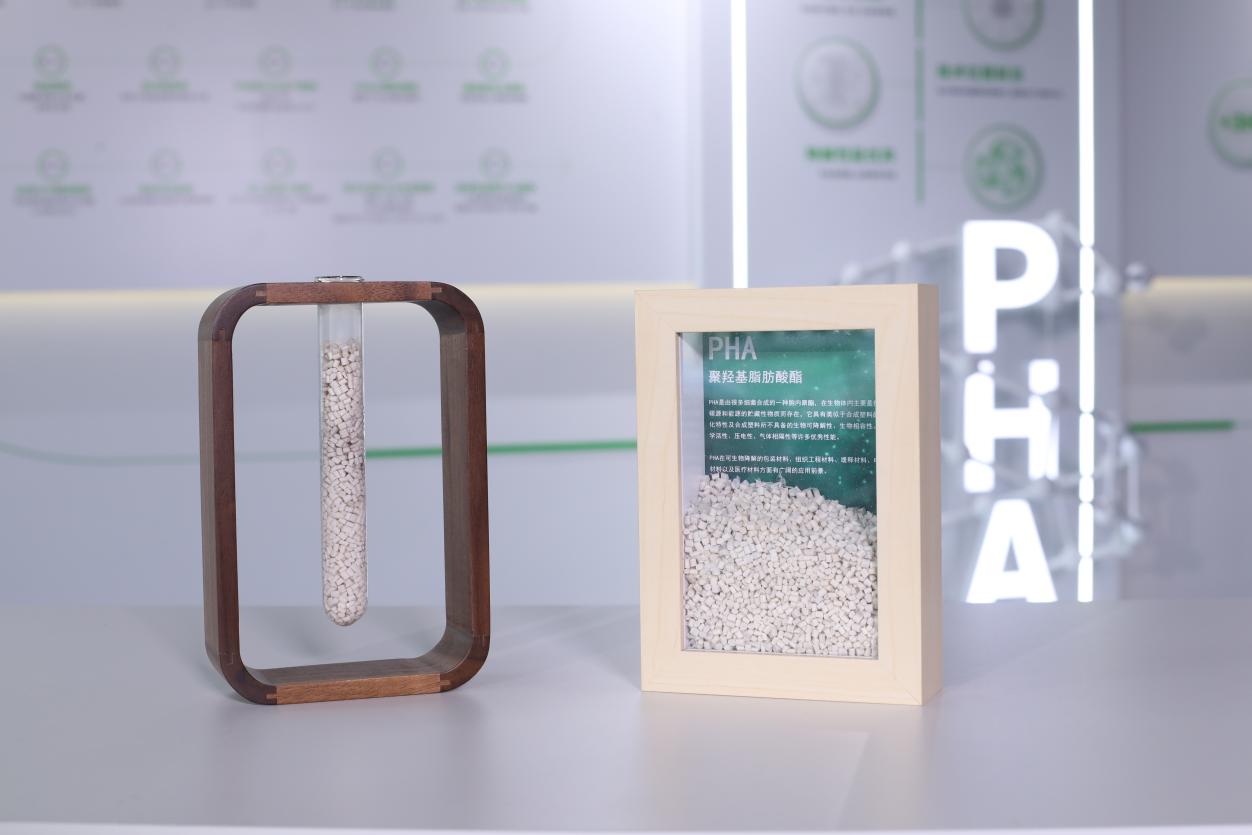
Figure: PHA granules produced using NGIB technology. Source: Tsinghua University.
Cost reduction is the prerequisite for understanding the current wave of capacity expansion. Without a breakthrough in costs, the 61,000 tons of planned capacity under construction is merely a set of unsupported figures.
II. The Three Major Driving Forces Brought by Compliance
The surge in demand for PHA is less a result of spontaneous market choice than a consequence of pressure from three policy drivers. Taking one common PHA application segment as an example, let us examine the impact brought about by these policies.
1EU PPWR will be mandatorily implemented on August 12, 2026.The EU Packaging and Packaging Waste Regulation (PPWR) was published in the Official Journal on January 22, 2025, entered into force on February 11, and will become mandatory on August 12, 2026, after an 18-month transition period.
The core requirements of this regulation include: a mandatory rating for recyclability, a compulsory quota for biobased content (with a target of 44% biobased content in food contact packaging by 2040), and the disclosure of the carbon footprint over the entire lifecycle. For Chinese companies exporting a large number of paper cups and food packaging to Europe each year, this threshold represents a substantial barrier to market entry, rather than a matter of choice.
2U.S. FDA PFAS ban.Starting in 2025, the FDA will revoke the food contact notification eligibility for 35 PFAS substances in the United States. PFAS have been widely used for oil resistance treatment in paper packaging, and some water-based coating formulations also rely on fluorinated additives. This path is being closed off.
3The pressure of market scale in the domestic Chinese market.According to research data from the China Packaging Federation, the market size of China’s disposable paper cup market will exceed RMB 45 billion in 2025, with the share of biodegradable products reaching 38%; the biodegradable paper cup market is expected to surpass RMB 20 billion in 2026, with an annual growth rate of over 25%.
The combined effect of these three policies has laid a solid foundation for the surge in demand for PHA.
III. Why PHA in Particular? The Core Differences Among the Four Routes
In the face of the above compliance pressures, the technological alternatives to PE coatings for paper cups are not limited to PHA; mainstream options include:PLA coating(only industrial composting degradation; very slow in home environments, and may contaminate the waste paper pulp stream)Water-based acrylic coating(The simplest process with the lowest cost, but essentially petroleum-based, cannot meet the bio-based content requirements of PPWR.)PBS/PBAT laminated film(Degradability is acceptable, but it still belongs to the melt coating process, with relatively high processing energy consumption); andPHA aqueous barrier coating。
Table: Core Comparison of Four Routes (Compiled by Zhuansulvjie)
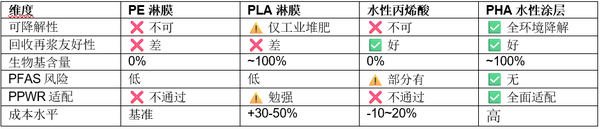
PHA's differentiated advantages are reflected in three dimensions:
First, true degradation in all environments.PLA requires industrial composting conditions above 58°C, while PHA does not. It can completely degrade into CO₂ and water in various natural environments, including home composting, freshwater, and seawater. Hengxin Life's PHA-coated paper cup products have obtained the world's first dual certification for PHA home + industrial composting DINCERTCO (2024) and BPI home composting certification (2025), which is a certification endorsement that no other route currently possesses.
Secondly, water-based coating = recycling-chain friendly.The “BioCarbon PHA” solution jointly developed by Dobocheng and MicroConstruct Factory uses a water-based coating process with emulsion-modified treatment. Paper cups coated with this layer can be directly fed into the waste paper recycling process, where the fibers and coating can be repulped together without the need for separation. This is the key to meeting the PPWR recyclability rating.
Third, PFAS-free, ensuring proactive compliance.Taking Bluepha’s PHA solution as an example, it has passed 95°C coffee leakage, heat-resistance, and food-contact safety tests, contains no PFAS compounds throughout the entire process, and aligns with the new FDA regulations and the global fluorine-free trend with virtually zero friction.
In short, if considering cost alone, choose acrylic; if considering biodegradability alone, choose PLA; if both requirements must be met simultaneously.Biodegradable + Recyclable + Bio-based + PFAS-freeAmong the four compliance requirements, PHA is currently the only technical pathway that can fully check all the boxes.
IV. Scale, processing, and supply chain are all indispensable
Of course, the story of PHA is not without its suspense. Beyond the enthusiasm, the following three hurdles must be addressed.
The first hurdle: absolute costs remain high.The 40% reduction in cost is real, but the current price of PHA particles is still about 1.5-2 times that of PLA and 3-4 times that of PE. Taking the paper cup industry as an example, it is a typical low-margin sector, where any material switch has very limited tolerance for cost. Only when production capacity is released to a sufficient scale and the cost of carbon sources is further optimized can prices potentially fall within an acceptable range for paper cup manufacturers.
The second hurdle: Narrow processing technology window.PHA has poor thermal stability, and the traditional PE coating extrusion temperature can directly lead to PHA degradation. Therefore, it is necessary to adopt the "water-based emulsion coating" route instead of the "melt coating" route, which implies a systematic transformation for existing production lines. Bocar PHA has overcome the technical challenges of high-speed stable coating, but this conversion capability is currently concentrated in a very small number of companies, and large-scale promotion requires more processors to complete the equipment switch.
The third hurdle: The supply chain support is not yet mature.PE has a global annual output measured in tens of millions of tons, and every supporting link in its value chain has well-established suppliers operating in a fully competitive market. By contrast, nearly every link in the PHA chain is still at the zero-to-one stage—strains, carbon sources, fermentation equipment, modification additives, coating equipment—and the absence of any single link can create a critical bottleneck. This is precisely the core value of the five-party industrial alliance formed in January 2026: Angel Yeast provides carbon-source synergies and raw-material security; Beijing Microfactory offers materials and technology; Dubocheng Group handles coating and converting; and APP and Hengxin Life connect the chain to end-use applications. The essence of the alliance is not a capital game, but a proactive effort to stitch together the missing links in the supply chain.
The essence of the industrialization of PHA is a dual race between cost competition and compliance windows. The planned construction capacity of 61,000 tons signifies that Chinese companies have completed their positioning at the starting line of the race. The remaining variables are only three: the speed of capacity realization, the degree of cost reduction, and the strength of policy enforcement. The time node at which these three variables resonate in the same direction will determine the true turning point for PHA to shift from a "compliance solution" to a "mainstream material."
Editor: Lily
Source materials: CHINAPLAS 2026 official reports and exhibitor information, China Economic Times, Eastday, China Chemical Information Weekly, Hexun, China Securities Journal, China Daily, Tonghuashun Finance, Sohu, and Tsinghua University official website.
【Copyright and Disclaimer】This article is the property of PlastMatch. For business cooperation, media interviews, article reprints, or suggestions, please call the PlastMatch customer service hotline at +86-18030158354 or via email at service@zhuansushijie.com. The information and data provided by PlastMatch are for reference only and do not constitute direct advice for client decision-making. Any decisions made by clients based on such information and data, and all resulting direct or indirect losses and legal consequences, shall be borne by the clients themselves and are unrelated to PlastMatch. Unauthorized reprinting is strictly prohibited.
Most Popular
-

A Look at the Material Suppliers Behind SpaceX
-

Global Chemical Giants Accelerate Production Capacity Restructuring, Dow and Celanese Optimize Global Industry Layout
-
【Overseas Highlights】Celanese Shuts Its Korean Engineering Plastics Plant! BASF to Divest Coatings Business; Six Japanese Corporations Tap Into Plastic Chemical Recycling
-
Name change without tax change: POM Anti-Dumping Duty Rate Inheritance Implemented
-
Gas Explosion Accident at Shanxi Tongzhou Group Liushenyu Coal Mine Results in 82 Deaths