



Rhine River Water Levels Plummet! European Olefins, Aromatics, Methanol Supply Chain Under Pressure
Market participants in the European petrochemical industry are increasingly concerned that persistently low water levels in the Rhine River could further disrupt logistics, raise delivery costs, and tighten supply chains in the fourth quarter. However, some industry insiders note that the full impact will only become apparent if the current drought conditions persist for several more weeks.
The Rhine River is Europe’s most important waterway for chemical transport. Due to persistent drought conditions, navigable water levels have been continuously dropping. In mid-July, the strategic locationKaub Water Level Control PointAs water levels approached the 40-centimeter critical threshold, initial market concerns emerged; conditions subsequently deteriorated further, with water levels hitting historic lows.
According to data from the German Waterways and Shipping Administration (WSV), the water level at the Kaub gauge was 11 centimeters on September 23 and fell further to approximately 5 centimeters by the morning of September 25. Forecasts indicate that the water level will continue to drop to just 1 centimeter by September 29 and remain at this level for at least three days.
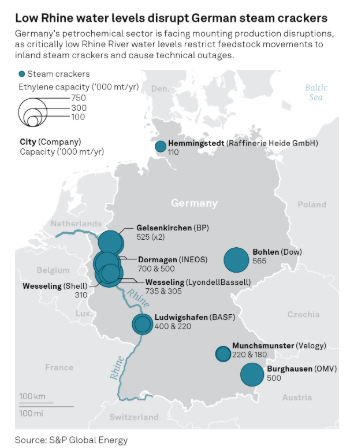
This waterway is a critical transport link connecting the Amsterdam-Rotterdam-Antwerp (ARA) port cluster with major chemical production hubs in Germany, including Ludwigshafen, Cologne, Leverkusen, and Wesseling. Although cargo shipments continue, barge load capacities are strictly limited, forcing companies to shift increasingly to rail and truck transport, thereby significantly driving up logistics costs.
Multiple sources across petrochemical supply chains indicate that operational difficulties are intensifying, with barges able to carry only a fraction of their normal capacity. One C4 trader stated that recent barge loadings have been restricted to approximately 700 metric tons, compared to a standard capacity of around 2,000 metric tons. Other market participants reported that actual maximum loadings have dropped as low as 450 metric tons, driving up freight rates and reducing the efficiency of inland cargo transshipment.
Rhine barges typically have a cargo capacity of 2,000–5,000 tons. When water levels drop below 75 centimeters, the maximum cargo load must be reduced by 75%.
In recent months, logistics issues on the Rhine River have already caused multiple production disruptions. On July 16,LyondellBasellDue to low water levels restricting the transportation of feedstock for cracking units, Wesseling’s 170,000-ton-per-year butadiene extraction plant has declared force majeure in August. Due to disruptions in raw material supply from the Rhine River, force majeure has been declared for polyether polyols produced in Dormagen.BASFDue to raw material shortages caused by logistics constraints, force majeure has been declared for certain surfactant products.
Industry experts note that the impact extends beyond transportation. Low river water levels combined with rising water temperatures have posed challenges for cooling operations at some petrochemical plants, placing producers—who are already grappling with tight raw material supplies—under dual pressure.
Olefin logistics under pressure
In the butadiene market, transportation disruptions have reshaped regional trade flows. Producers that previously relied on Rhine River shipping have largely switched to rail transport, leading to increased orders for Central European suppliers with mature rail networks. However, some producers note that limited railway infrastructure resources and the shift to alternative transport modes have incurred substantial additional costs.
“We need to use rail transfer cars to ship goods to Central Europe... The existing technical infrastructure is completely inadequate, and freight costs have risen sharply,” said a manufacturer.
According to S&P Global Platts data, the average FOB Rotterdam price of butadiene so far in September stands at $1,184.41 per tonne, up nearly $158 from the August average of $1,026.50 per tonne.
The propylene market is also highly sensitive to logistics disruptions on the Rhine River, as the product relies heavily on barge transportation between the ARA ports and inland German plants. Earlier this summer, restrictions on naphtha and liquefied petroleum gas (LPG) shipments tightened feedstock supplies for cracking units, curbing output of propylene and its derivatives.
The decline in vessel cargo capacity has forced companies to increasingly rely on rail and road transport, significantly raising delivery costs and heightening the risk of losses from unused shipping space. Businesses are left with little choice but to either bear exorbitant logistics expenses or opt for more expensive rail and road alternatives. Industry experts warn that if low water levels on the Rhine River persist, rail capacity alone will be insufficient to meet total demand.
In addition, the planned renovation of the central section of the right-bank railway main line along the Rhine in Germany is currently underway, with closures scheduled from July 10 to December 12, further constraining rail freight capacity in Germany.
In contrast, the European ethylene market has been less affected by disruptions on the Rhine River, as most ethylene is transported between major production and consumption areas via a mature pipeline network.
The aromatics industry chain is under pressure.
Across the entire aromatics value chain, low water levels in the Rhine River are exerting downward pressure on both supply and demand fundamentals. In the benzene segment, difficulties in barge loading, unloading, and transportation are suppressing demand. Meanwhile, disruptions in raw material transport along the Rhine and operational stress on cooling systems at benzene extraction units are also impacting the supply side.
The styrene market demonstrates relatively stronger risk resilience, as its customer base is not concentrated in the Rhine River basin, allowing for more convenient access to rail and road logistics.
According to Platts data, the average CIF benzene price for ARA deliveries stood at $1,264.29 per tonne so far in September, compared with an average of $1,103.39 per tonne in August.
Phenol and acetone are also facing raw material supply challenges. A distributor stated that extreme low water levels in the Rhine River are constraining raw material deliveries, “directly impacting the current situation in the German market.” Another producer noted that, due to the combination of raw material supply disruptions on the Rhine and local production disturbances, Germany is currently “the easiest market to sell into,” with local buyers experiencing tight supply.
Methanol market under pressure
The methanol industry also regards Rhine River logistics as a primary risk. Barge loading restrictions have led to a decline in terminal throughput, tank storage capacity is nearing its limit, and alternative transport routes are fully congested.
Sources at a terminal in the ARA region reported that storage tank utilization climbed to around 95% in late August due to handling constraints, hindering feedstock unloading and prompting suppliers to seek additional spot tankage. Even companies that do not rely on Rhine barge deliveries for their feedstocks have been indirectly affected by terminal congestion and a surge in road and rail freight.
A methanol purchaser stated that a large number of cargo owners have been forced to abandon barge transport and compete for railway capacity, noting that once the scheduled rail loading window is missed, it is difficult to secure a new loading slot. Another purchaser reported that the current maximum barge load is only about 450 tons; despite logistical constraints, plants are maintaining operations by relying on low operating rates and high inventory levels.
Market estimates indicate that current freight rates are 2.5 to 3 times higher than normal levels, while companies are already bearing high electricity and natural gas costs.
“The factory has not yet halted production simply because the cost of shutdown is too high, and Germany provides natural gas subsidies,” said the purchaser.
The impact depends on the duration of the disturbance.
Industry experts believe that the ultimate impact will depend on how long the current crisis lasts. Having experienced two low-water events in the Rhine River in 2018 and 2022, the industry has enhanced its resilience, with many companies developing emergency response plans and diversifying their transportation channels. However, the market cautions that, in the long run, rail capacity is insufficient to fully replace inland waterway shipping.
European industry insiders warn that if low water levels persist, inland supply chain pressures will continue to rise, and insufficient alternative transport capacity could trigger a “domino effect” chain crisis.
Rhine River water levels are expected to remain at seasonally low levels in the coming weeks. The olefins, aromatics, and their derivatives industry will continue to closely monitor the situation. Although there have been no widespread supply disruptions so far, market concerns persist that prolonged logistical bottlenecks could lead to more force majeure events on production, tighter regional supplies in the fourth quarter, and higher arrival costs.
【Copyright and Disclaimer】The above information is collected and organized by PlastMatch. The copyright belongs to the original author. This article is reprinted for the purpose of providing more information, and it does not imply that PlastMatch endorses the views expressed in the article or guarantees its accuracy. If there are any errors in the source attribution or if your legitimate rights have been infringed, please contact us, and we will promptly correct or remove the content. If other media, websites, or individuals use the aforementioned content, they must clearly indicate the original source and origin of the work and assume legal responsibility on their own.
Most Popular
-
Global Chemical Superpower? BASF Holds Preliminary Talks With Evonik On Merger
-

Evonik Parts Ways With The Polyester Business! A Strategic Retreat By A Germany Chemical Giant And The Global Industry Shift
-

Evonik Unveils Growth Strategy, Tailor-Made Plan Enters Second Phase
-
Humanoid Robot Industry Develops Rapidly, China PEEK Market Accelerates Its Rise
-
PEEK Sector "Crowded"! Giants Cross Over to Challenge Global Leadership


