



Polyethylene Prices May Remain Stable with a Downward Bias Amid Weakening Supply-Demand Margins and Pre-Holiday Stockpiling by Downstream Sectors
Summary
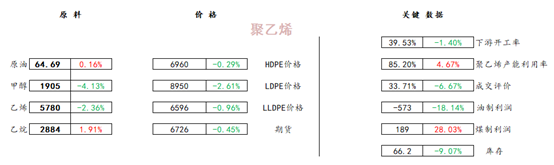
This week, the polyethylene market price first fell and then rose, with the price center of gravity shifting down by 100-280 yuan/ton. This week, production facilities gradually started up as planned, leading to a rapid increase in supply. Downstream factory operating rates continued to decline, pre-Chinese New Year stocking was not active, and there was a wait-and-see attitude towards price declines, resulting in reduced replenishment efforts. Coupled with the digestion of macro-level benefits at the beginning of the week and domestic economic data that was difficult to improve, market sentiment was mostly bearish, leading to price declines. Fortunately, social sample warehouse inventories returned to a downward trend, and continuous increases in the cost side provided increased support. After macro news boosted the market again, polyethylene market prices stopped falling and rebounded rapidly at the weekend. As of January 22, the mainstream linear low-density polyethylene (LLDPE) price in North China was 6600-6750 yuan/ton.
Key focuses in the recent polyethylene market:
This week, polyethylene production reached 698,800 tons, up 4.33% from last week. Among them, production in North China saw a significant increase of 11.31%, while production in Northwest China experienced a major decline of 0.82%.
2. This week, the polyethylene inventory of sampled Chinese production enterprises stood at 335,000 tons, down 4.37% month-on-month; the social sample warehouse inventory was 477,400 tons, down 1.43% month-on-month.
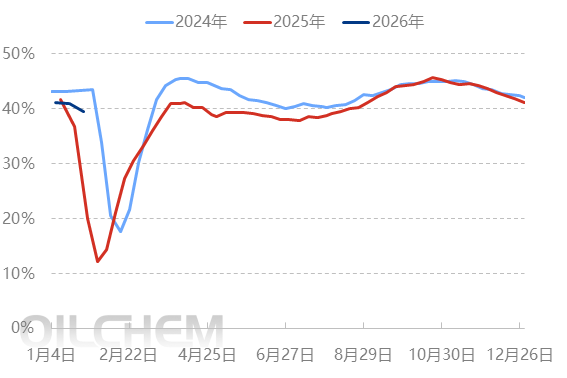
3. This week's overall operating rate of downstream industries of polyethylene was 39.53%, a decrease of 1.41% compared to last week.
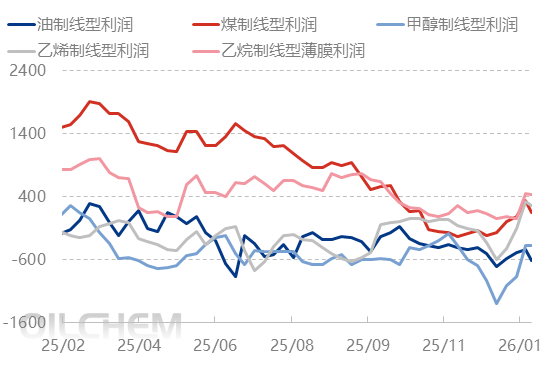
Polyethylene profit adjusted, oil-based profit decreased by 18.14%, and coal-based profit increased by 28.03%.
This week, the price of US dollars in the Chinese market fell by 5-25 USD/ton, and market sentiment cooled, with importers expecting to lower their acceptance prices.
I. Macro factors drive market trends and boost shipments, polyethylene prices fall then rise.
Forecast: On the supply side, there will be some changes in polyethylene plants next week. Daqing Petrochemical's LLDPE and Yangzi Petrochemical's HDPE Line 3 are scheduled for maintenance shutdowns. Sinochem Quanzhou's HDPE and Maoming Petrochemical's HDPE are scheduled to start up. Coupled with the large number of plants that started up previously, the supply is expected to remain at a high level, and pressure will continue. On the demand side, downstream factories' seasonal demand is weakening, and purchase volume is expected to shrink, but pre-holiday stockpiling is expected to begin gradually. Social sample warehouse inventories face significant destocking pressure. Although the macro environment is providing strong support, it is difficult to sustain price increases. The market is expected to maintain active shipments. Therefore, in the short term, the supply and demand margins of the polyethylene market are expected to weaken next week. Attention should be paid to downstream pre-holiday stockpiling. The trend of active shipments is expected to continue, and prices may remain stable with a slight decline. The mainstream price of linear low-density polyethylene in North China is expected to be 6600-6800 yuan/ton.
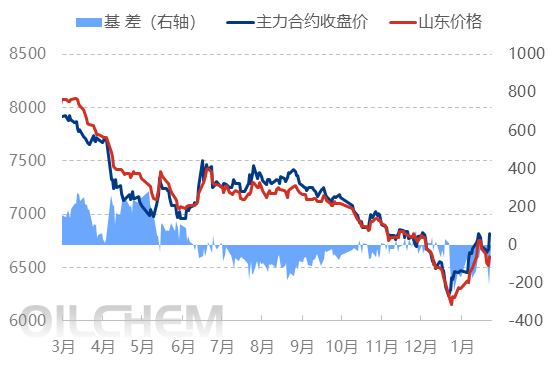
Plastic basis weakened this week. In the first half of the week, market sentiment was bearish, and participants actively lowered prices to ship goods, with spot prices falling more than futures. On Thursday, the plastic main contract stopped falling and expanded its gains due to macro factors, while spot price increases were cautious, with traders mainly shipping goods, leading to a continuous weakening of the basis.
Figure 1. Polyvinyl Chloride Spread Trend Chart, 2025-2026 (Unit: Yuan/Ton)
Data Source: Longzhong Information
This week, domestic polyethylene production increased by 4.34%. Breaking it down by raw material source, coal-based polyethylene production saw a significant decrease of 1.36%, while oil-based polyethylene production experienced a substantial increase of 6.00%. Recently, more production facilities have started operations as planned, leading to a stable increase in output, and supply is expected to continue its upward trend.
Table 1 Weekly Polyethylene Supply and Demand Balance Sheet in China
Unit: 10,000 tons
|
Data type |
This issue |
Rise and fall |
|
Polyethylene inventory |
47.73 |
-1.45% |
|
Domestic production of polyethylene |
69.90 |
4.34% |
|
Polyethylene import volume |
27.93 |
6.81% |
|
Total Polyethylene Supply |
97.83 |
5.04% |
|
Polyethylene exports |
1.42 |
-25.11% |
|
Apparent Consumption of Polyethylene |
96.41 |
5.66% |
|
Total Demand |
97.11 |
6.37% |
|
Supply-demand gap |
0.72 |
-1.13 |
Data period: last Thursday to this Wednesday
II. Smooth Inventory Destocking Provides Enhanced Support
Forecast: Next week, the sample inventory of polyethylene producers in China is expected to be around 320,000 tons, with inventory continuing to decline. The main reason is that as the end of the month approaches, producers face some sales pressure and are expected to actively destock. However, supply remains at a high level, creating some pressure. Downstream demand is weakening, and operating rates are trending downwards. There are also expectations for pre-Chinese New Year stocking, but destocking still faces some pressure. Therefore, producers' inventories are expected to decrease slightly.
Looking ahead to the next cycle for social sample warehouse inventory, recent market conditions have weakened, and market expectations for the future are cautious. Pre-holiday, attention needs to be paid to the terminal stocking situation, so it is expected that the next period's inventory may decrease slightly.
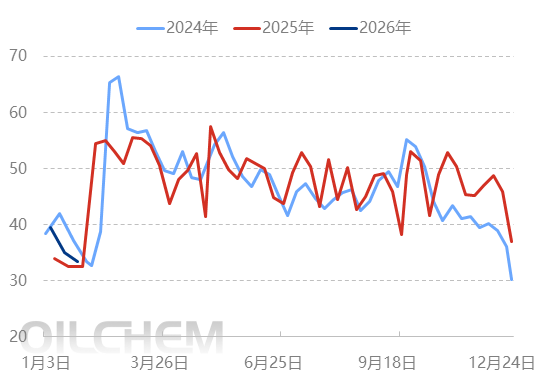
This week's sample inventory of Chinese polyethylene producers was 335,000 tons, a decrease of 15,300 tons compared to the previous period, a month-on-month drop of 4.37%. The inventory trend maintained a downward momentum. The main reason is the digestion of positive macroeconomic news, leading to a rebound and subsequent decline in market prices, prompting producers to actively lower prices to destock, shifting inventory downwards. However, with a significant number of new production units starting up recently, supply has increased. Downstream factories are largely adopting a wait-and-see attitude towards price drops, with limited restocking, resulting in only a slight decrease in producer inventory.
Figure 2: Polyethylene Producers' Inventory Trends 2024-2026 (Unit: 10,000 tons)
Source: OilChem
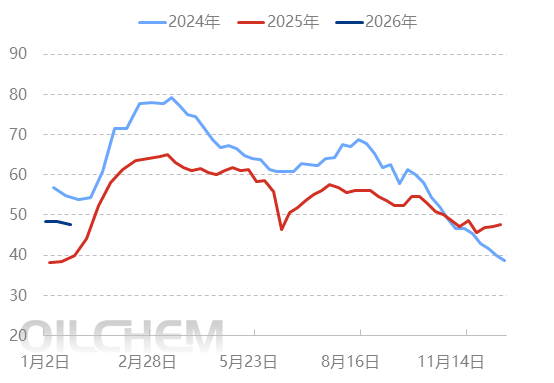
As of January 16, 2026, the social sample warehouse inventory of polyethylene was 477,400 tons, a decrease of 6,900 tons from the previous period, a decrease of 1.43% month-on-month, and an increase of 24.15% year-on-year. The warehouse inventory of imported polyethylene in China decreased by 0.57% month-on-month and increased by 20.20% year-on-year. HDPE social sample warehouse inventory decreased by 1.78% month-on-month and decreased by 30.26% year-on-year; LLDPE social sample warehouse inventory decreased by 0.59% month-on-month and increased by 141.33% year-on-year; LDPE social sample warehouse inventory decreased by 2.22% month-on-month and increased by 68.81% year-on-year. During the statistical period, there was buying on dips in the market, which led to a decrease in inventory levels.
Figure 3: Trends in Polyethylene Social Warehouse Inventory from 2024 to 2026 (Unit: 10,000 tons)
Data source: Longzhong Information
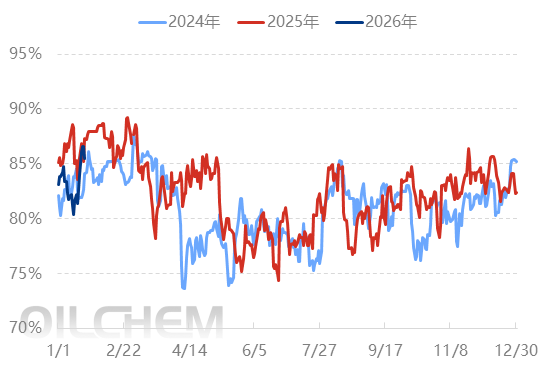
During this period (January 16th - January 22nd), polyethylene production was 698,800 tons, an increase of 4.33% compared to last week. Among them, North China saw the largest increase in production, with a magnitude of 11.31%, while Northwest China saw the largest decrease, with a magnitude of 0.82%. Planned maintenance shutdowns remained high in January, with an estimated production loss of 398,500 tons, a decrease of -9.44% month-on-month and an increase of +49.13% year-on-year.
Figure 4: Trend of Polyethylene Capacity Utilization Rate from 2024 to 2026
Data source: Longzhong Information
Table 2 Weekly Polyethylene Production in Various Regions of China
Unit: 10,000 tons
|
Region |
Last week |
This week |
Month-on-month |
|
Northeast China |
8.98 |
8.97 |
-0.11% |
|
North China |
10.08 |
11.22 |
11.31% |
|
East China |
11.13 |
12.00 |
7.82% |
|
South China |
13.08 |
14.09 |
7.72% |
|
Central China |
1.62 |
1.68 |
3.70% |
|
Northwest |
20.77 |
20.60 |
-0.82% |
|
Southwest |
1.32 |
1.32 |
0.00% |
|
Total |
66.98 |
69.88 |
4.33% |
Data period: Last Friday to this Thursday
This week, the Chinese market for US dollar-denominated goods saw a general decline, with fluctuations ranging from $5 to $25 per ton. As of now, LDPE prices are between $930 and $950 per ton, and LLDPE prices are between $750 and $790 per ton.
The market sentiment cooled down during the week, with prices for second-hand properties declining and fewer new properties being offered. Market participants are cautious in purchasing high-priced resources. However, as prices in the Chinese market remain at a global low, foreign buyers' offers and price levels will depend on the price differentials between regions. The outlook for the market is currently uncertain, and with expectations of increased domestic supply, importers anticipate a downward adjustment in their purchasing prices. In terms of prices, the market is expected to trade sideways with fluctuations next week.
Table 3: Price Gap Comparison Between Imported Polyethylene and Domestic Resources (CNY/ton, USD/ton)
|
Product |
Grade / Designation |
Market Price |
Mainstream US dollar price |
Convert/RMB |
Domestic and international price spread |
|
LLDPE |
Ningmei 7042 |
6570 |
750 |
6432 |
138 |
|
LDPE |
Exxon 100AC |
8300 |
930 |
7940 |
360 |
|
HDPE Thin film |
Jihua 5740F |
6680 |
810 |
6935 |
-255 |
|
HDPE Wire drawing |
Lanhua 5000S |
6950 |
805 |
6893 |
57 |
|
HDPE Small and hollow |
Baofeng 5502 |
6800 |
760 |
6516 |
284 |
|
HDPE Piping |
Borouge 3490LS |
8500 |
960 |
8191 |
309 |
|
HDPE Injection molding |
Sino-British T60-800 |
6550 |
750 |
6432 |
118 |
Table 4: Detailed Schedule of Polyethylene Import Vessels
|
Country/Brand |
Variety |
Grade |
Port of Destination |
Estimated time of arrival at port of destination |
|
Saudi Arabia |
HDPE |
TR144 |
Shanghai |
1 24th of [Month] |
|
Saudi |
HDPE |
TR131 |
Ningbo |
1 August 20th |
|
Saudi Arabia |
HDPE |
TR144 |
Dalian |
1 September 23rd |
|
Saudi Arabia |
HDPE |
TR144 |
Xiamen |
1 30th of the month |
|
Saudi Arabia |
HDPE |
5502BN |
Xiamen |
1 20th of [Month] |
|
Saudi Arabia |
LLDPE |
218WJ |
Whampoa |
1 30th of the month |
|
Saudi Arabia |
LLDPE |
219ZJ |
Whampoa |
2 May 5th |
|
Saudi Arabia |
LLDPE |
218WJ |
Qingdao |
1 31st |
Insufficient follow-up on mulch film orders, with a primary focus on plastic film delivery orders.
Forecast: Downstream operating rates are expected to maintain a downward trend next week, with a decrease of 1.52%. By sector, operating rates for agricultural film and injection molding are expected to drop by around 3%, the packaging film industry by around 2%, the drawing industry by 0.5%, and the pipe industry by 1%. Conversely, the hollow blow molding industry is expected to see an increase of approximately 1%. New orders for mulch film remain insufficient, while the packaging film sector is primarily focused on delivering existing orders.
Weak supply and demand on the margin, polyethylene prices fall.
Explanation: Translate the above content into English. Output the translation directly, without any explanations.
Price unit: Yuan/ton
Price cycle: Weekly average price (last Friday to this Thursday)
Product Pricing Range: Mainstream Prices in the Domestic Market
From an upstream and downstream transmission perspective, international crude oil futures are showing a strong trend, providing some support for the cost side. However, with more units operating, capacity utilization has increased, leading to greater supply pressure. Downstream operating rates have declined, and transactions have slowed, indicating a weakening supply-demand dynamic, primarily leading to a fall in polyethylene prices. Specifically, HDPE prices fell by 0.29%, LDPE prices by 2.61%, and LLDPE prices by 0.93%. Polyethylene profits have adjusted, with oil-based profits falling by 18.14% and coal-based profits rising by 28.03%.
Figure 5: 2025-2026 Polyethylene Profit Trend by Different Feedstock (RMB/Ton)
Data source: Longzhong Information
2. Slow start for mulch film, packaging film mainly fulfilling pre-Chinese New Year short-term contract orders.
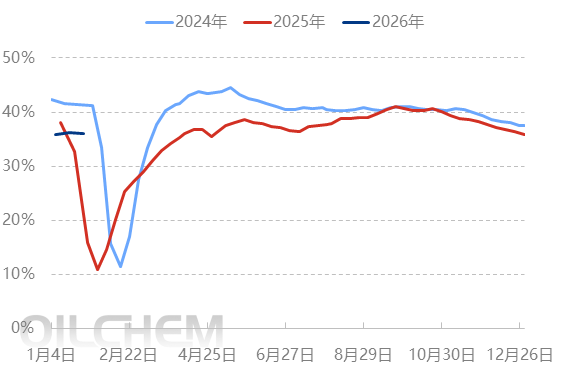
This week, the overall operating rate of downstream polyethylene industries is 39.53%, down 1.41% from last week, and is expected to decrease by 1.52% next week.
In the agricultural film industry, the operating rate is 36.32%, a decrease of 0.61% from last week. Greenhouse film production is winding down, with a few small businesses already on holiday. Production at larger companies has also decreased, and only a small number of companies are concentrating on order production, which has led to a slight increase in the operating rate. Overall, the operating rate for greenhouse film continues to decline. Mulch film is starting slowly, with a few companies having some tender orders and generally operating. Other companies are operating sporadically or shut down, and the operating rate has seen a slight increase.
For PE packaging film, the operating rate is 44.96%, a decrease of 3.19% from the previous period. This week, the fundamentals of PE packaging film showed differentiated changes in terms of rise and fall. Terminal demand still saw some stocking behavior, leading to a phased improvement in demand for processed products, with order days increasing by 3.2% month-on-month. However, due to some workers taking early holidays, factories gradually reduced their operating loads, and orders were mostly concentrated for production and delivery, leading to a 3.2% decrease in the operating rate month-on-month, primarily for executing short-term agreements or customized orders before the year-end. In terms of raw materials, terminal orders this week still had some days of support, and packaging enterprises mostly purchased appropriately on dips, leading to an increase in raw material inventory days month-on-month.
Figure 6 Polyethylene Downstream Operating Rate Trend Chart 2024-2026
Source: OilChem
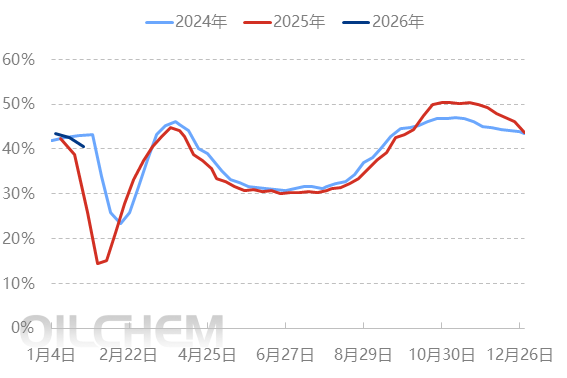
Figure 7: LLDPE/LDPE Downstream Capacity Utilization Trend Chart, 2024-2026
Data source: Longzhong Information
Figure 8 Operating rate trends of HDPE downstream sectors, 2024-2026
Data source: Longzhong Information
IV. Slow Improvement in Global Crude Oil Demand, International Oil Prices Have Room for Slight Decline
Forecast: Geopolitical tensions in Iran, the US-Venezuela relationship, and Syria are expected to ease somewhat. Coupled with persistent oversupply and slow demand improvement, these multiple factors will put pressure on the oil market. International oil prices are expected to decline slightly next week, with WTI potentially trading in the $58-61/barrel range and Brent in the $62-65/barrel range. Slow improvement in global crude oil demand suggests a small downside risk for international oil prices.
This week, the cost differential between oil-based and coal-based polyethylene expanded by 158 yuan/mt, while the profit differential narrowed by 48 yuan/mt. Profits were primarily on a downward trend, with LDPE experiencing the most significant decline, reaching 763 yuan/mt.
Figure 9: Cost Trend of Polyethylene from Different Feedstock Sources, 2025-2026 (RMB/ton)
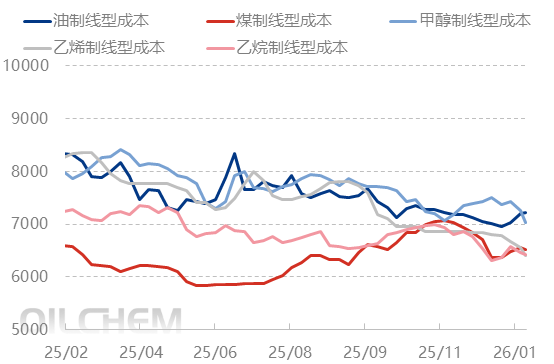
Source: OilChem
Table 5 Analysis of Domestic Polyethylene Market Cost and Gross Profit
|
Category |
2026/1/22 |
2026/1/15 |
Week-on-week |
2025/1/22 |
Year-on-year (YoY) |
|
Oil-based linear cost |
7255 |
7142 |
+113 |
8626 |
-1371 |
|
Cost of coal-based linear products |
6485 |
6530 |
-45 |
6629 |
-144 |
|
Oil-based low-pressure cost |
7595 |
7482 |
+113 |
8966 |
-1371 |
|
High Pressure Oil Production Costs |
7895 |
7782 |
+113 |
9485 |
-1590 |
|
Oil-based linear profit |
-655 |
-342 |
-313 |
-376 |
-279 |
|
Coal-to-Linear Alpha Olefins Profit |
165 |
430 |
-265 |
1391 |
-1226 |
|
Low-pressure molding profit |
-795 |
-732 |
-63 |
-1466 |
+671 |
|
High-pressure oil production profit |
755 |
1518 |
-763 |
315 |
+440 |
|
Cost difference between oil-based and coal-based production |
770 |
612 |
+158 |
1997 |
-1227 |
|
Oil-to-gas profit margin difference |
-820 |
-772 |
-48 |
-1767 |
+947 |
|
Profit margin difference between linear and low-pressure injection molding |
140 |
390 |
-250 |
1090 |
-950 |
V. Supply and demand margins are weakening, but downstream pre-holiday stockpiling may keep polyethylene prices stable or slightly lower.
Recent focus: macro guidance, supply recovery, social inventory destocking, and potential escalation of regional conflicts.
Unit: 10,000 tons
|
Data Types |
This week |
W+1 |
W+2 |
W+3 |
|
Polyethylene Inventory |
47.73 |
46.90 |
46.00 |
45.90 |
|
Polyethylene domestic production |
69.90 |
73.49 |
73.72 |
73.86 |
|
Polyethylene import volume |
27.93 |
27.21 |
26.14 |
25.21 |
|
Total Polyethylene Supply |
97.83 |
100.70 |
99.86 |
99.07 |
|
Polyethylene exports |
1.42 |
1.58 |
1.27 |
1.22 |
|
Apparent Consumption of Polyethylene |
96.41 |
99.12 |
98.60 |
97.86 |
|
Aggregate Demand |
97.11 |
99.95 |
99.50 |
97.96 |
|
Supply-demand gap |
0.72 |
0.75 |
0.37 |
1.12 |
Supply: In the next 1-3 weeks, domestic polyethylene production is expected to remain high. The low point is 734,900 tons in week one, and the high point is 738,600 tons in week three. Next week, only partial changes are expected in production facilities. As the Lunar New Year holiday approaches, most producers will maintain stable production, leading to significant inventory pressure.
Next week, downstream operating rates are expected to continue their downward trend, with a decrease of 1.52%. By product, operating rates for agricultural film and injection molding are expected to fall by approximately 3%, packaging film by approximately 2%, hollow products are expected to rise by approximately 1%, drawing by 0.5%, and pipe by 1%. Orders for agricultural film are insufficient, and packaging film is mainly for delivery.
Agricultural Film: The average operating rate of agricultural film enterprises is expected to decline by about 3%. Currently, the demand in the agricultural film market is entering a crossover phase. The demand for greenhouse film continues to weaken, and there is an expectation that the operating rate of enterprises will further decline. Although the mulch film market is gradually starting up and orders have increased, the overall social order follow-up is insufficient, and the increase in the operating rate of enterprises is limited. Overall, the agricultural film market is expected to continue its volatile and weak trend next week.
PE packaging film: The average operating rate of PE packaging film sample enterprises is expected to decline by about 2%. On the one hand, considering the holiday factors of small and medium-sized enterprises directly reduce the production load, factories will shut down or further reduce their operating rate. On the other hand, new orders are expected to be limited next week, and terminal long-term agreement consumption is nearing its end, mainly focusing on the delivery of pre-holiday execution orders. Therefore, comprehensively considering the above factors, the operating rate of PE packaging film sample enterprises is expected to decline month-on-month next week.
Cost perspective
Crude Oil: Geopolitical tensions in Iran, the US-Venezuela relationship, and Syria have eased somewhat. Coupled with persistent oversupply and slow demand improvement, multiple factors are weighing on the oil market. International oil prices are expected to decline slightly next week, with WTI potentially trading in the $58-61/barrel range and Brent in the $62-65/barrel range. Slow global crude oil demand improvement suggests a slight downside risk for international oil prices.
Ethylene: Ethylene prices are expected to remain stable next week. Producers in the East China region are not facing significant pressure to ship goods, and downstream inquiries have also increased, leading to a slight improvement in market sentiment regarding potential weakness. However, there are expectations of increased tradable supply in the Northern region, which could negatively impact the ethylene market in East China. Ethylene prices are therefore expected to remain stable, but a slight downward adjustment is not ruled out, with prices projected to hover around 5700-5800 yuan/ton. In terms of USD prices, due to reduced operating rates at some ethylene plants, domestic demand for USD-denominated imports may increase slightly. However, abundant ethylene resources in Southeast Asia could impact the North Asian market, limiting the likelihood of price increases, with an expected range of 700-720 USD/ton.
Figure 10: Comparison Chart of Quarterly Price Range for Polyethylene from 2025-2026 (RMB/ton, 10,000 tons)
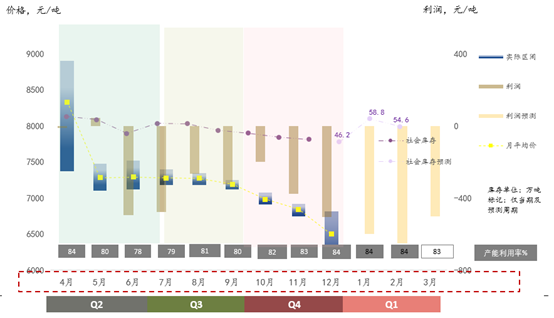
Data source: Longzhong Information
Conclusion (Short-term): On the supply side, there will be some changes in polyethylene plants next week. Daqing Petrochemical's LLDPE and Yangzi Petrochemical's HDPE Line 3 are scheduled for maintenance shutdowns. Sinochem Quanzhou's HDPE and Maoming Petrochemical's HDPE are planning to start up. Coupled with the large number of plants starting up earlier, the supply is expected to remain at a relatively high level, and pressure will continue. On the demand side, seasonal demand from downstream factories is weakening, and procurement volume is expected to shrink, but pre-holiday stocking for the Spring Festival is expected to begin gradually. Social sample warehouse inventories face significant destocking pressure. Although the macro environment has provided strong support, it is unlikely to sustain price increases. The market is expected to maintain an active shipment strategy. Therefore, in the short term, the marginal supply-demand trend in the polyethylene market next week will weaken. Attention should be paid to downstream pre-holiday stocking. The trend of active shipments is expected to continue, and prices may remain stable with a slight decrease. The mainstream price of linear low-density polyethylene (LLDPE) in North China is expected to be in the range of 6600-6800 yuan/ton.
Conclusion (Mid- to Long-Term): February coincides with the Chinese New Year holiday. Most production enterprises maintain normal production, while the market is mostly closed or approaching closure before and after the holiday, resulting in weak trading activity. Production enterprises and traders have a positive expectation of destocking, while market resources are relatively abundant, and downstream factories have a weak willingness to stock up. With supply remaining at a relatively high level, the polyethylene market will continue to be under pressure. Therefore, in the mid- to long-term, the polyethylene market has a slight downward potential in February.
【Copyright and Disclaimer】The above information is collected and organized by PlastMatch. The copyright belongs to the original author. This article is reprinted for the purpose of providing more information, and it does not imply that PlastMatch endorses the views expressed in the article or guarantees its accuracy. If there are any errors in the source attribution or if your legitimate rights have been infringed, please contact us, and we will promptly correct or remove the content. If other media, websites, or individuals use the aforementioned content, they must clearly indicate the original source and origin of the work and assume legal responsibility on their own.
Most Popular
-

List Released! Mexico Announces 50% Tariff On 1,371 China Product Categories
-
RMB Hits 32-Month High! Alpek Shuts Down PET Recycling Plant; Porsche Sales Plummet
-
Vynova's UK Chlor-Alkali Business Enters Bankruptcy Administration!
-

EU Changes ELV Regulation Again: Recycled Plastic Content Dispute and Exclusion of Bio-Based Plastics
-

Continental Plans to Begin Sale of ContiTech in Early 2026

