



New 3D Printing Extrusion System Arrives, May Replace Traditional Extruders, Already Producing Car Bumpers
Specialized Plastics Insights observes that Oak Ridge National Laboratory (ORNL) has developed a new 3D printing extrusion system that integrates multiple extruders into a single high-output stream through a specially designed nozzle, achieving a dual breakthrough in speed and precision.
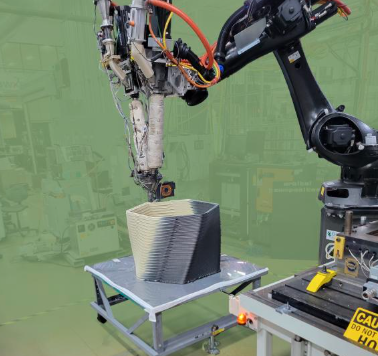
Source: Oak Ridge National Laboratory, U.S. Department of Energy
The core advantages and principles of new extrusion systems.
Traditional large extruders, due to their excessive weight, require expensive gantry systems or robotic support. Furthermore, in low extrusion volume scenarios, they are prone to issues such as reduced accuracy and unstable flow, leading to a need to decrease printing speed for small parts to prevent heat accumulation and warping.
The new system features a patented aluminum bronze nozzle module with an internal structure capable of merging two molten polymer streams. This design enhances flexibility while maintaining the speed of large-scale equipment—users can dynamically enable or disable small extrusion units during operation, achieving simultaneous multi-material printing without the need for hardware replacement.
This system supports flow multiplication technology, merging multiple molten plastics through a Y-shaped nozzle design, significantly reducing printed object porosity and potentially increasing extrusion efficiency by three, four, or even more times. Core-sheath nozzles innovatively achieve one material encapsulating another, enabling the precise fusion of two materials with distinct properties (such as high-strength fibers and flexible rubber) in a single printing pass.
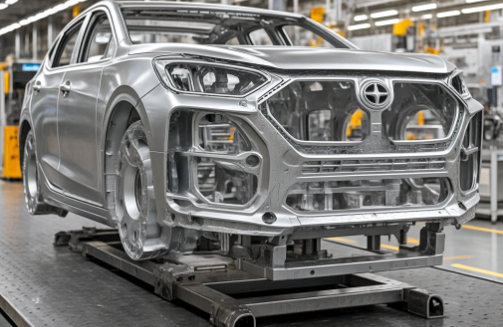
Image generated by AI
This design addresses a long-standing problem of interlayer delamination in polymer additive manufacturing – by enhancing interlayer adhesion, the composite core material effectively resists delamination, thereby improving overall structural strength.
Application Potential: Automotive Bumper Production Practice
In the automotive manufacturing field, the system has been successfully applied to bumper production.
General Motors partnered with Shape Corp. to produce carbon fiber rear bumper beams using TTI radius pultrusion technology, achieving stable molding with chrome-plated steel molds and fiberglass surface texture, with an annual capacity of 70,000 parts. Oak Ridge National Laboratory further verified that, in conjunction with a twin-screw extruder, mixing polypropylene, saturated ethylene-octene copolymer, and calcium sulfate whiskers within a temperature range of 170-220℃ for 3-8 minutes can produce bumper-specific materials with a 30% increase in strength and a 15% reduction in molding shrinkage.
Furthermore, the aerospace field also benefits—the system can manufacture composite panels with both radar-absorbing and anti-collision functions, achieving a gradient distribution of conductive material and matrix resin through core-sheath structure nozzles.
In the energy sector, it is used to produce lightweight battery racks and thermal system brackets. The flame-retardant casing uses phosphorus-based flame retardant modified plastic, which maintains a UL94 V-0 flame retardant rating while reducing weight by 40%.
The system prints protective panels for the defense sector that achieve a 50% weight reduction while maintaining high strength and supporting rapid on-site repair.
In the civil sector, it has further expanded to bridge deck reinforcement and hull manufacturing. A single continuous print can complete complex curved structures, saving 30% in material costs compared to traditional processes.
The Sustainable Evolution and Functional Expansion of Plastics
New extrusion systems are driving innovative applications of plastic materials. In the production of automotive bumpers, calcium sulfate whiskers, as a reinforcing material, maintain their aspect ratio through side-feed technology, forming a three-dimensional network structure with polypropylene-graft-maleic anhydride copolymer, resulting in a 25% increase in impact strength.
Regarding biodegradable plastics, the supramolecular polymer developed by the University of Tokyo in Japan forms a reversible network through salt bridge connections, allowing it to naturally decompose in a seawater environment, making it suitable for 3D printing marine structural components. The material has a tensile strength of 94MPa and a thermal decomposition temperature of 202℃, supporting high-temperature printing and subsequent shape reshaping with water mist.
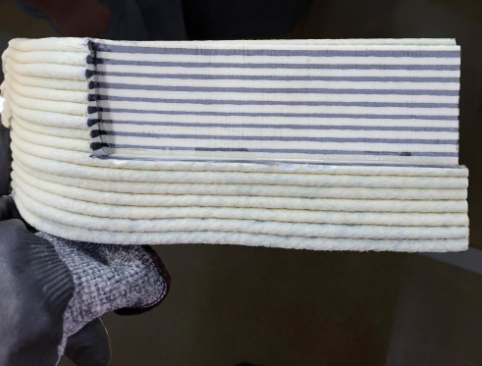
Image source: Oak Ridge National Laboratory
In the field of engineering plastics, carbon fiber reinforced polyether ether ketone (PEEK) achieves uniform dispersion with 30% fiber content through this system, used for printing aerospace engine blades. For transparent plastics, nano-silica modified polycarbonate is used, which maintains 90% light transmittance while increasing heat resistance to 150℃. In the field of recycled plastics, real-time monitoring of the printing process through machine learning algorithms can increase the waste recovery rate to 95%, combined with a closed-loop recycling system to achieve full-process regeneration from discarded bumpers to new parts.
Oak Ridge Laboratory's real-time monitoring system, through sensor fusion and machine learning, achieves a 90% defect detection rate, reducing costs by 60% compared to traditional CT scans. The system has been validated by ASTM D638 standards, with printed automotive bumper bars maintaining dimensional stability from -40℃ to 120℃ and meeting SAE J2260 weatherability requirements. With the deep integration of materials science and process innovation, new extrusion systems are driving 3D printing from prototyping to mass production, ushering in a new era in plastic processing where "precision is uncompromised, and speed is limitless."
【Copyright and Disclaimer】This article is the property of PlastMatch. For business cooperation, media interviews, article reprints, or suggestions, please call the PlastMatch customer service hotline at +86-18030158354 or via email at service@zhuansushijie.com. The information and data provided by PlastMatch are for reference only and do not constitute direct advice for client decision-making. Any decisions made by clients based on such information and data, and all resulting direct or indirect losses and legal consequences, shall be borne by the clients themselves and are unrelated to PlastMatch. Unauthorized reprinting is strictly prohibited.
Most Popular
-

EU Changes ELV Regulation Again: Recycled Plastic Content Dispute and Exclusion of Bio-Based Plastics
-

Vynova's UK Chlor-Alkali Business Enters Bankruptcy Administration!
-

Continental Plans to Begin Sale of ContiTech in Early 2026
-

List Released! Mexico Announces 50% Tariff On 1,371 China Product Categories
-

Vioneo Abandons €1.5 Billion Antwerp Project, First Commercial Green Polyolefin Plant Relocates to China

