May polycarbonate market price analysis and june trend forecast
I. Review of Polycarbonate (PC) Price Trends in May 2026
In May 2026, the domestic PC market experienced a trend of initial decline followed by a slight rebound, with overall narrow fluctuations. Prices at the end of the month showed a slight recovery compared to the beginning of the month, but overall trading was light throughout the month, reflecting a "weak supply and demand" pattern.
1. Specific price trends
According to monitoring data from SunSirs, the changes in the domestic PC blended benchmark price (ex-factory price) in May are as follows:
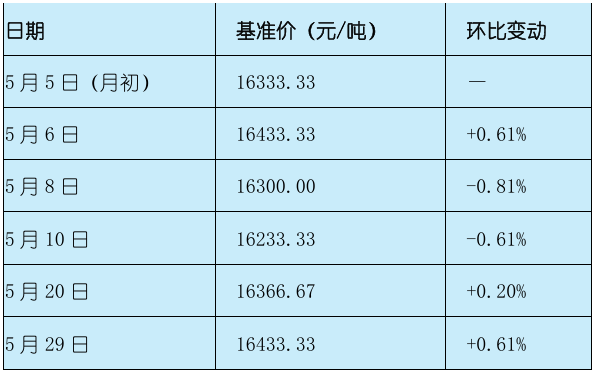
At the beginning of the month (May 5), the benchmark price was RMB 16,333.33 per ton, and it edged up by 0.61% to RMB 16,433.33 per ton on May 6. However, the rally failed to continue, and by May 10 the price had fallen back to RMB 16,233.33 per ton, down about 0.61% from the start of the month. After that, the price rebounded moderately, rising to RMB 16,366.67 per ton on May 20, a slight increase of 0.20% from the start of the month. It closed at RMB 16,433.33 per ton on May 29, up 0.61% overall from the beginning of the month.
From an annual perspective, the current PC price is in the upper range of the year. The annual low is 12,800 yuan/ton, the annual high is 16,866.67 yuan/ton, and the median is 14,833.34 yuan/ton. The current price is still about 433.34 yuan below the annual high.
2. Phase-by-phase analysis of May market trends
Early May (May 6-10): Supply contraction meets weak consumption, prices consolidate.
In early May, the market exhibited a typical "mixed" trend with both rises and falls. On the supply side, domestic PC polymerization enterprises have reduced their operating rates, with Cangzhou Dahua undergoing a complete shutdown for maintenance, causing industry load to drop to around 74%. Maintenance plans at Shanghai Mitsubishi, Zhejiang Petrochemical, and others are also underway, with strong expectations of expanded production losses. Weekly production remains above 60,000 tons. However, demand has been lackluster; the profitability of downstream PC enterprises has not improved, downstream factories maintain relatively low operating rates, buyers are cautious with inventory replenishment, and pre-holiday stocks still need to be digested, resulting in a strong market atmosphere of wait-and-see.
Mid-month (May 11-20): Both supply and demand are weak, fluctuating within a narrow range.
As we enter the middle of the month, the contraction on the supply side further intensifies. Maintenance schedules from companies like Mitsubishi in Shanghai and Zhejiang Petroleum are being realized, resulting in the industry's operating rate dropping to a new low of around 67% for the year, with weekly production falling below 60,000 tons. The pressure on polymer plants to sell their products is low, and their willingness to maintain prices has somewhat increased. However, demand is also weakening, as the downstream PC sector gradually enters the off-season, leading to a decline in demand for boards, casings, and other products. Terminal enterprises are operating at low capacity, and there is a need to digest the low-priced resources in the market, which exerts some downward pressure on the pricing focus of polymer plants.
Late May (May 21-29): Prices gently rebounded, but transaction volume was light.
In late May, PC prices edged up to 16,433.33 yuan/ton, but overall trading activity remained sluggish. On May 28, PC fell 0.40% in a single day, while it had risen 0.41% the previous day, May 26, indicating a lack of clear market direction. On May 29, it finally closed at 16,433.33 yuan/ton, with a cumulative increase of 0.61% since the beginning of the month. Notably, in the engineering plastics price gainers and losers list on May 18, PC was one of only two commodities that posted gains, rising 0.61% that day.
3. Cost side: Bisphenol A prices remain weak.
The overall price of upstream raw material bisphenol A (BPA) for PC was weak in May. The fluctuations in international crude oil prices and the decline in phenol market prices collectively dragged down the domestic BPA price level. Merchants were active in selling goods, tending to offer discounts to facilitate transactions, which continuously weakened the cost support for PC. From a longer-term perspective, the fundamental oversupply situation in the BPA market for the entire year of 2026 has become clear — with planned new production capacity of 480,000 tons, the total production capacity will reach 6.641 million tons per year, while the additional consumption capacity in downstream fields such as epoxy resin and PC is only 340,000 tons, resulting in a supply-demand gap of approximately 140,000 tons.
II. Analysis of PC Market Trends in June 2026
1. Supply Side: Maintenance Continues, but Marginal Benefits Are Diminishing
From a global perspective, the PC industry is entering an "expansion vacuum period" in 2026. Global PC production capacity is approximately 8.5–8.8 million tons per year, of which China's capacity is 4.3–4.4 million tons per year, accounting for more than 50% of the global total. In 2026, China will see basically no new capacity additions. Global capacity utilization has risen from 85% in 2025 to over 90% in 2026, indicating a pronounced rigid contraction in supply.
Domestic PC polymerization enterprises’ maintenance plans are still ongoing in June, and the industry operating rate may remain at a relatively low level. Inventory pressure at polymerization plants is limited, and overall delivery pressure is not significant. However, it should be noted that after the intensive maintenance peak from April to June, as some facilities gradually restart in late June, the positive effect of supply-side contraction will marginally diminish. Looking at the upstream and downstream industrial chains, the PTA industry related to PC is undergoing the largest maintenance wave in history, with planned maintenance capacity reaching 19.5 million tons from April to June, accounting for more than 20% of total capacity. The supply recovery in June will be relatively limited, and PC will continue to benefit from the tight supply situation of raw materials.
2. Demand Side: The Off-Season Effect Further Intensifies
June is usually the traditional off-season for chemical product consumption, and downstream demand for PC is expected to weaken further.
Automotive sector: The penetration rate of new energy vehicles continues to increase, and the per-vehicle PC usage is expected to rise from the current approximately 12 kg to 18 kg by 2030, providing growth support for PC consumption in the medium to long term. However, June is a traditional off-season for automobile sales, so the short-term incremental contribution is limited.
In the electronic and electrical field, the overall growth rate of the global PC (personal computer) industry is slowing down. IDC predicts that global PC shipments will decline by 11.3% year-on-year by 2026, which will suppress demand for consumer electronics-grade PCs. However, the high-end electronic sector, represented by 5G, folding screens, and AR/VR, is experiencing a growth rate of over 10% in demand for specialized PCs, showing a clear trend of high-end differentiation.
In the construction sector, high temperatures in summer affect outdoor construction work, leading to reduced demand for pipes, profiles, sheets, and other materials. As a result, demand for PC in the construction sector will experience a seasonal decline.
On the export side, as the localization process accelerates, China’s dependence on PC imports has fallen from 88% in 2015 to 24% in 2025, while export volumes have maintained solid growth. However, since May, signs of weakening demand have also emerged in overseas markets, so the upward impact of stronger exports on prices is expected to be limited.
3. Cost side: Weakness upstream suppresses the price increase.
The broad market pattern of oversupply in bisphenol A will continue to suppress the cost support for PC in June. Bisphenol A capacity continues to expand, while downstream consumption growth falls short of expectations. The supply-demand gap is about 140,000 tons, and the cumulative inventory build-up for the year is expected to reach 160,000 tons. Bisphenol A prices are unlikely to stage a strong rally, which means that although PC’s own fundamentals are supported by tightening supply, it lacks positive momentum from the cost side, and the upside for PC prices will be significantly limited.
4. Core Prediction
Considering the above factors, the PC market in June is likely to continue maintaining a "high-level consolidation and range oscillation" operating pattern. The overall trend forecast is as follows:
-
Price center: It is expected to fluctuate within the range of RMB 16,000–16,800/ton. The upper resistance level is relatively clear (the current price is about RMB 433/ton below the year-to-date high of RMB 16,866.67/ton), indicating obvious pressure; there is some support around RMB 16,000/ton on the downside.
-
Direction assessment: The pattern of both weak supply and weak demand is unlikely to fundamentally change, and the market lacks clear directional drivers. If some maintenance units restart as scheduled, support from the supply side may weaken, and the price center may come under slight downward pressure. Mainstream transaction prices in East China may retest the lower bound of RMB 16,000/ton.
-
Main risks: Uncertainty and volatility in upstream crude oil and bisphenol A prices; risk of downstream demand recovery falling short of expectations; ongoing monitoring required for changes in industry operating rates and maintenance schedules.
For buyers, in an environment where prices are fluctuating at elevated levels and lacking directional guidance, purchasing as needed and building positions in batches is a relatively prudent strategy. They should avoid blindly chasing prices higher when they rebound.
【Copyright and Disclaimer】The above information is collected and organized by PlastMatch. The copyright belongs to the original author. This article is reprinted for the purpose of providing more information, and it does not imply that PlastMatch endorses the views expressed in the article or guarantees its accuracy. If there are any errors in the source attribution or if your legitimate rights have been infringed, please contact us, and we will promptly correct or remove the content. If other media, websites, or individuals use the aforementioned content, they must clearly indicate the original source and origin of the work and assume legal responsibility on their own.
Most Popular
-

A Look at the Material Suppliers Behind SpaceX
-
Eastman France PET Depolymerization Plant: Project "Alive," But Construction Paused
-
Mitsubishi Chemical Plans To Split Petrochemical Business By 2028
-

Bola Carbon Black Announces Global Restructuring of Specialty Carbon Black and Multi-Walled Carbon Nanotube Business
-
900,000-Ton-Per-Year Ethylene Plant Shut Down! ExxonMobil Reshapes Asia-Pacific Petrochemical Landscape