



India’s Sole TDI Plant Restart Delayed Again; Tariff Exemption Extended by Half a Month, Creating Another Short-Term Export Opportunity to India
On June 30, 2026, India’s Ministry of Finance issued the latest customs notification, once again extending the basic import duty exemption for 40 categories of petrochemical and chemical products, including polyurethane raw materials. The duty-free window, originally set to expire on June 30, has been extended to July 15.
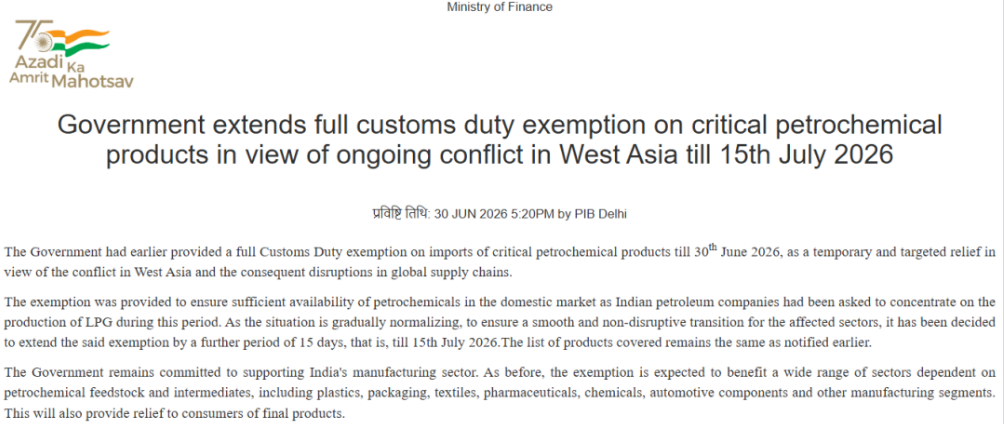
Earlier, India’s Ministry of Finance announced the temporary tariff exemption policy on April 1, 2026, and implemented it from April 2, 2026. It was originally scheduled to expire on June 30, 2026, with an initial period of only three months, and has now been extended by an additional 15 days.
The core reason behind the Indian government’s introduction of a zero-tariff policy lies in the pronounced shortcomings in the country’s petrochemical industry chain. India remains highly dependent on imports for polyurethane, resins, chemical fiber raw materials, and other key inputs. Coupled with fluctuations in global crude oil prices and persistently high international shipping costs, downstream industries such as automobiles, building insulation, furniture, and coatings have continued to face pressure from rising raw material prices. By exempting basic customs duties on imports, the policy can directly reduce the landed cost of chemical raw materials, stabilize production costs for end-use manufacturing industries, and curb upward pressure on domestic inflation.
The categories benefiting from this tariff exemption cover 40 key petrochemical products, with the polyurethane industry chain occupying a central position. The list includes core raw materials such as toluene, TDI, MDI, polyether polyols, and polyurethane system materials. It also covers coating-related resins such as epoxy resin, phenolic resin, and unsaturated polyester resin, as well as general chemical raw materials including styrene, ethylene glycol, PTA, PVC, and PET chips, spanning almost the entire industrial chain of plastics, coatings, textiles, and building materials. It is important to note that this exemption applies only to basic import tariffs and agricultural infrastructure surcharges. Existing anti-dumping duties and safeguard measures imposed by various countries will remain unchanged. Trade barriers against Chinese chemical products have not been eased, which remains a key weakness restricting the competitiveness of Chinese supply.
According to the latest news, the maintenance schedule for GNFC’s TDI plant in Dahej, India, has been extended again. This is the only TDI production facility in India. The annual routine turnaround was originally scheduled from May 30 to June 11, 2026; after the first delay, the restart date was pushed back to July 1. Latest market reports indicate that the plant’s restart has now been further delayed to mid-July. Combined with the plant’s prolonged low-load operation in February and March this year, effective domestic TDI supply has continued to shrink, and the supply-demand gap in the domestic market can only be filled by imported cargoes.
According to customs data, China’s total TDI exports to India in 2025 amounted to 311,000 tons, while export volume from January to May 2026 had already reached 191,000 tons, approaching 60% of last year’s full-year total. The supply-side gap is the core driver behind the surge in demand. India has only one domestic TDI production unit, which operated at a low load for an extended period from February to March this year, causing a sharp contraction in local supply; the market shortfall can only be filled through imports. In addition, with the zero-tariff policy taking effect in April, the basic import tariff on domestic TDI cargoes has been eliminated. Even though an anti-dumping duty of USD 260 per ton on Chinese imports still applies, the overall landed cost remains attractive, directly boosting bilateral trade volume.
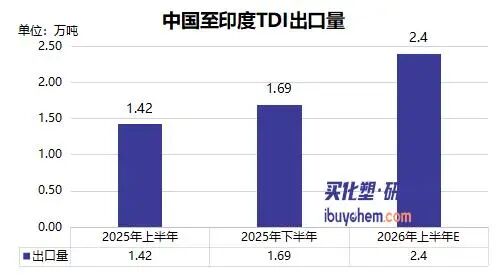
Benefiting from the 15-day extension policy, China’s TDI shipments to India increased significantly again in June. It is expected that China’s total TDI exports to India in the first half of 2026 may exceed 24,000 tonnes, representing a year-on-year increase of nearly 70%. In the short term, the tariff extension brings substantial benefits to exporters. The 15-day buffer window preserves their price advantage, allowing companies to coordinate production schedules and secure shipping slots, postpone delivery of existing orders until mid-July, and further capture a larger share of India’s import market.
However, this is only a short-term extension of 15 days. If no new extension notice is issued on July 16, the import base tariff will immediately revert to its original level. Enterprises with long-term forward contracts must add tariff adjustment clauses to their contracts in advance to avoid the risk of a sharp decline in profits after the policy expires. In addition, India’s fiscal revenue and expenditure remain under pressure, and tariff revenue is an important source of government income. The domestic petrochemical industry association has repeatedly called for the cancellation of the temporary duty-free policy to protect newly built local chemical capacity. The market generally expects that once the policy expires on July 15, the government will most likely not renew it. Starting in August, the export costs of China’s chemical products will rise significantly.
India’s long-standing anti-dumping barriers against China remain in place, and compared with duty-free supplies from the Middle East and Southeast Asia, Chinese sources are still at a disadvantage. Once the basic tariff is reinstated, the domestic and international price gap will narrow further, and the market share of China’s polyurethane raw materials in India may decline rapidly. Overall, India’s 15-day short-term tariff extension this time is only a phased stabilization measure and cannot alter its long-term direction of protecting its domestic chemical industry and tightening import concessions.
【Copyright and Disclaimer】The above information is collected and organized by PlastMatch. The copyright belongs to the original author. This article is reprinted for the purpose of providing more information, and it does not imply that PlastMatch endorses the views expressed in the article or guarantees its accuracy. If there are any errors in the source attribution or if your legitimate rights have been infringed, please contact us, and we will promptly correct or remove the content. If other media, websites, or individuals use the aforementioned content, they must clearly indicate the original source and origin of the work and assume legal responsibility on their own.
Most Popular
-
Research progress on surface modification of white carbon black and its applications
-
2026 Electronic Components Price Increase Notice
-

A Look at the Material Suppliers Behind SpaceX
-

List Released! Mexico Announces 50% Tariff On 1,371 China Product Categories
-
Major Shake-Up! Latest China Auto Export Rankings Released


