



How Will The EU PPWR New Regulation Affect The Medical Industry?
Five years after the implementation of the MDR Medical Device Regulation, while the industry is still in the process of deep adaptation, another major EU regulation—the Packaging and Packaging Waste Regulation (EU) 2025/40 (PPWR)—will be fully implemented in August 2026.
This sweeping green transformation in packaging across all industries is also having a profound impact on the medical device, pharmaceutical, and in vitro diagnostics sectors. Under the dual demands of safety and compliance, the healthcare industry is ushering in a new round of major adjustments to its packaging strategies. Today, let us take a look at the relevant regulations.
PPWR focuses on waste reduction, recycling, and recyclability, imposing mandatory requirements for almost all packaging in the EU market regarding recyclability, use of recycled materials, packaging reduction, and control of harmful substances. Considering the special requirements for sterility and safety in medical packaging, the regulations have set specific exemptions and extensions. However, medical companies are not completely exempt; for medical enterprises exporting to the EU, it is urgent to clearly identify the impact boundaries and grasp the compliance rhythm.
The central goal of PPWR is recyclability, with regulatory requirements for the recyclability rate according to...A,B,C,D,Eat the level and be carried out in phases:
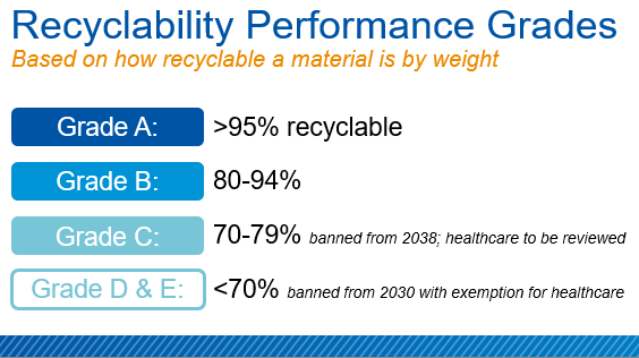
The industry will develop Design for Recyclability (DfR) standards, which are expected to be implemented in 2028.
By 2030, only A, B, and C grade packaging (≥70% recyclable) will be allowed to enter the market, while D and E grade packaging will be deemed non-recyclable and banned from use.
By 2035, packaging must achieve “recycling at scale” (i.e., be collected, sorted, and processed in real-world infrastructure).
By 2038, Grade C will be gradually phased out, meaning that only Grade A/B and packaging materials with a recycling rate exceeding 80% will be allowed to enter the market.
For sensitive packaging related to medical devices, in vitro diagnostic equipment, and pharmaceutical products, regulations grant a delay exemption, allowing companies to postpone compliance with the 2030 recyclable design requirements until the review in 2035, thereby providing time for innovation in materials without compromising patient safety.
PCR: Recycled Material Requirements
To promote a circular economy, the PPWR stipulates that from 2030, plastic packaging must contain a certain proportion (10%–35%) of post-consumer recycled content (PCR). By 2040, this proportion will be further increased, with the specific percentage determined by packaging type.
It should be noted that, for the medical industry, sensitive plastic packaging will be granted an indefinite exemption from PCR requirements, with product safety and performance integrity taking priority, and no compromise needed on environmental standards.
EPR: Extended Producer Responsibility mechanism
EPR refers to the costs paid by enterprises that put packaged products on the market to cover the expenses of recycling, sorting, and processing their packaging waste. This requirement applies to all packaging materials (plastic, paper, glass, aluminum, etc.).
By 2025, all EU Member States must establish eco-modulated EPR systems. By 2030, fees must be linked to recyclability ratings, meaning lower fees for packaging that is easy to recycle, contains PCR, or is reusable, and higher fees for difficult-to-recycle packaging. Notably, medical packaging must also pay the fees, with no exemptions.
Minimization: Requirements for packaging reductionization
PPWR emphasizes the requirement to reduce packaging waste at the source, that is, the reduction of packaging. By 2030, the internal empty space rate of packaging should be ≤50%, and unnecessary false bottoms, redundant layers, and excessively thick materials should be reduced.
The objectives at the EU level are as follows.:
2030: Per capita packaging waste reduced by 5%
2035: Reduce by 10%
2040: reduce by 15%
For packaging in the healthcare industry, design should prioritize functionality and minimize excessive packaging by considering the use of lighter materials and optimizing packaging dimensions.
Reuse: Reuse
The PPWR promotes the reduction of single-use packaging and sets reuse targets. For medical industry packaging, there is no mandatory reuse target due to safety and sterility considerations.
For transport and logistics packaging (such as pallets, reusable crates, etc.), 40% must be reusable by 2030; internal logistics must be 100% reusable. It is worth noting that cardboard packaging is not subject to the mandatory reuse requirement.
PFAS: Restrictions
PFAS is among the first provisions of the PPWR to take effect. The regulation stipulates that, from August 2026, the intentional addition of PFAS in food-contact packaging will be prohibited, with limits set at ≤25 ppb for any individual PFAS, ≤250 ppb for the sum of all PFAS, and ≤50 ppm for total organic fluorine.
The medical industry is gradually complying with PFAS-free requirements, and the limit for heavy metals must meet: lead + cadmium + mercury + hexavalent chromium ≤ 100 mg/kg.
Labeling & Claims
Regarding labeling and declarations, the PPWR stipulates that starting from 2028, there will be a unified identification of material types, recycling methods, and recycling iconography. The EU will standardize the icon system for packaging and waste classification systems. Medical packaging may apply for exemptions due to space limitations. Additionally, "environmental claims" are prohibited from vague expressions such as "eco-friendly" or "green"; all claims must be specific, accurate, and substantiated.
In summary, PPWR is another strict compliance barrier for medical device exports to the EU following MDR. Although medical packaging can enjoy some regulatory exemptions, the integration of safety compliance and environmental sustainability has become a prevailing trend in the industry.
For enterprises, the implementation of the new regulations is not only a challenge but also an opportunity. By developing new materials, optimizing packaging structures, and improving the entire packaging system, enterprises can lay a solid foundation for long-term, stable development.
【Copyright and Disclaimer】The above information is collected and organized by PlastMatch. The copyright belongs to the original author. This article is reprinted for the purpose of providing more information, and it does not imply that PlastMatch endorses the views expressed in the article or guarantees its accuracy. If there are any errors in the source attribution or if your legitimate rights have been infringed, please contact us, and we will promptly correct or remove the content. If other media, websites, or individuals use the aforementioned content, they must clearly indicate the original source and origin of the work and assume legal responsibility on their own.
Most Popular
-

A Look at the Material Suppliers Behind SpaceX
-
Ethylene: Production Capacity Accelerates Expansion, Global Industry Landscape Is Being Reshaped
-
Ethylene Industry Enters Production Boom Period! Multinational Giants and Domestic Leaders Compete in Trillion-Dollar Track
-
Breaking news! formosa petrochemical olefins division lifts force majeure! asia olefins supply and demand dynamics face another reversal
-

Target To Reduce Plastic By 30%! South Korea Enters Plastic Recycling Controversy, Involving National Interests


