



Global Chemical Giants Accelerate Production Capacity Restructuring, Dow and Celanese Optimize Global Industry Layout
Since the beginning of this year, amid multiple pressures including high energy costs, intensifying market competition, and supply chain volatility, the global chemical industry has continued to undergo deep strategic adjustments. Recently, Dow Chemical and Celanese, two major international chemical giants, have successively implemented measures such as layoffs, plant closures, and capacity transfers, proactively reducing inefficient capacity in high-cost regions such as Europe, the United States, and South Korea, while further cultivating high-potential markets in Asia. A global reshaping of the chemical industry landscape has already begun.
European business faces pressure as Dow intensifies cost-cutting and doubles down on the Chinese market.
On June 3, Dow Chemical announced the layoff of 605 employees in the Netherlands as an important measure of its "Transformation Beyond" cost reduction and efficiency enhancement plan.

Dow has three core production bases in the Netherlands, each with clear divisions of labor and substantial scale: the Terneuzen site is the largest production base outside the United States, housing 16 factories and approximately 3,200 employees, capable of producing nearly 800 types of industrial chemicals and plastic products; the Delfzijl site, with over 50 years of development history, is the largest isocyanate production base in the world; the Dordrecht site specializes in the production of specialty plastics for medical and food applications, with several products widely used in packaging and composite bonding scenarios.
Persistent losses in performance are the core reason behind Dow’s frequent workforce and capacity adjustments. In recent years, Dow has carried out multiple rounds of global cost-cutting measures: two large-scale layoffs in 2023 and 2025, followed by a comprehensive restructuring plan in January 2026, which aims to cut 4,500 jobs worldwide and generate an additional $2 billion in operating profit. Financial data show that Dow posted a net loss of more than $2.4 billion for full-year 2025, while first-quarter 2026 revenue fell 6% year over year and quarterly losses widened to $445 million, sharply increasing operational pressure. At the same time, geopolitical factors have disrupted shipping through the Strait of Hormuz, restricting nearly half of the world’s ethylene and polyethylene supply. The resulting shortages of chemical feedstocks and rising prices are expected to persist throughout 2026.
While downsizing its European operations, Dow continues to increase its investment in the Chinese market. In April 2026, the construction of Dow Silicones (Zhangjiagang) 2,500 tons/year silicone polymer expansion project officially commenced. Currently, this base has established multiple mature production lines for alcohol ethers, polyether polyols, siloxanes, and fumed silica, while also positioning itself with downstream products such as silicone resins, liquid silicone rubber, and sealants, forming a complete industrial chain and becoming an important production hub for Dow in China. On the personnel side, Dow's Chief Operating Officer Karen S. Carter will take over as CEO and join the board on July 1, overseeing the implementation of a new round of corporate strategy.
Celanese Makes Major Capacity Layout Adjustment, Shifting Focus to the Chinese and Indian Markets
Following Dow, specialty materials company Celanese announced on June 4 that it would immediately shut down its engineering plastics compounding plant in Ulsan, South Korea, and shift all local production capacity to its manufacturing bases in Nanjing and Shenzhen, China, and Silvassa, India.
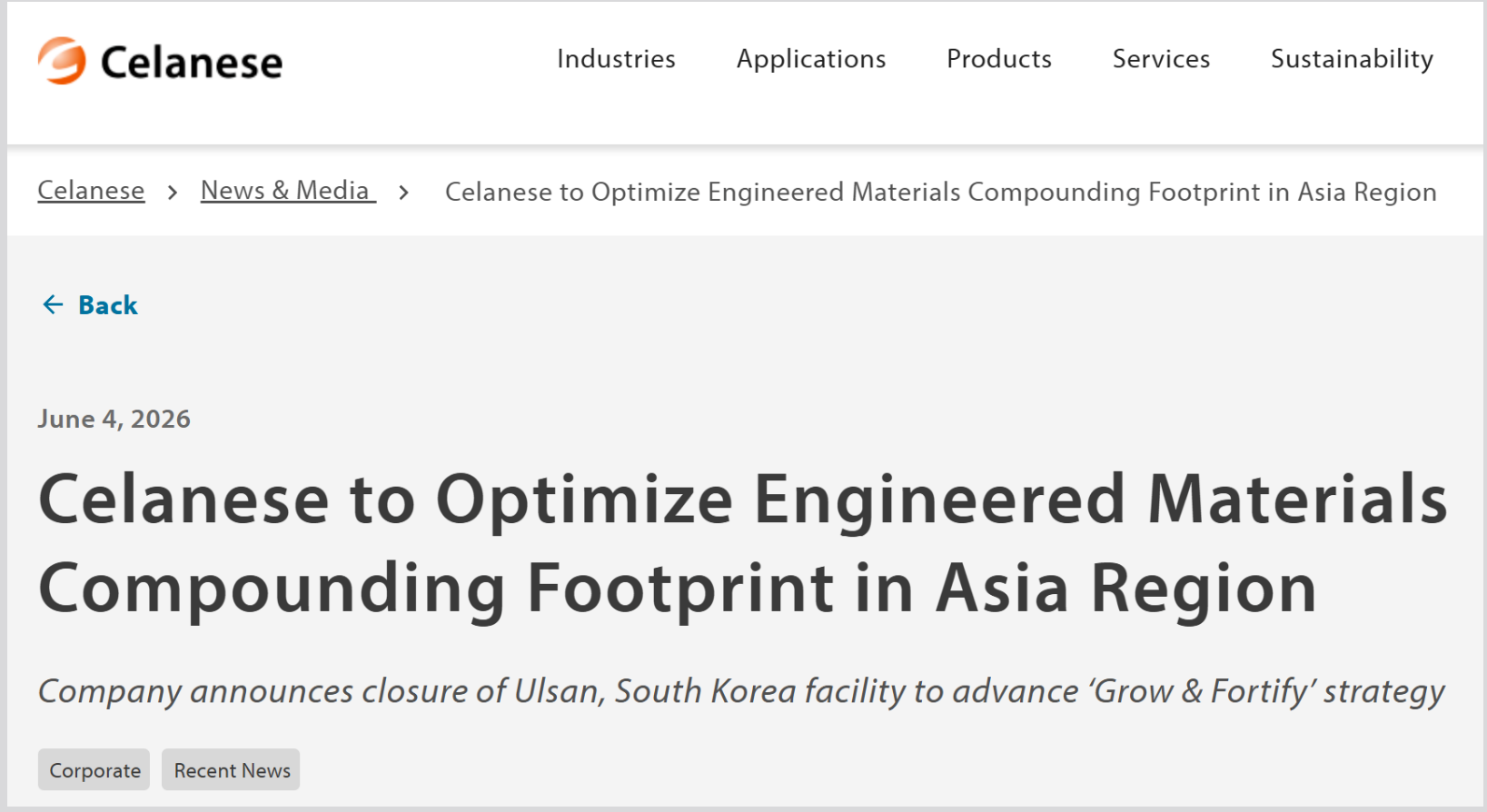
This adjustment is an implementation of Celanese’s “Grow and Strengthen” strategy, aimed at optimizing its global production network, reducing operating costs, and leveraging mature capacity in China and India to consolidate its supply chain advantages in Asia.
As a Fortune 500 company with an annual sales revenue of $9.5 billion and approximately 11,000 employees worldwide, Celanese specializes in engineering plastics such as PET, PA, PBT, and high-temperature nylon, with products covering multiple sectors including automotive, electronics, and industrial manufacturing. The company states that there is significant growth potential in the Asian market, and the transfer of production capacity to China and India can bring them closer to end customers and shorten service distances. During the transition period, they will also make every effort to ensure the smooth delivery of customer orders.
In fact, Celanese has been restructuring its assets and streamlining its operations globally over the past two years. In May 2026, the company announced the closure of its nylon plant in Singapore and optimized its two nylon 66 production facilities in North America, proactively reducing polymer production capacity. At the same time, it has strategically developed new businesses, such as liquid crystal polymers in China, medical-grade compounds in Asia, and product localization in India. Additionally, the company has divested non-core businesses through asset sales and the closure of outdated factories: in February 2026, it sold its Micromax® business for $500 million, and in 2025, it gradually exited low-efficiency production lines in Belgium, Switzerland, Canada, and other locations, concentrating resources on its core operations.
Deep industry restructuring: Asia has become the strategic center of global deployment.
The series of actions taken by the two industry giants is a true reflection of the current state of the global chemical industry. The European chemical industry is now mired in difficulties, with high energy costs, stringent regulatory policies, and intense external market competition gradually eroding the cost advantages of established overseas plants. It has become common practice in the industry to shut down inefficient capacities and streamline personnel. In contrast, the Asian market, supported by a well-developed industrial chain, a large consumer market, and reasonable production costs, has become the core battleground for international chemical companies. The simultaneous contraction of production capacities in South Korea, Europe, and Singapore by Dow and Celanese, along with their continued investment in China, underscores the rising status of Asia in the global chemical landscape.
Industry analysis indicates that the structural adjustment of the global chemical industry will continue. Leading companies will abandon the extensive expansion model and adopt a development path focused on core business, cost reduction, efficiency improvement, and regional in-depth cultivation. For the domestic chemical industry, the capacity transfer from overseas giants presents both opportunities for technological and supply chain collaboration and more intense market competition. Domestic enterprises need to seize the opportunities of industrial transformation, strengthen technological research and development, consolidate their advantages in the industrial chain, and steadily enhance their overall competitiveness in the global industrial restructuring.
Editor: Abby
Some of the materials were compiled from DT New Materials, Beichen Chemical, and other sources.
【Copyright and Disclaimer】The above information is collected and organized by PlastMatch. The copyright belongs to the original author. This article is reprinted for the purpose of providing more information, and it does not imply that PlastMatch endorses the views expressed in the article or guarantees its accuracy. If there are any errors in the source attribution or if your legitimate rights have been infringed, please contact us, and we will promptly correct or remove the content. If other media, websites, or individuals use the aforementioned content, they must clearly indicate the original source and origin of the work and assume legal responsibility on their own.
Most Popular
-

A Look at the Material Suppliers Behind SpaceX
-
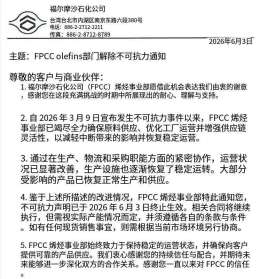
Breaking news! formosa petrochemical olefins division lifts force majeure! asia olefins supply and demand dynamics face another reversal
-
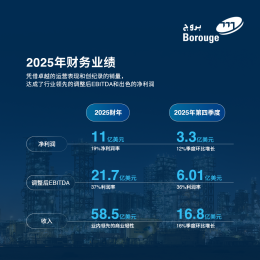
Borouge Achieves Stellar $1.1 Billion Net Profit in 2025 Driven by Operational Excellence and Record Sales
-
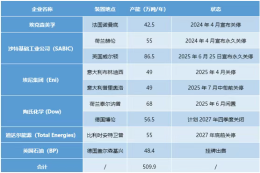
Ethylene: Production Capacity Accelerates Expansion, Global Industry Landscape Is Being Reshaped
-
Gas Explosion Accident at Shanxi Tongzhou Group Liushenyu Coal Mine Results in 82 Deaths


