



Farewell to oil dependence! toray & ptt gc crack 100% bio-based nylon 66 full-chain technology
Recently, Toray Industries, Inc. of Japan and PTT Global Chemical Public Company Limited, a subsidiary of Thailand’s national oil company PTT, jointly announced that they had successfully developed the world’s first complete manufacturing technology for 100% bio-based nylon 66 fibers. Using non-food cassava pulp as the raw material, they verified the entire process from saccharification to polymerization and fiber formation through a production route combining biological fermentation and chemical conversion.
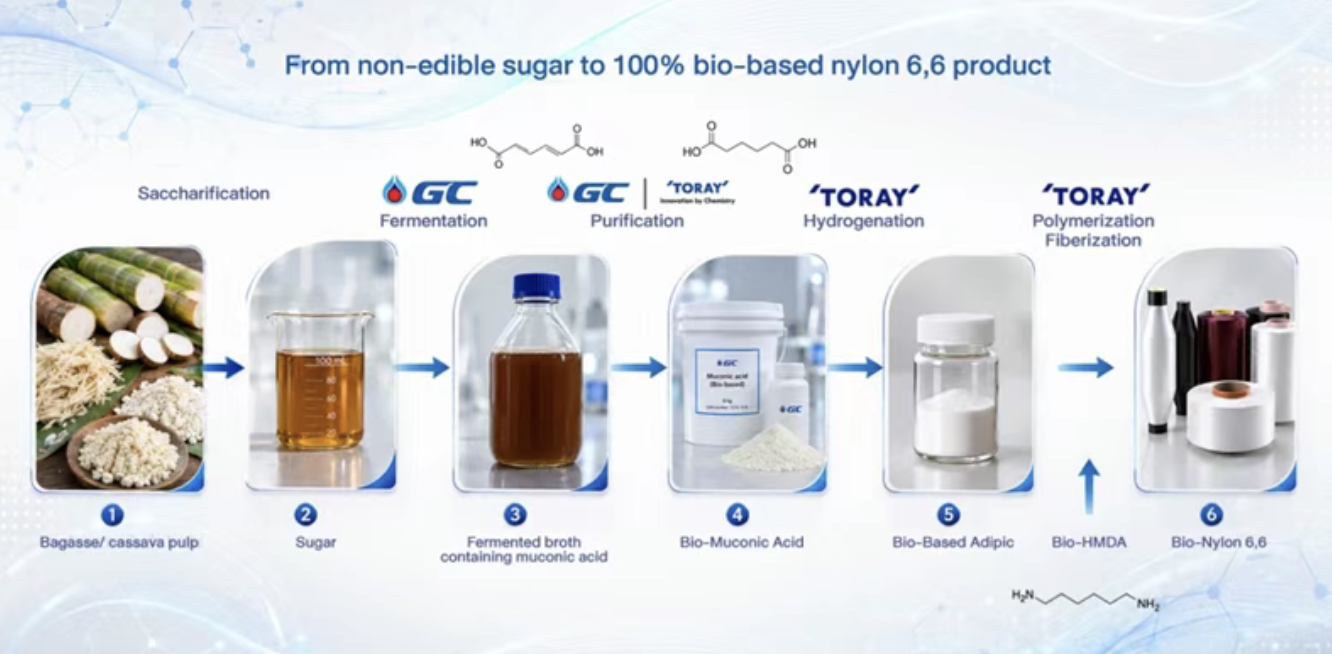
The essence of this breakthrough lies not in the technological level itself, but in the fact that a complete industrial chain running through upstream waste materials, midstream biological conversion, and downstream high-end products has been successfully established for the first time.
Technological Breakthrough: Full-Chain Innovation from Cassava Residue to Nylon 66
- Saccharification stage (led by Toray)Using 66 tons of cassava residue with 85% moisture content as the feedstock, an energy-saving membrane separation technology is employed to achieve a daily output of 5 tons of glucose (dry basis), efficiently converting waste starch residues into sugars while offering the advantages of low energy consumption and high purity.
- Fermentation Stage (Led by PTT GC)Leveraging a proprietary strain, we efficiently and stably produce bio-based muconic acid fermentation broth through fermentation. The technology has undergone full-scale validation from the laboratory to a 50 m³ pilot-scale fermenter, with industry-leading stability and conversion rates.
- Refining process (collaborative effort between both parties)Integrating the proprietary technologies of both companies, high-purity bio-based mucic acid is purified from fermentation broth and can be directly used for the production of bio-based adipic acid once purity meets the required standards, thereby addressing the industry pain point of difficult purification of bio-fermentation products.
- Chemical Conversion (led by Toray)Convert bio-based into bio-based adipic acid, strictly control purity, fully meet the high-purity standards for Nylon 66 polymerization, andNo nitrous oxide greenhouse gas is generated during the production process.The environmental advantages are significant.
- Aggregation and Fiberization (Led by Toray)Using bio-based sebacic acid and bio-based hexamethylenediamine (HMDA) as raw materials, nylon 66 polymerization and fiber processing were successfully completed on a laboratory scale, with product performance fully matching petroleum-based nylon 66.
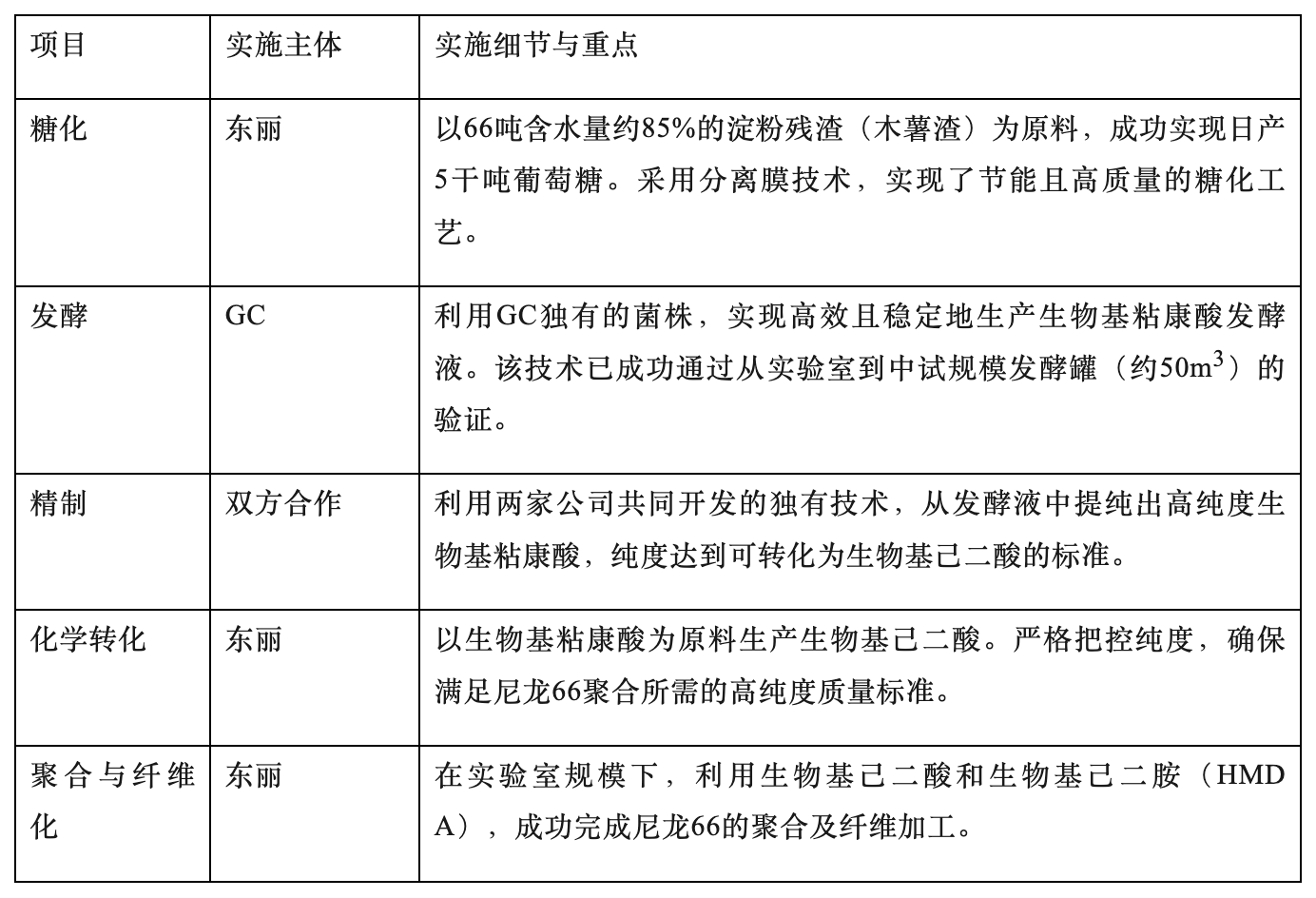
Image source: DT New Materials

From an industrial perspective, this logic closes the loop across three stages: upstream, it avoids competition with food crops; midstream, it converts industrial waste into standardized raw materials; and downstream, it provides a stable sugar feedstock supply for bio-based nylon. PTT GC, as a Thai state-owned energy and chemical giant, plays a key role in the midstream fermentation process.
2028: Industry Rhythm Behind the Commercialization Timeline
Toray has set a clear goal: to begin selling 100% bio-based nylon 66 textiles as early as fiscal 2028. This timeline reflects the real pace of the industry—from laboratory validation to mass production and then to end-market sales, the entire chain requires about two years to complete capacity expansion and cost optimization.
Judging from industry data, Toray’s decision is well substantiated. In 2024, the global bio-based nylon fiber market was valued at approximately USD 1.25 billion and is projected to grow to USD 2.75 billion by 2033, representing a compound annual growth rate (CAGR) of 9.5%. Meanwhile, the Nylon 66 product line targeted in this move is also in a steady growth phase: the global Nylon 66 market is estimated at about USD 19.2 billion in 2025 and is expected to reach approximately USD 25.55 billion by 2035, with a CAGR of around 2.9%.
This means that the growth potential of bio-based nylon 66 mainly comes from replacing traditional petroleum-based nylon 66, rather than simply expanding the market. Companies that can take the lead in achieving environmentally friendly substitution while maintaining consistent performance will dominate this replacement process.
Policy dividends and the global competitive landscape
Toray has adopted the “sugar route” technology this time—using renewable sugars such as glucose and cellulose as raw materials, which are converted into bio-based nylon monomers through microbial fermentation. Running parallel to this is the “oil route,” which uses natural oils and fats such as castor oil as raw materials, with representative products including PA11, PA1010, and other bio-based nylons. Currently, the global bio-based nylon market is mainly dominated by companies such as Arkema, Evonik, BASF, Solvay, Cathay Biotech, and Kingfa Sci. & Tech., with the competitive landscape rapidly taking shape.
Of particular note are the industrial projects that will be implemented intensively between 2025 and 2026.
Internationally, France's Arkema is the leader in the bio-based nylon sector using castor oil as raw material. In January 2026, its new Rilsan® Clear transparent polyamide (PA11) facility in Singapore was fully completed and put into operation, tripling the global production capacity of this product. In July 2025, Arkema also announced the expansion of its bio-based high-performance nylon PA11 production line in Singapore, increasing capacity by 50%, continuing to strengthen its investment in the castor oil route.
Domestically, Kaisai Bio is the global leader in long-chain dicarboxylic acids. In August 2025 it formed a joint venture with CATL to build a manufacturing base with an annual capacity of 2.5 million sets of bio-based Nylon 56 composite battery housings, with a total investment of RMB 500 million, entering the new energy vehicle lightweighting track. Wantong Special Plastics, a subsidiary of Kingfa Technology, holds more than 90% of the global market share in bio-based high-temperature semi-aromatic polyamides; in March 2026 the environmental impact assessment for its 8,000-ton-per-year bio-based high-temperature nylon project was approved. In April 2026 Woter Co., Ltd. domestically launched Wouper® high-performance bio-based PA46 resin, breaking a nearly 40-year foreign monopoly; in May of the same year it signed an industry-chain strategic cooperation agreement with China Resources Double-Crane to promote the coordinated commercialization of bio-based feedstocks and specialty polymer materials.
Dongli's commercialization timing happened to coincide with the upswing of this wave of industrial expansion.
In Conclusion
Nylon 66 is one of the most widely used engineering plastics in the world, with extensive applications in automotive parts, electronics, electrical appliances, and fiber garments. Transitioning from fossil resources to renewable biomass is not only a necessary choice to address climate change pressures, but also a historic opportunity for the chemical industry to reshape its raw material structure. Toray and PTT GC have, over three years, established the entire chain of "cassava residue—glucose—adipic acid—nylon 66," demonstrating that an industrial closed loop starting from waste materials and ending with high-end chemical fibers is indeed achievable.
The key next step is not the technology itself, but whether it can move out of the laboratory, enter the production line, and ultimately be placed on the shelves under the premise of controllable costs.
【Copyright and Disclaimer】This article is the property of PlastMatch. For business cooperation, media interviews, article reprints, or suggestions, please call the PlastMatch customer service hotline at +86-18030158354 or via email at service@zhuansushijie.com. The information and data provided by PlastMatch are for reference only and do not constitute direct advice for client decision-making. Any decisions made by clients based on such information and data, and all resulting direct or indirect losses and legal consequences, shall be borne by the clients themselves and are unrelated to PlastMatch. Unauthorized reprinting is strictly prohibited.
Most Popular
-

A Look at the Material Suppliers Behind SpaceX
-
Eastman France PET Depolymerization Plant: Project "Alive," But Construction Paused
-
Mitsubishi Chemical Plans To Split Petrochemical Business By 2028
-

Bola Carbon Black Announces Global Restructuring of Specialty Carbon Black and Multi-Walled Carbon Nanotube Business
-
900,000-Ton-Per-Year Ethylene Plant Shut Down! ExxonMobil Reshapes Asia-Pacific Petrochemical Landscape


