EU Passes Vehicle Circularity Regulation, Recycled Plastic Share Set at 15% in 6 Years and 25% in 10 Years
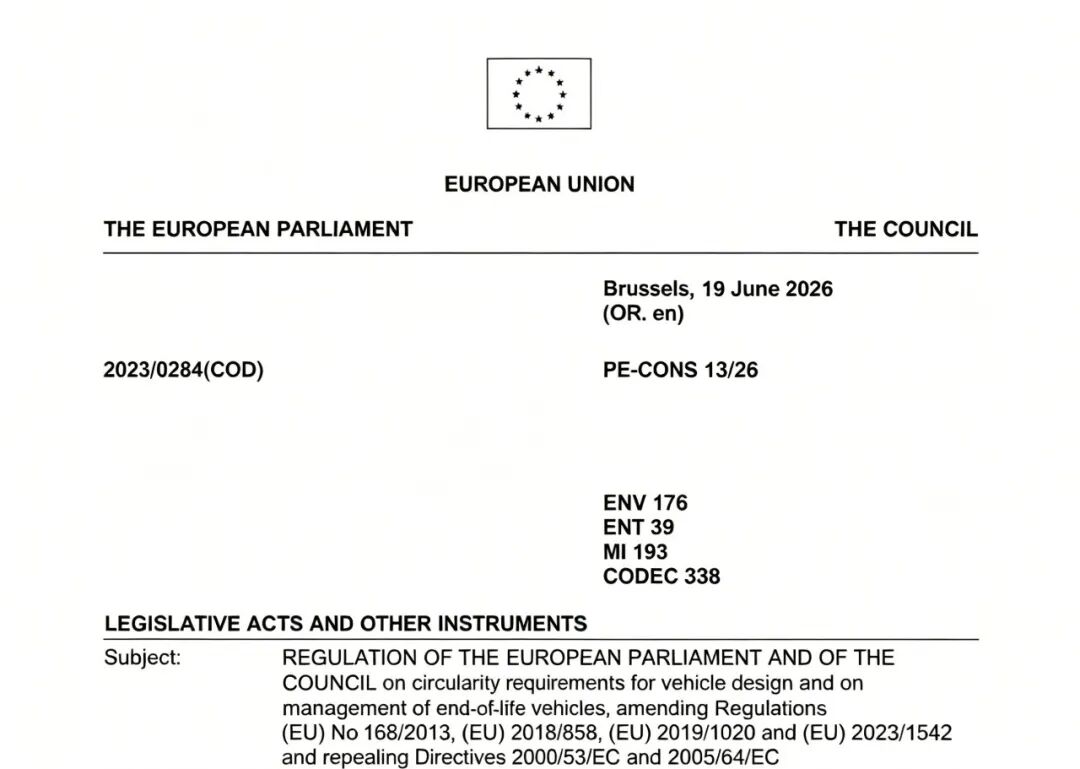
On June 29, 2026, the Council of the European Union formally adopted the End-of-Life Vehicles Regulation (ELVR), which sets out circularity requirements for vehicle design and the management of end-of-life vehicles. Previously, the European Parliament had voted to approve the legislation on June 18. The new rules will replace the End-of-Life Vehicles Directive, which has been in force for 25 years, and the 3R type-approval directive, taking the form of a unified EU regulation directly applicable in all Member States. The new regulation aims to ensure that new vehicles are designed from the outset to facilitate reuse, recycling and recovery, driving the automotive industry’s comprehensive transition toward a circular economy and sustainable development.
— 1 —
Mandatory recycled plastic target
15% in 6 years, 25% in 10 years, with a requirement for “closed-loop recycling”
In terms of material circularity, the new regulation establishes, for the first time, legally binding targets for the use of recycled materials in the automotive industry. Specifically:
Six years after the regulation takes effect.For each new vehicle model, at least 15%It must be recycled plastic.
10 years after the regulations take effect, The proportion increased to25%;
Among the above-mentioned recycled plastics, at least20%It must come from scrapped vehicles or recycled materials from old parts, achieving "Closed-loop cycle”。
This means that, six years after the regulations take effect, new vehicles must have3%A proportion of the plastic components comes from end-of-life vehicles; in 10 years, this proportion must reach 5%。
Only materials derived from post-consumer waste can count toward the target. Paolo Campanella, Secretary General of the European Waste Management Association (FEAD), said this restriction “can compel society as a whole to invest in plastics recycling, sorting, and reprocessing industries, giving recycling companies stable long-term expectations for capacity expansion.” With the recycled-content targets not taking effect for another six years, the industry has a sufficient buffer period to prepare.
In terms of imported materials, within 48 months after the regulation takes effect, recycled materials from third countries (non-EU countries) will not be allowed to count toward the minimum recycled content target. Even if they are permitted to count later, they will still be subject to strict third-party audit requirements.
Chemical recycling will be accepted as a means of compliance and will use a mass balance accounting method. The European Commission is required to establish specific verification methods within 24 months of the regulation’s entry into force. In addition, the European Commission must complete a feasibility study within one year of the regulation’s entry into force and introduce future recycled-content targets for recycled steel, aluminum, magnesium, and critical raw materials.

— 2 —
Extended Producer Responsibility
Automakers bear the full life-cycle recycling costs.
The new regulation establishes an Extended Producer Responsibility (EPR) system covering the entire life cycle of vehicles. Automakers will bear financial and organizational responsibility for the vehicles they place on the market, covering all stages from promoting circular design to the free take-back and proper treatment of end-of-life vehicles. Three years after the regulation enters into force, automakers must fully implement extended producer responsibility and bear the costs of collection and treatment of end-of-life vehicles across the EU.
EPR obligations apply to all member states where the vehicle is scrapped, regardless of where the vehicle was originally sold. Recycling enterprises can enter the producer responsibility organization council of the vehicle manufacturers as observers, establishing a regular communication channel between the manufacturers and the recycling sector.
— 3 —
Digital Circular Passport
Full lifecycle information transparency
The new regulation introduces a digital management tool called the "Circularity Vehicle Passport." Each new vehicle will be equipped with a digital passport that records its material composition, component information, and circularity performance data. This passport will cover data such as dismantling information, material sources, the presence of critical raw materials, and recycling content. In the future, dismantling companies will be able to safely trace, separate, and extract high-value components or hazardous substances based on this information.
Within six years of the regulation coming into effect, every vehicle placed on the market must be equipped with a digital circular vehicle passport. The circular vehicle passport will remain valid for at least six months after the destruction certificate is issued for the vehicle.
— 4 —
Strictly control “missing vehicles”
Scrap determination standardized, complete export ban.
To address the issue of the EU’s approximately 3.5 million end-of-life vehicles “going missing” each year—that is, being illegally dismantled or exported—the new rules significantly strengthen traceability and control measures. Once a vehicle is deemed an end-of-life vehicle, it must be processed by an authorized treatment facility and may no longer be legally exported or resold as a used vehicle.
The new regulations establish unified mandatory criteria for determining end-of-life vehicles. When selling a used vehicle within the EU, official proof must be provided to confirm that the vehicle is not legally classified as an end-of-life vehicle. When businesses sell used vehicles, they must provide a vehicle appraisal report or a valid roadworthiness inspection certificate.
The regulation also explicitly prohibits the export of used vehicles that are no longer fit for road use. Exporters must prove that vehicles shipped outside the EU are roadworthy and capable of being driven on the road. The ban will formally take effect five years after the regulation enters into force. This measure is intended to ensure that the EU fulfills its commitment not to shift pollution to third countries and to keep valuable resources within the EU.
It is estimated that more than 6 million end-of-life vehicles are generated in the EU each year. Around 3.5 million end-of-life vehicles “disappear” each year—about one-third of the entire recyclable vehicle fleet.
— 5 —
Scope of application: Fully applicable to passenger cars, motorcycles and heavy trucks are included in the regulation.
The new regulations will apply comprehensively to passenger cars (M1 category) and light commercial vehicles (N1 category). Heavy vehicles (such as trucks), motorcycles, and special vehicles will be subject to more limited requirements, focusing on ensuring their proper handling.
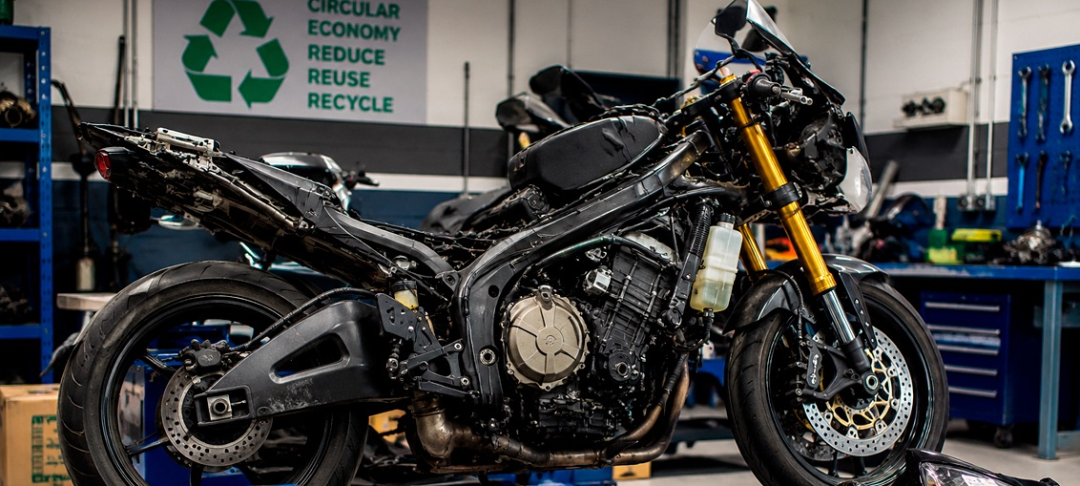
This marks the first time that motorcycles have been brought within the EU’s regulatory framework for end-of-life vehicles. Motorcycle manufacturers will be required to ensure that vehicles are designed for easy dismantling and to assume extended producer responsibility obligations, including financing collection systems and ensuring free take-back mechanisms. Previously, motorcycles were largely not subject to end-of-life vehicle regulations.
— 6 —
Industry Response: Widespread Support, with Implementation as the Key
The three major European recycling associations—FEAD (the European Waste Management Association), Recycling Europe, and FER (the Spanish Recycling Federation)—have all endorsed the regulation’s circular economy orientation, but collectively issued a warning: “Whether the policy can be effective ultimately depends on its implementation.”
The new regulations position authorized treatment facilities (ATFs) as the core entities for end-of-life vehicle disposal, responsible for issuing vehicle destruction certificates, carrying out harmless treatment of pollutants, and ensuring full-chain traceability, thereby formally defining end-of-life vehicles as strategic resources within Europe’s circular economy strategy.
FIGIEFA, the Independent Automotive Aftermarket Association, welcomed the regulation, and particularly noted that the new rules make clear that parts dismantling must not be hindered by software-related processes. The regulation also clarifies that parts recovered from end-of-life vehicles or from repair and maintenance activities and intended for reuse or remanufacturing should not be regarded as waste.
The European Environmental Bureau (EEB) pointed out that lawmakers had made compromises under industry pressure on key provisions such as recycled plastics. Environmental groups also warned that the regulations did not address restrictions on the production of resource-intensive vehicles such as large SUVs.
The new regulations will officially take effect 20 days after their publication in the Official Journal of the European Union and will be fully implemented 24 months after they come into effect.
【Copyright and Disclaimer】The above information is collected and organized by PlastMatch. The copyright belongs to the original author. This article is reprinted for the purpose of providing more information, and it does not imply that PlastMatch endorses the views expressed in the article or guarantees its accuracy. If there are any errors in the source attribution or if your legitimate rights have been infringed, please contact us, and we will promptly correct or remove the content. If other media, websites, or individuals use the aforementioned content, they must clearly indicate the original source and origin of the work and assume legal responsibility on their own.
Most Popular
-

Kingfa Sci. & Tech., 1,000-Ton Pilot PEI Line Put Into Production! Polyetherimide: Who Is Laying Out the Market, and What Is the Production Capacity?
-
2026 Electronic Components Price Increase Notice
-

A Look at the Material Suppliers Behind SpaceX
-

Research progress on surface modification of white carbon black and its applications
-
Major Shake-Up! Latest China Auto Export Rankings Released