Eu anti-dumping measures on chinese pbat cause export pattern to suffer a waterloo in the eu
In June 2026, the European Union officially launched an anti-dumping investigation against China's PBAT. Against the backdrop of frequent heavy taxation on upstream and downstream raw materials, this move will weaken the competitiveness of China's PBAT exports to Europe and exacerbate domestic surplus pressure. The industry urgently needs to accelerate market diversification, integration of the industrial chain, and breakthroughs in bio-based routes to find a solution.
In early June 2026, the European Commission officially initiated an anti-dumping investigation into polybutylene adipate terephthalate (PBAT) originating in China. This marks an extension of trade protection measures to the finished PBAT product segment, following the EU’s anti-dumping investigations in 2025 into upstream raw materials such as BDO (with provisional duties of 105.6%–113.7%) and adipic acid (with provisional duties of 28.6%–46.8%).
PBAT’s upstream raw materials have been hit by a “chain of anti-dumping measures.” The main raw materials for PBAT (polybutylene adipate terephthalate) are adipic acid (AA) and 1,4-butanediol (BDO), and both of these key materials have recently been severely affected by EU anti-dumping actions. The EU’s provisional anti-dumping duties have been imposed since February 6, 2026. The duty rate for Chinese companies involved in the case is as high as 105.6%–113.7%. Combined with the cancellation of China’s export tax rebate from April 1, 2026 (previously 13%), BDO exports are facing a double squeeze of “external duties and internal rebate withdrawal.” BDO accounts for more than 40% of PBAT raw material costs, and such high anti-dumping duties have almost blocked the direct export channel for Chinese BDO to the EU. On May 6, 2026, the European Commission issued its final anti-dumping ruling on Chinese adipic acid, imposing anti-dumping duties of 29.1% to 42.3% on Chinese companies. Chinese companies are now accelerating the redirection of trade flows toward Asia, the Middle East, and Africa to ease domestic supply pressures.
Data sources: General Administration of Customs of China, JLC
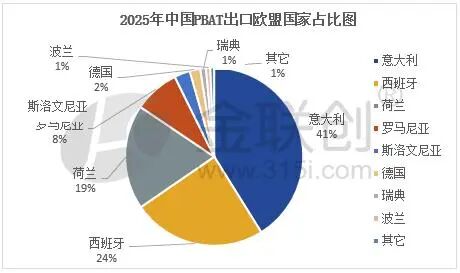
In 2025, China's PBAT exports to EU countries reached 69,200 tons, accounting for 50.95% of the total export volume. From January to April 2026, the export volume to EU countries had already reached 34,700 tons, with the proportion rising to 55.98%. Europe is one of the largest export destinations for China's PBAT. Among the EU member states, Italy ranks first in PBAT export volume from China, with an export volume of 28,500 tons, accounting for 41% of the total in the EU. Spain and the Netherlands follow, with export volumes of 16,800 tons and 13,200 tons, respectively, accounting for 24% and 19%. Together, these three countries account for 84% of the total export volume to EU countries, highlighting the significant role the EU plays as a trading partner for China's PBAT exports.
The EU’s anti-dumping investigation into PBAT from China will have a direct impact. China’s domestic PBAT overcapacity continues to be evident, and PBAT exports have risen for five consecutive years, with a relatively high dependence on exports at present. If anti-dumping duties are imposed, export quotations for Chinese PBAT to Europe will be forced to rise, further increasing cost pressures on companies and weakening their price advantage over competitors. Chinese PBAT orders will face the risk of being diverted, as EU importers may turn to other sources of supply, putting Chinese export orders under pressure of being lost. At the same time, high-cost enterprises will be forced to shift to domestic sales, and excess supply will intensify price competition in the domestic market.
The high anti-dumping duties already imposed on BDO and adipic acid will indirectly affect PBAT through the cost pass-through mechanism. The EU’s high tariffs on BDO and China’s cancellation of export tax rebates will restrict export volumes to Europe, causing a large amount of BDO capacity to shift to the domestic market and further exacerbating domestic oversupply. As a result, domestic BDO prices will come under pressure. Meanwhile, affected by the EU’s anti-dumping measures on adipic acid, domestic supply will exceed demand, prompting companies to accelerate capacity optimization. Low-cost producers will have a clear pricing advantage, and PBAT raw material costs are expected to decline.
In summary, as China’s PBAT industry faces an increasingly severe trade environment, companies will accelerate efforts to expand into Asian, Middle Eastern, and Latin American markets, as well as to regularize transshipment compliance by making use of third-country transshipment, continuously improving the qualifications and technologies required for compliance, and reducing their dependence on Europe. They will also pursue industrial chain integration to reduce the profit risks associated with a single business model and, against the backdrop of carbon tariffs, speed up breakthroughs in bio-based pathways, obtain green and low-carbon certifications, and enhance their core competitiveness in exports.
【Copyright and Disclaimer】The above information is collected and organized by PlastMatch. The copyright belongs to the original author. This article is reprinted for the purpose of providing more information, and it does not imply that PlastMatch endorses the views expressed in the article or guarantees its accuracy. If there are any errors in the source attribution or if your legitimate rights have been infringed, please contact us, and we will promptly correct or remove the content. If other media, websites, or individuals use the aforementioned content, they must clearly indicate the original source and origin of the work and assume legal responsibility on their own.
Most Popular
-

A Look at the Material Suppliers Behind SpaceX
-
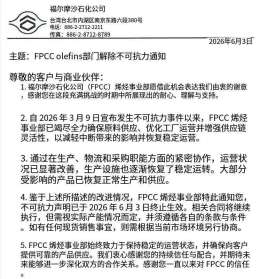
Breaking news! formosa petrochemical olefins division lifts force majeure! asia olefins supply and demand dynamics face another reversal
-
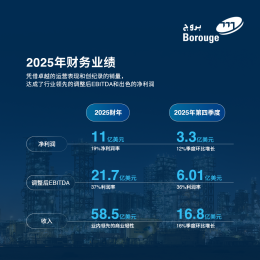
Borouge Achieves Stellar $1.1 Billion Net Profit in 2025 Driven by Operational Excellence and Record Sales
-
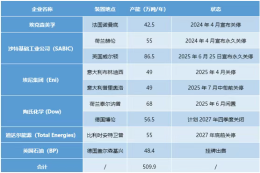
Ethylene: Production Capacity Accelerates Expansion, Global Industry Landscape Is Being Reshaped
-

Gas Explosion Accident at Shanxi Tongzhou Group Liushenyu Coal Mine Results in 82 Deaths