Cost collapse combined with weak demand, pp nonwoven fabric faces “volume and price both falling” dilemma
International crude oil prices have fallen, and navigation through the Strait of Hormuz is gradually returning to normal. The pressure from supply shortages is easing, while the U.S. lifting some sanctions on Iran has also raised expectations for increased supply. Prices of polypropylene feedstocks have dropped sharply, and the decline in costs has led downstream PP nonwoven fabric enterprises to adopt a largely bearish outlook. Their willingness to restock has weakened, resulting in a significant decline in industry operating rates.
The geopolitical situation continues to ease, and costs have declined significantly.
Oman and Iran issued a joint statement emphasizing their "sovereign rights in the territorial waters of the Strait of Hormuz." Both sides expressed their commitment to ensuring safe passage through the Strait of Hormuz. The Omani side stated that, in light of the country's responsibilities regarding the Strait of Hormuz and the critical role of the strait in the global economy, Oman has coordinated with the International Maritime Organization to establish a temporary maritime route for all vessels, based on compliance with international law and the United Nations Convention on the Law of the Sea, ensuring free passage through the strait without charging a toll, and taking into account the achievements of the relevant negotiations and mediation efforts between the United States and Iran.
|
Figure 1 Analysis of Domestic Polypropylene Market Price Trends in 2025–2026 (Unit: RMB/ton) |
|
|
|
Data source: Longzhong Information |
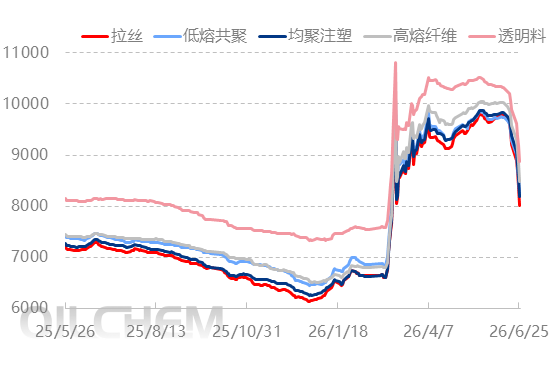
Recently, the polypropylene market has seen a significant decline, with cost collapse becoming the core driving factor for the sharp drop in prices. As of the 25th, the national average price for drawn polypropylene is 8021 yuan/ton, a decrease of 1525 yuan/ton compared to last week, reflecting a drop of 15.98%. This week, the U.S. and Iran have reached a framework consensus and issued a joint statement, marking a phased progress in talks, which has heightened market risk aversion. The substantial pullback in crude oil prices has led to a rapid plunge in the polypropylene market. From the current PP fundamentals, there has been a significant drop in crude oil, propane, and propylene prices this week. Production units that were previously forced to reduce output or shut down due to raw material shortages and high costs now have the motivation to restart. A considerable increase in domestic supply is expected in July, which will weigh on both the cost and supply sides of PP prices. The demand side is in the off-season, with operating rates being relatively low, leading to insufficient supply-demand fundamentals in the future. There is still potential for further weakening of PP at the current position, and the risks in the spot market outweigh those in the futures market, maintaining a downward price trend.
Order Shrinkage, Inventory Backlog, and Cost Collapse: The PP Nonwoven Fabric Market Faces a “Triple Kill” Situation
|
Figure 2 2024–2026 PP Nonwoven Fabric Order Days Trend Chart (Days) |
|
|
|
Data source: Longzhong Information |
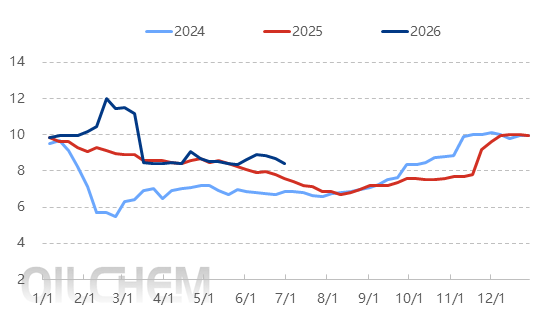
Recently, international crude oil prices have plummeted, the Strait of Hormuz has gradually reopened, and the partial lifting of U.S. sanctions on Iran has significantly heightened market concerns about an oversupply of crude oil. As crude oil is the primary raw material for the polypropylene industry chain, the downward shift in its price center has directly weakened the cost support for PP non-woven fabrics. Downstream end enterprises generally expect further declines in raw material prices, leading to a very cautious inventory replenishment attitude, with most opting to hold cash and observe, purchasing on an as-needed basis, and a proactive destocking mindset dominating. As of June 25, the latest data shows that the average order days in the PP non-woven fabric industry have decreased by 3.46%, standing at 10.99%.
|
Figure 3 Trend Chart of Finished Product Inventory Days for PP Nonwoven Fabric from 2024 to 2026 (days) |
|
|
|
Source: Longzhong Information |
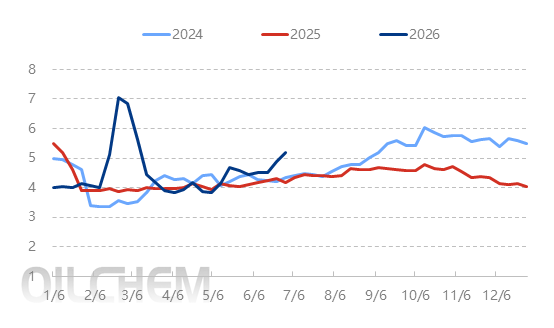
The decline in PP prices has further strengthened the bearish expectations of downstream enterprises. Their procurement strategy has shifted from proactive stockpiling to an extremely cautious approach of purchasing based on demand, resulting in a significant drop in replenishment enthusiasm. At the same time, downstream enterprises still hold high-priced resources from earlier periods. With the substantial decline in PP raw material prices, these enterprises are adopting a wait-and-see attitude, reducing raw material replenishment, which has led to a slow outflow of high-priced resources from PP non-woven fabric companies and increased pressure on inventory depletion.
In the context of weak demand on the purchasing side, PP non-woven fabric production enterprises have passively accumulated finished product inventory. Recent data shows that in June, the finished product inventory of sample enterprises in the PP non-woven fabric industry increased by 7.17% month-on-month, indicating a significant rebound. The main reason is that the industry is currently in a demand off-season, with weak enthusiasm for replenishing inventory from end-users. Additionally, the recent decline in PP prices has resulted in a virtual halt in the outflow of previously high-priced orders from end-user companies. To alleviate capital occupation and storage pressure, some PP non-woven fabric enterprises may adopt strategies of lowering prices and offering discounts to actively reduce inventory.
|
Figure 4 Comparison of PP Nonwoven Fabric Price Trends from 2023 to 2026 (Yuan/ton) |
|
|
|
Source: Longzhong Information |
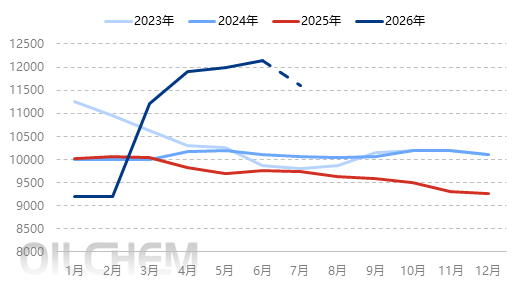
From 2023 to June 2026, PP nonwoven fabric prices showed a trend of prolonged decline followed by a rebound and then a pullback. After the full lifting of public health restrictions in 2023, PP nonwoven fabric prices fluctuated downward from RMB 11,250/ton to RMB 10,114/ton at the end of the year. In 2024, with no significant support from the supply and demand sides, PP nonwoven fabric prices mostly fluctuated around RMB 10,000/ton. In 2025, amid weak support from polypropylene feedstock, PP nonwoven fabric prices fell further along with costs to around RMB 9,200/ton.
Recently, the prices of PP non-woven fabrics have weakened, mainly due to the collapse of cost support from upstream polypropylene raw materials. In the first half of 2026, influenced by geopolitical conflicts in the Middle East and other factors, polypropylene prices experienced a rare surge. However, as the geopolitical risk premium rapidly dissipated in June, both crude oil and polypropylene prices fell sharply, directly leading to a "collapse" in the cost side of PP non-woven fabrics.
However, the decline in costs has failed to effectively boost demand, leaving the industry caught in a dual squeeze of falling costs and weak demand. On the one hand, downstream enterprises generally maintain a bearish outlook and are extremely cautious in procurement, leading to a marked decline in new orders for PP nonwoven fabrics and a passive buildup of finished goods inventories. On the other hand, although operating rates have fallen to a low of 38.68%, the oversupply situation remains difficult to alleviate. Under the dual pressure of shrinking orders and declining costs, PP nonwoven fabric prices still face the risk of a passive downward adjustment in the short term.
【Copyright and Disclaimer】The above information is collected and organized by PlastMatch. The copyright belongs to the original author. This article is reprinted for the purpose of providing more information, and it does not imply that PlastMatch endorses the views expressed in the article or guarantees its accuracy. If there are any errors in the source attribution or if your legitimate rights have been infringed, please contact us, and we will promptly correct or remove the content. If other media, websites, or individuals use the aforementioned content, they must clearly indicate the original source and origin of the work and assume legal responsibility on their own.
Most Popular
-

Evonik Parts Ways With The Polyester Business! A Strategic Retreat By A Germany Chemical Giant And The Global Industry Shift
-
Research progress on surface modification of white carbon black and its applications
-
Major Shake-Up! Latest China Auto Export Rankings Released
-

A Look at the Material Suppliers Behind SpaceX
-

Nike mind: Neuroscience and Foam Material Innovation Merge to Lead Low-Carbon Upgrading Technology in the Footwear Industry