Claiming 967 million and demanding production line destruction! kysaio biotech’s 16-year patent battle escalates, how to break the biomanufacturing dilemma
On the evening of July 14, Cathay Biotech (688065.SH), a leading synthetic biology company on the STAR Market, dropped a "bombshell" in the biomanufacturing industry with a single announcement.
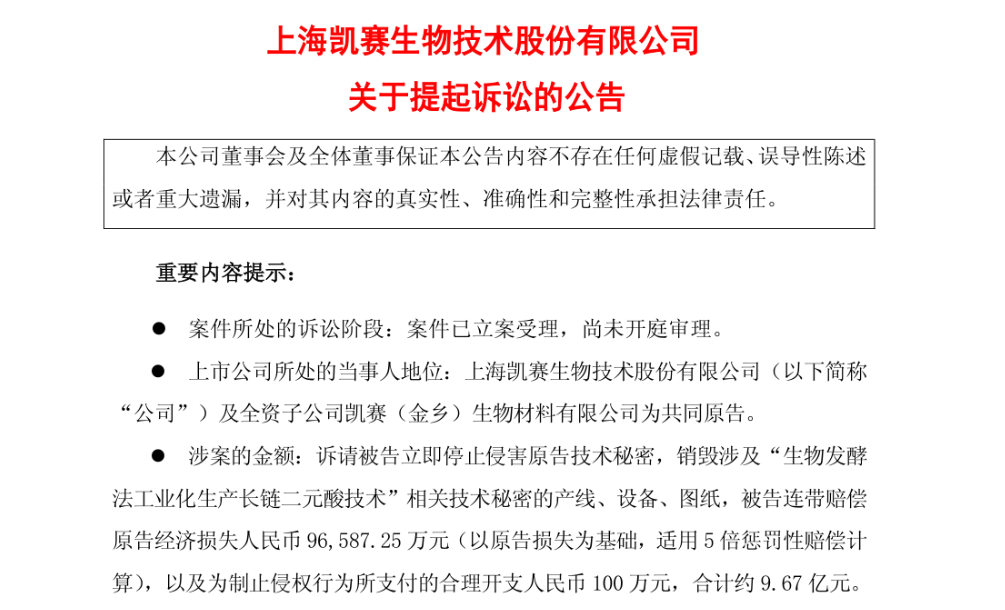
The company and its wholly owned subsidiary, CathayBiomaterials Co., Ltd., have filed a lawsuit with the Beijing High People’s Court against 10 defendants, including ST Ningke (600165) and its subsidiary, on the grounds of infringement of trade secrets. The plaintiffs are seeking the destruction of all infringing production lines, equipment, and technical drawings, as well as joint and several compensation for economic losses and enforcement expenses totaling approximately RMB 967 million.
A claim amount of RMB 967 million is nothing short of “astronomical” in intellectual property litigation in China’s biomanufacturing sector; and the extreme demand to “destroy the production line” has pushed this technological contest, which began 16 years ago, to a new climax.
1. Behind the 967 million compensation claim: A 16-year tug of war over technical secrets.
The core subject of the lawsuit by Kaisi Biotechnology is its independently developed industrialization technology for the complete set of bios fermentation method for long-chain dicarboxylic acids.Since its industrialization in 2003, this technology has been the “lifeline” underpinning Cathay Biotech’s position in the industry. The company has accumulated more than 200 invention patents around the entire process, while numerous key parameters—such as undisclosed fermentation strains and refining procedures—constitute trade secrets under strict legal protection.
According to the announcement, Cathay Biotech’s complaint outlines a complete chain of infringement: former employees Wang Zhizhou and Ge Minghua, lured by Shandong Hanlin and its legal representative Cao Wubo, disclosed the core technical secrets they had mastered for the latter’s use; based on this, Shandong Hanlin quickly built a production line and used a technology transfer contract with the Institute of Microbiology of the Chinese Academy of Sciences as a “legal cover”; the technology was then further disseminated to Shandong Guiyuan, Ningke Biological, and its subsidiary Zhongke Xincai, ultimately resulting in large-scale production.
This is not the first time Cathay Biotech has "drawn its sword."According to reports, the intellectual property dispute between Cathay Biotech and Shandong Hanlin has lasted for 16 years and gone through 42 rounds of litigation. Criminal judgments found that Shandong Hanlin and former Cathay Biotech employees had committed the crime of infringing trade secrets, while Cathay Biotech also prevailed in subsequent civil and administrative lawsuits. At the end of 2025, Cathay Biotech also secured two favorable judgments from the Supreme People’s Court, involving punitive damages for patent infringement and substantial damages for trade secret infringement.
However, the favorable ruling did not mark the end. Cathay Biotech discovered that Shandong Hanlin had continuously changed its nominal operating entities and registered new companies through leasing arrangements, while continuing to produce the accused infringing products using the original production lines and personnel. The lawsuit before the Beijing High People’s Court is the latest round in this protracted battle.
2. From Long-Chain Dicarboxylic Acids to Bio-Based Polyamides: Kasei Bio's "Technological Moat"
To understand why Cathay Biotech is so committed to intellectual property protection, one must examine the technological landscape it has built over more than two decades of deep engagement in the bio-based field.

Long-chain dicarboxylic acids: The global dominant position of the "basic platform"
Long-chain dicarboxylic acids (C10-C18) are key raw materials for high-end nylon, aviation lubricants, pharmaceutical intermediates, and biodegradable materials. Traditionally, they have been produced using chemical methods, which have long been monopolized by international giants. In 2000, Liu Xiucai, the founder of Kasei Biotech, bet on this field, investing 500 million yuan over five years, and achieved the world's first industrialization of lauric acid through biological methods at a scale of 10,000 tons in 2003. Around 2016, traditional chemical lauric acid producers, represented by Invista, exited the market, and Kasei Biotech won the "first battle" of biological methods replacing chemical methods due to its cost-performance advantage.
Today, Cathay Biotech has become the world’s dominant supplier of long-chain dibasic acids. The product was recognized as a Manufacturing Single Champion Product by the Ministry of Industry and Information Technology in 2018, with a gross margin of 42.88%. In 2025, the company achieved operating revenue of RMB 3.295 billion, up 11.4% year on year, and net profit attributable to shareholders of the parent company of RMB 561 million, up 14.68% year on year.
Biobased Polyamide: The "Ambition" of the Second Growth Curve
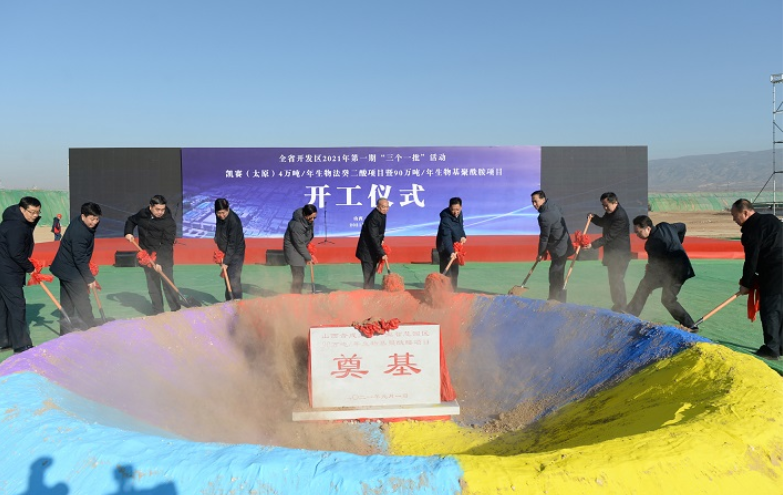
Beyond long-chain dibasic acids, Cathay Biotech is vigorously expanding its bio-based polyamide industry chain. Its core monomer, bio-based 1,5-pentanediamine, is produced from biomass sugars through the biotransformation of genetically engineered strains. At present, the Wusu plant has established an annual production capacity of 50,000 tons of bio-based pentanediamine and 100,000 tons of bio-based polyamide, while the Taiyuan plant’s “500,000 tons per year of bio-based pentanediamine and 900,000 tons per year of bio-based polyamide project” is under construction.
On the application side, progress has been equally broad-based: in the civilian silk segment, the company has already entered the supply chains of well-known brands in underwear and school uniforms; its industrial yarn cord has been validated by multiple tire manufacturers; and the bio-based composite refrigerated containers developed in cooperation with Haier Biomedical have been delivered at scale. In 2025, Cathay Biotech also established the joint venture “Kaixian Times” with CATL and completed a RMB 5.914 billion private placement with China Merchants Group, further expanding its strategic footprint.
From the biosynthesis of core monomers to downstream polymer applications, Cathay Biotech has built a complete technological closed loop spanning strain design to large-scale fermentation. President Yang Chen once stated bluntly: “For bio-based materials to replace traditional petroleum-based products, they cannot rely solely on a ‘green’ label; they must establish a clear edge in both performance and cost.” It is precisely the technological accumulation behind this “hard edge” that underpins Cathay Biotech’s frequent initiation of intellectual property litigation—its core technologies are its lifeline.
III. The Dilemma of "Repeated Complaints, Repeated Infringements": Shandong Hanlin and the Technology Diffusion Chain
Why does Kaisa Biotech "frequently sue"? The answer lies in a chain of technology diffusion.
Shandong Hanlin: 16 Years from Stealing Secrets to Bankruptcy
Shandong Hanlin Technology Co., Ltd. was established in 2008 and is located in Laiyang, Shandong. Its main business is also long-chain dicarboxylic acids. According to the facts as determined by the court, in 2008, core employees of Cathay Biotech’s Shandong plant, Wang Zhizhou and Ge Minghua, were lured away by Hanlin’s legal representative Cao Wubo, and took the technical secrets with them in their entirety to Hanlin. In April 2009, Hanlin signed a “Technology Transfer Agreement” with the Institute of Microbiology, Chinese Academy of Sciences, and Chen Yuantong was appointed chief scientist of Hanlin. Just two months later, the production line was completed and put into operation.
In 2010, Chen Yuantong, Fu Shenzhan, and others, together with Cao Wubo, applied for multiple patents using Cathay Biotech’s technical secrets; the court later ruled that the patent rights belonged to Cathay Biotech. In 2018, Wang Zhizhou was sentenced to five years’ imprisonment for the crime of infringing trade secrets. By the end of 2025, the Supreme People’s Court had ruled in favor of Cathay Biotech in both the trade secret infringement case and the patent infringement case, with the latter applying double punitive damages.
However, in 2022, Shandong Hanlin plunged into a severe debt crisis, and in May of the following year entered bankruptcy reorganization proceedings, with liabilities of approximately RMB 7.4 billion. Against this backdrop, Hanlin continued to evade enforcement by leasing out assets and changing its operating entity, while its affiliate, Shandong Guiyuan, leased its factory buildings and equipment to continue production. Tao Xinliang, Honorary Dean of the Intellectual Property School of Shanghai University, commented: “Although the infringer repeatedly lost in more than a dozen cases, it maliciously continued the infringement through such egregious tactics as shell-switching reorganization and leasing out equipment.”
Secondary diffusion of technology: the "transfer" role of the Institute of Microbiology, Chinese Academy of Sciences
More noteworthy is the role of the Institute of Microbiology of the Chinese Academy of Sciences in the technology diffusion chain. In April 2017, the institute signed a Technology Transfer Contract with Ningke Biotechnology, transferring to Ningke Biotechnology technologies related to the large-scale production of long-chain dicarboxylic acid (dodecanedioic acid), with its subsidiary Zhongke New Materials responsible for building and operating the plant. Cathay Biotech contends that the technology is still essentially derived from its misappropriated trade secrets. In 2024, Ningke Biotechnology and Zhongke New Materials entered pre-bankruptcy reorganization proceedings. While providing technical consulting services to them, Cathay Biotech discovered that the technology used by Zhongke New Materials was highly similar to its own trade secrets, thereby triggering the present RMB 967 million lawsuit.
Ningke Biotech firmly denied this, stating in an announcement that its technology was acquired from the Institute of Microbiology of the Chinese Academy of Sciences for compensation and that the transaction was supported by complete and lawful procedures. With both sides sticking to their own claims, the final decision still awaits a court ruling.
IV. Conclusion: Intellectual Property Protection, the “Mandatory Question” for the Bio-Manufacturing Industry
Cathay Biotech’s “patent defense battle” is essentially a deep-seated contest over the protection of technical secrets and the order of industrial competition.
On the one hand, Cathay Biotech’s technological barriers, built on more than 200 accumulated patents, are the foundation of its dominant position in the global long-chain dicarboxylic acid market and the basis for its second growth curve in bio-based polyamides. The theft, dissemination, and transfer of its core technologies directly threaten its survival and development, making rights protection inevitable. On the other hand, the infringing parties sought a path to “legitimization” through technology transfer contracts, while the bankruptcy reorganization of Shandong Hanlin and the pre-reorganization of Ningke Biotech also reflect the capital and market risks in the industrialization process of long-chain dicarboxylic acids.
The outcome of this lawsuit will directly affect the fate of the two listed companies and may also become a benchmark case for intellectual property protection in the synthetic biology industry. If Cathay Biotech prevails and succeeds in enforcing its demand to “destroy the production lines,” the cost of technological infringement in the sector will rise sharply; if the defendants’ defense is upheld, it may reshape the standards for determining ownership of trade secrets in biomanufacturing and fermentation processes.
For the burgeoning biomanufacturing industry, how to balance the open sharing of technological innovation with strict protection of intellectual property, and how to prevent the recurrence of an infringement chain of “theft of technical secrets—preemptive patent filing—circumvention by repackaging,” is an unavoidable “must-answer question.” And the answer may well lie in the trial records that follow.
Editor: Lily
Sources: National Enterprise Bankruptcy Reorganization Case Information Network, 21st Century Business Herald, Sina Finance, East Money Information, Blue Whale News, Science and Technology Daily, Cathay Biotech’s investor relations interactive platform, Huatai Securities research reports, etc.
Image source: Cathay Biotech
【Copyright and Disclaimer】This article is the property of PlastMatch. For business cooperation, media interviews, article reprints, or suggestions, please call the PlastMatch customer service hotline at +86-18030158354 or via email at service@zhuansushijie.com. The information and data provided by PlastMatch are for reference only and do not constitute direct advice for client decision-making. Any decisions made by clients based on such information and data, and all resulting direct or indirect losses and legal consequences, shall be borne by the clients themselves and are unrelated to PlastMatch. Unauthorized reprinting is strictly prohibited.
Most Popular
-
AI Computing Power Demand Ignites Electronic Fabrics! China Jushi Hits Limit Up! Domestic Substitution Welcomes Golden Window
-
South Korea Initiates Anti-Dumping Investigation Into China’s PVC Suspension Resin! Triple Tariff Iron Curtain Falls, Who Pays for China’s Chemical Exports?
-

Focus on going global! kingfa sci. leads, huitong, preter, and kumho nire follow, china’s modified plastics frenziedly expanding worldwide
-
South Korea initiates anti-dumping investigation against Chinese PVC suspension resin! The target is Tianjin Bohua and Wanhua Chemical. How to break through?
-
Technology, Quality, and Partnership: How Linquan Uplifts the Value Behind "Smartly Made in Danyang"