Breaking: United States (US) Plans to Impose a 12.5% 301 Tariff on Mainland China and Hong Kong
On June 3, 2026, the Office of the United States Trade Representative (USTR) released the results and proposed measures of the Section 301 investigation regarding the failure of various countries/regions to implement and effectively enforce the prohibition on imports of goods made with forced labor. It stated that additional Section 301 tariffs of 10% and 12.5% would be imposed on imported goods from 60 economies, including China, Japan, India, South Korea, and Vietnam, on the grounds that these economies "have failed to implement and effectively enforce the ban on imports of products made with forced labor," meeting the conditions for punitive tariffs under Section 301.
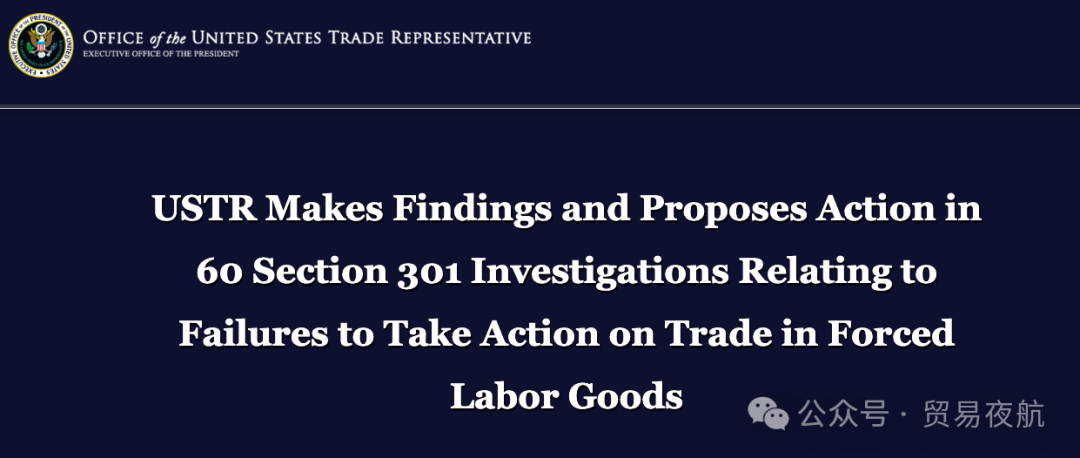
The United States plans to impose additional tariffs on all products from economies that have legislated or committed to implementing bans or have introduced some control regulations, with an extra 10% tariff; all products from other economies will face an additional 12.5% tariff.
Specific tariff plan:
🚨 An additional 10% Section 301 tariff is imposed on 14 countries/regions.
Canada, Ecuador, the European Union, Indonesia, Mexico, Pakistan, Argentina, Bangladesh, Cambodia, El Salvador, Guatemala, Malaysia, Taiwan Province of China, the United Kingdom.
The reason is that the aforementioned economies have either implemented import bans on goods produced with forced labor but have not effectively enforced them; committed through reciprocal trade agreements to implement and enforce such bans; or adopted certain control measures to prevent the import of certain goods produced with forced labor.
Impose an additional 12.5% Section 301 tariff on the remaining 46 countries/regions.
Mainland China, Hong Kong, China, Vietnam, Algeria, Angola, Australia, Bahamas, Bahrain, Brazil, Chile, Colombia, Costa Rica, Dominican Republic, Egypt, Guyana, Honduras, India, Iraq, Israel, Japan, Jordan, Kazakhstan, Kuwait, Libya, Morocco, New Zealand, Nicaragua, Nigeria, Norway, Oman, Peru, Philippines, Qatar, Russia, Saudi Arabia, Singapore, South Africa, South Korea, Sri Lanka, Switzerland, Thailand, Trinidad and Tobago, Turkey, United Arab Emirates, Uruguay, Venezuela.
The reason is that the above-mentioned economies have not implemented and effectively enforced a ban on the import of products made with forced labor.
The tariff applies to all product categories, meaning that all products will be subject to additional duties, to be compounded with the previously imposed extra 301 tariffs, except for the following exempted products.
Exempt Products:
The announcement attachment lists the products exempted from the additional tariffs mentioned above, mainly including:
Some agricultural products, such as beef, coffee, spices, and fruit
Medications, vaccines, vitamins
Chemicals, polymers, rubber, wood
Aircraft and parts thereof
Some electronic components and optical instruments
Gold, silver, and other precious metals
·Chemical fertilizers, mineral products, paper, textiles, etc.
Products under Section 232 tariffs mainly include steel, aluminum, copper and derivative products, automobiles, and auto parts.
Goods compliant with the USMCA
Central America Free Trade duty-free textiles, donated books, personal baggage, etc.
This is the Trump administration’s latest move as the United States shifts to Section 301 as its main tariff tool after the Supreme Court previously ruled that some IEEPA tariffs were unlawful.
This marks the United States' readiness to broadly impose Section 301 tariffs on 60 global economies under the justification of "not prohibiting the importation of forced labor."
The above Section 301 tariff measures are expected to take effect as early as July.
Affected countries/regions and enterprises may submit comments or apply for a hearing within the prescribed time limit.
Submission of Hearing Request and Summary of Testimony: June 22, 2026
Submit written comments: July 6, 2026
Public hearing: Starting from July 7, 2026.
Submit rebuttal comments within 5 days after the hearing.
【Copyright and Disclaimer】The above information is collected and organized by PlastMatch. The copyright belongs to the original author. This article is reprinted for the purpose of providing more information, and it does not imply that PlastMatch endorses the views expressed in the article or guarantees its accuracy. If there are any errors in the source attribution or if your legitimate rights have been infringed, please contact us, and we will promptly correct or remove the content. If other media, websites, or individuals use the aforementioned content, they must clearly indicate the original source and origin of the work and assume legal responsibility on their own.
Most Popular
-

A Look at the Material Suppliers Behind SpaceX
-
Ethylene: Production Capacity Accelerates Expansion, Global Industry Landscape Is Being Reshaped
-
Ethylene Industry Enters Production Boom Period! Multinational Giants and Domestic Leaders Compete in Trillion-Dollar Track
-
Target To Reduce Plastic By 30%! South Korea Enters Plastic Recycling Controversy, Involving National Interests
-

Amer Sports Releases 2025 Sustainability Report, Apparel And Footwear Recycled Material Proportion Reaches 19.3%