



Ampacet Releases Spectro4.0 AI System to Tackle Color Consistency Challenges in Recycled Material Extrusion
Facing the dual pressure of ensuring stable product quality and implementing sustainable development initiatives, innovations in automation and artificial intelligence technology are becoming transformative solutions for the plastic industry. As the proportion of recycled materials such as post-consumer recycled (PCR) and post-industrial recycled (PIR) resins continues to rise, challenges such as color instability and low production efficiency also arise.
These issues not only erode corporate profits and increase material waste but also damage brand reputation. However, cutting-edge technology is helping manufacturers overcome these obstacles, ensuring that the extrusion process is both highly precise, efficient, and sustainable.
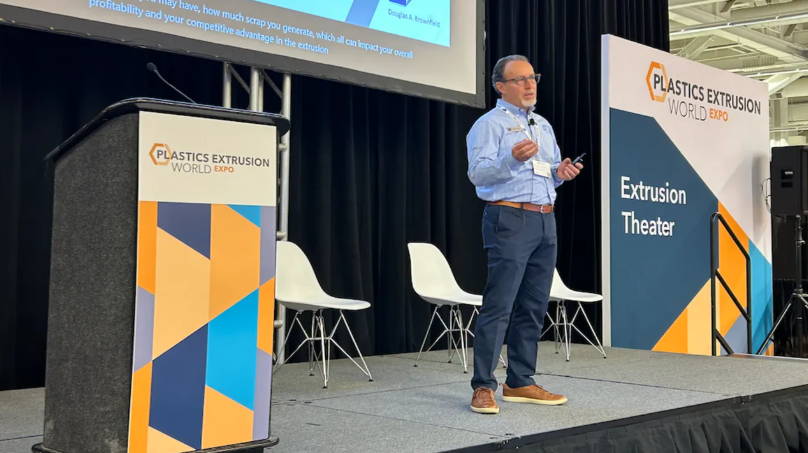
Douglas Brownfield, Business Director of Ampacet, a color masterbatch manufacturer based in Tarrytown, New York, delivered a speech at the AMI International Plastics Exhibition in Cleveland, Ohio, addressing the industry's pain points. Brownfield highlighted the company's Spectro 4.0 AI color auto-calibration system, which effectively enhances production efficiency and tackles the complex challenges posed by the use of recycled materials. In his speech, he emphasized that automation technology is a key lever for companies to achieve sustainable development goals while maintaining high-quality standards.
"How is your company's current profitability level in the extrusion business?" Brownfield posed this question during his speech, emphasizing that manufacturers are under increasing pressure from stringent quality standards, particularly in color control. He explained that customers demand nearly flawless color in products, but achieving this goal often requires extended downtime, increased scrap rates, and declining profitability. Moreover, the use of PCR and PIR materials exacerbates fluctuations in product performance, forcing companies to increase the frequency of quality inspections.
Brownfield stated, "Production line operators calibrate colors by adjusting the feed amount of masterbatch, but they are not professional color chemists. This non-professional adjustment method can lead to a significant increase in masterbatch consumption—uncontrolled operations may even double the consumption, significantly raising production costs."
He also pointed out that the current shortage of skilled labor in the industry further exacerbates the aforementioned issues. Brownfield emphasized that companies urgently need to rely on automation technology to reduce dependence on skilled workers while ensuring production quality and efficiency. He explained that automation not only helps companies maintain good customer relationships but also achieves stable and controllable product quality. In addition, he mentioned that compared to powdered pigments, single pigment concentrates (monochrome masterbatches) have significant advantages in small-batch production.
"The flexibility of a single pigment solution allows for real-time color calibration on the production line, which powdered pigments cannot achieve," he added.
Spectro 4.0: Reshaping the Extrusion Production Landscape
The core of Brownfield's presentation is Ampacet's flagship product, the Spectro 4.0 AI Color Control System. This technology enables automatic color calibration, significantly enhancing extrusion process efficiency. Spectro 4.0 is equipped with an online non-contact spectrophotometer that continuously monitors product colors and compares them with preset standard color values. The system automatically calculates color difference values (ΔE) and adjusts the masterbatch feeding speed in real-time to ensure color consistency throughout the production process.
Brownfield Introduction: "This technology can real-time calibrate the deviation of A and B color parameters — whether the product color is biased towards blue, yellow, green, or red, it can be accurately corrected."
Spectro 4.0 offers two configuration options: one is a single feeder configuration suitable for masterbatch, and the other is an advanced configuration that uses individual pigments and supports high-precision calibration.
Unlike traditional handheld detection devices that require color card comparison and rely on a stable environment, Spectro 4.0 can operate steadily in harsh factory production environments. Its patented self-calibration technology eliminates the need for frequent manual calibration, maintaining a high level of detection accuracy at all times.
Brownfield said, "Our system features built-in whiteboard calibration integrated within the equipment chassis, ensuring stable and reliable detection accuracy even in harsh production environments."
This technology can also eliminate interference from ambient light such as fluorescent lamps, remaining unaffected by external lighting conditions and consistently maintaining precise detection. Spectro 4.0's color difference value (ΔE) control accuracy can reach 0.05, comparable to laboratory desktop equipment, fully meeting the stringent requirements of industrial production.
In addition, the system records a timestamp for each color detection, allowing manufacturers to download and analyze the entire production process data. Brownfield pointed out, "When customers question the color quality of a product, this comprehensive data can serve as strong evidence of production compliance."
Artificial Intelligence Empowering Sustainable Development: Solving the Challenges of PCR Material Application
Brownfield emphasized that artificial intelligence technology is the key to addressing the challenges in the application of PCR materials. Although the use of PCR materials is an important measure for practicing sustainable development, the impurities and color instability of these materials can easily lead to product scrapping, production line shutdowns, and material waste.
"Color instability can severely damage a brand's color recognition," said Brownfield. Ampacet's Spectro 4.0 system, combined with a single pigment masterbatch solution, can fundamentally address the issue of color consistency in the application of PCR materials by adjusting pigment ratios in real-time on existing extrusion lines.
The promotion and application of PCR and PIR materials is a positive step for the plastic industry towards sustainable development, but it also presents significant challenges for manufacturers. Brownfield explained that impurities in recycled materials often cause color deviations, leading to product rejection and resource wastage.
"These issues will eventually lead to production downtime, material waste, and even threaten the brand's color reputation," he added.
The Spectro 4.0 system, through the combination of artificial intelligence technology and Ampacet's innovative single pigment masterbatch, can automatically adjust the pigment ratio during production. This ensures stable product color quality even when using complex recycled materials.
Brownfield also emphasized the flexibility advantages of Spectro 4.0 in small-batch production. He stated that a single pigment solution supports real-time color calibration on the production line, which is not achievable with traditional powdered pigment technologies.
"A single pigment scheme allows for dynamic adjustments in the production process, ensuring stable product quality while significantly reducing material waste," he said.
Automation and Artificial Intelligence: Future Directions of the Extrusion Industry
At the end of the speech, Brownfield emphasized that automation and artificial intelligence technology have a revolutionary impact on reshaping extrusion production. With technologies like Spectro 4.0, manufacturers can overcome quality control challenges, reduce material waste, and improve profitability.
"Upgrading existing equipment to a smart production system can achieve precise real-time color calibration, completely eliminating the subjectivity and inefficiency of manual operations," Brownfield concluded.
Ampacet's advanced color control system marks a significant breakthrough in extrusion technology. This technology helps manufacturers meet customer demands in a competitive market while steadily advancing sustainability goals. These innovations not only effectively address industry challenges associated with the application of recycled materials but also comprehensively enhance production efficiency, reduce material waste, and achieve stable and controllable product quality.
【Copyright and Disclaimer】This article is the property of PlastMatch. For business cooperation, media interviews, article reprints, or suggestions, please call the PlastMatch customer service hotline at +86-18030158354 or via email at service@zhuansushijie.com. The information and data provided by PlastMatch are for reference only and do not constitute direct advice for client decision-making. Any decisions made by clients based on such information and data, and all resulting direct or indirect losses and legal consequences, shall be borne by the clients themselves and are unrelated to PlastMatch. Unauthorized reprinting is strictly prohibited.
Most Popular
-

List Released! Mexico Announces 50% Tariff On 1,371 China Product Categories
-
[PET Weekly Outlook] Polyester Bottle Chips Expected to Oscillate and Warm Up with Costs Today
-
EVA Morning Prices on September 12: Most of the Market Holds Steady, Highest Rise of 50 Yuan
-

EU Changes ELV Regulation Again: Recycled Plastic Content Dispute and Exclusion of Bio-Based Plastics
-

Case Study | Clariant AddWorks™ Additives Solve Plastic Yellowing Problem

