



AI Computing Power Demand Ignites Electronic Fabrics! China Jushi Hits Limit Up! Domestic Substitution Welcomes Golden Window
Zhuansu Shijie has learned that on July 3, A-share electronic fiberglass cloth concept stocks surged again. China Jushi (600176.SH) hit the daily limit during the session, with its market capitalization briefly approaching RMB 300 billion and buy orders exceeding 350,000 lots. International Composites, Sinoma Science & Technology, Honghe Technology, and several other stocks also rose in tandem. Just one day earlier, major electronic cloth manufacturer Fu Qiao Industrial had confirmed a new round of price hikes: ordinary E-glass electronic fiberglass cloth was up 30%, while low-dielectric-constant electronic cloth for AI servers rose 15%.
What has gone up in price is a piece of cloth.
A cloth woven from glass fibers thinner than a strand of hair.
1. What is electronic fabric?
Electronic fabric, officially known as electronic-grade glass fiber cloth, is woven from electronic-grade glass fiber yarn with a diameter of no more than 9 micrometers through warping, sizing, and weaving. It is as thin as a cicada's wing—the thinnest model is only about 0.02 millimeters thick, and weighs less than 20 grams per square meter.
Yet this thin sheet of fabric is the “skeleton” of the modern electronics industry.
Electronic glass fiber fabric is compounded with resin and copper foil to produce copper-clad laminate (CCL), which is then etched into printed circuit boards (PCBs). In other words, the green circuit board inside the smartphone in your hand, the computer on your desk, and the AI servers in data centers all rely on this fabric. In the production cost of copper-clad laminates, electronic glass fiber fabric can account for 25% to 40%. According to estimates, by 2026 the market size for glass fiber fabric driven by the global PCB industry could reach US$7.664 billion, and by 2030 it is expected to grow to US$11.101 billion.
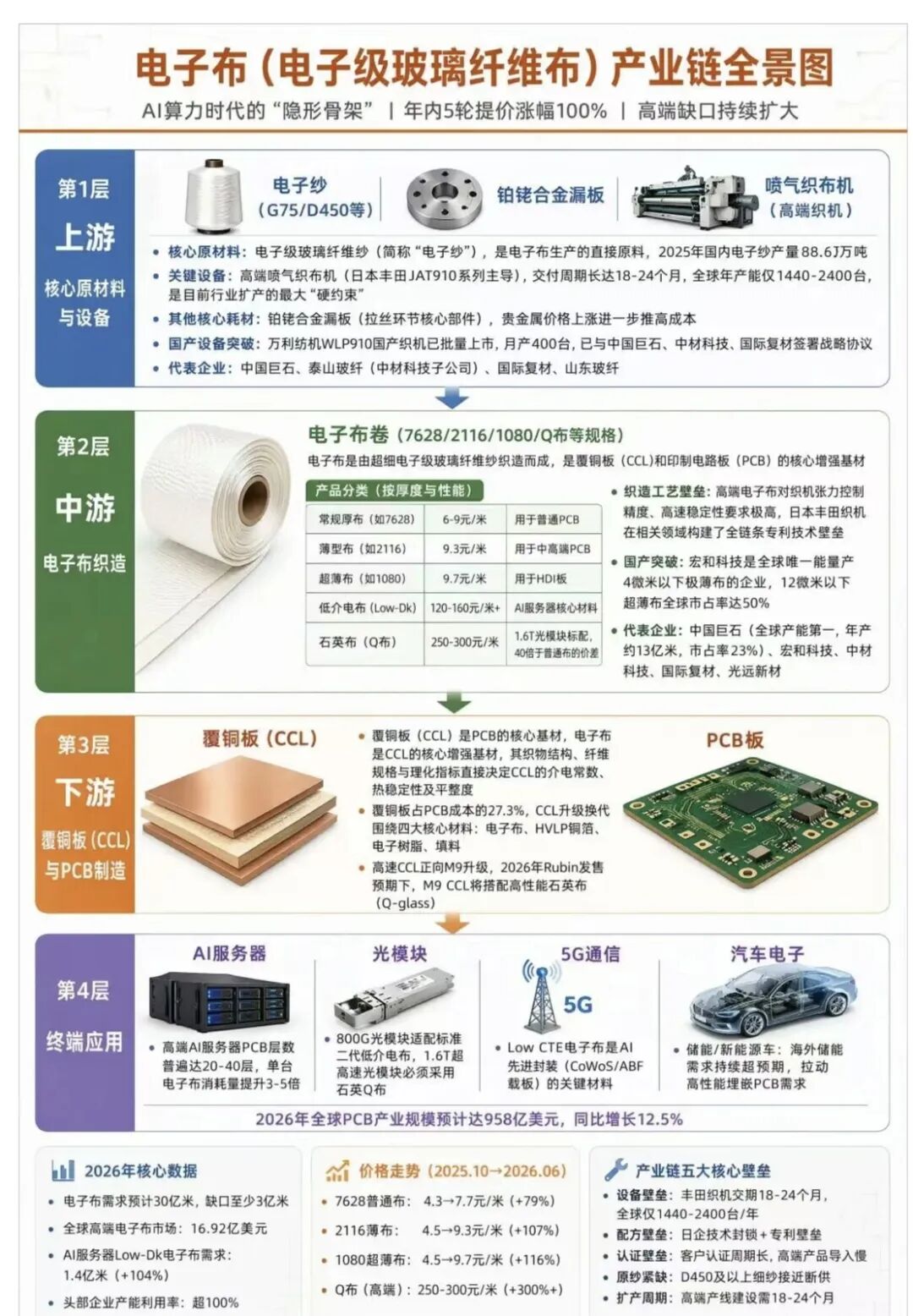
Image source: Chemical New Materials
II. Doubling in One Year: What Happened?
Electronic glass fiber cloth is nothing new. But its price skyrocketed in 2026.
As of early June 2026, the mainstream specifications of electronic fabrics in the market have undergone five price increases this year, with an average price reaching 7.4 yuan per meter, representing a 100% increase compared to the low point in the third quarter of 2025. In other words, the price has doubled in less than a year.
What sparked this price hike was AI.
Since 2025, the demand for AI servers has exploded, directly driving the demand for high-end PCBs. High-end PCBs require advanced copper-clad laminates, which in turn require high-performance electronic fabrics. This chain of transmission is clear and direct. According to a report by Huatai Securities, the market demand for low-dielectric electronic fabrics driven by computing power GPUs is expected to be approximately 68.57 million meters in 2025, and is projected to increase to 140 million meters in 2026.
While demand is surging, supply cannot keep up.
The production of electronic cloth places extremely high demands on specialized equipment and process control. From electronic yarn drawing to weaving, it involves dedicated equipment such as tank furnace drawing machines, warping machines, and high-end air-jet looms. The technical barriers and capital requirements are both very high. The pace of capacity expansion is constrained, and the tight supply-demand situation is unlikely to ease in the short term.
More importantly, as companies have shifted production capacity toward high-end electronic cloth, a supply gap has emerged in standard electronic cloth instead. This explains a seemingly counterintuitive phenomenon in the current round of price increases: standard electronic cloth has risen by 30%, higher than the 15% increase for high-end products. Fuqiao (Dongguan) Fiberglass Co., Ltd. responded that “prices have been rising every month recently.” At present, mainstream models such as 7628, 2116, and 1080 have no spot inventory, and “we still can’t fulfill existing customer orders.”
Three, the track monopolized by Japan at 90%.
Behind the price increase in electronic glass fiber cloth, there is also a deeper industrial story.
In the global high-end electronic fabric market, Japanese companies have long held a dominant position. Among them, Nittobo alone monopolizes over 90% of the global high-end fiberglass fabric share. In the Low-CTE (low coefficient of thermal expansion) electronic fabric sector, Nittobo's share exceeds 90%, making it nearly the sole supplier.
Founded in 1923, this Japanese company started out in cotton spinning and has built up more than 40 years of leading expertise in the fiberglass field. The low-thermal-expansion T-glass electronic fabric required for AI chips can be stably supplied almost only by Nittobo. According to reports, Nvidia CEO Jensen Huang once personally flew to Japan to visit Nittobo, solely to secure more supply.
However, Nittobo is extremely cautious about expanding capacity. Its new capacity for the full year of 2026 will increase by only 10% to 20%, with large-scale expansion expected to come in the second half of 2027. Even after the new production lines come online, Nittobo itself acknowledges that it will still be difficult to bridge the gap between supply and rapidly growing demand.
This has left enormous market opportunities for Chinese companies.
4. Domestic substitution is happening.
China is the world’s largest producer of electronic fiberglass fabric, with Chinese companies accounting for over 70% of global production capacity. China Jushi alone holds approximately 23% of the global electronic fiberglass market, making it the world’s leading producer of electronic fiberglass fabric.
For a long time, Chinese companies have mainly focused on the ordinary electronic cloth sector, while the high-end market has been firmly held by Japanese companies. Now, the explosion of demand brought by AI is changing this landscape.
In 2025, China Jushi achieved sales of 1.062 billion meters of electronic fabric, while revenue from its fiberglass and fiberglass products business reached RMB 18.345 billion. In May 2026, the company announced an investment of RMB 4.431 billion to build a production line with an annual capacity of 50,000 tons of electronic yarn and 320 million meters of electronic fabric. Previously, its Huai’an production line, with an annual capacity of 100,000 tons of electronic-grade fiberglass and 390 million meters of electronic fabric, was ignited in March 2026, making it the world’s largest single electronic fiberglass production line. With the addition of the new capacity, China Jushi’s total electronic fabric production capacity is expected to surge to more than 1.6 billion meters.
Breakthroughs are also taking place in higher-end segments. Taishan Fiberglass, a subsidiary of Sinoma Science & Technology, has achieved mass production of specialty fiber fabrics; Honghe Technology has the capability to mass-produce ultra-thin and extremely thin T-glass fabrics; and Feilihua is the only domestic company capable of mass-producing quartz fiber fabric. In the field of low-CTE electronic glass fiber fabric, Nittobo was previously the sole global supplier, but Sinoma Science & Technology and Honghe Technology have now achieved technological breakthroughs and begun contributing through mass production.
As of the end of 2025, the cumulative investment in special electronic glass fiber projects under construction or planned in the industry has reached RMB 13.38 billion, with production capacity expected to be released in a concentrated manner in 2027.
5. The Industry Transformation Behind a Piece of Cloth
In the abnormal trading announcement issued by Sinoma Science & Technology on June 28, 2026, the company reminded that its electronic fabrics products (excluding specialty fabrics) and specialty fiber fabrics achieved sales revenue of RMB 360 million and RMB 628 million in 2025, respectively, accounting for only 1.19% and 2.08% of the company’s operating revenue, respectively.
Although the share is still small, the growth rate is astonishing. In the first quarter of 2026, China Jushi reported revenue of RMB 5.282 billion, up 17.93% year on year, and net profit attributable to shareholders of RMB 1.267 billion, up a remarkable 73.48%. In the first quarter, Honghe Technology’s net profit attributable to shareholders surged by more than threefold year on year, while International Composite Materials’ increased by more than fourfold.
CITIC Securities believes that 2026 will be a major year for price increases in electronic glass fiber cloth. For both conventional cloth and specialty cloth, production costs are relatively stable, and most of the price increases will be translated into profits. China Post Securities expects the price increase momentum to continue through year-end, and the flexibility of this round of price hikes is expected to exceed expectations.
From a thin piece of fabric, to a listed company with a market value of hundreds of billions, and then to a critical “chokepoint” in the global AI industrial chain—the story of electronic fabric reflects the path of Chinese manufacturing as it upgrades from low-end capacity to high-end breakthroughs. The road ahead remains long, but the direction is already clear.
【Copyright and Disclaimer】This article is the property of PlastMatch. For business cooperation, media interviews, article reprints, or suggestions, please call the PlastMatch customer service hotline at +86-18030158354 or via email at service@zhuansushijie.com. The information and data provided by PlastMatch are for reference only and do not constitute direct advice for client decision-making. Any decisions made by clients based on such information and data, and all resulting direct or indirect losses and legal consequences, shall be borne by the clients themselves and are unrelated to PlastMatch. Unauthorized reprinting is strictly prohibited.
Most Popular
-
Kingfa Sci. & Tech., 1,000-Ton Pilot PEI Line Put Into Production! Polyetherimide: Who Is Laying Out the Market, and What Is the Production Capacity?
-

A Look at the Material Suppliers Behind SpaceX
-
2026 Electronic Components Price Increase Notice
-
Chinese companies going global in southeast asia: 36 Cases, 5 Golden Rules
-
Basf exits joint venture with cnpc! chinese refrigeration products sell explosively overseas! south korea plans to build chip factory


