25 Nucleating Agents Explained: Full Coverage of Transparency, Stiffness Enhancement, Flame Retardancy, and Conductivity to Solve Polyolefin Modification Pain Points
I. Overview of Nucleating Agents: The “Small Lever That Moves a Great Weight” in Polyolefin Modification
This article systematically reviews 25 mainstream polyolefin nucleating agents, covering four major application areas: transparency modification, stiffness enhancement, flame retardancy modification, and conductive modification. It also summarizes the core product lines of major manufacturers, providing practitioners with a comprehensive technical reference from product selection to process compatibility.
II. Classification System of Nucleating Agents
Nucleating agents can be divided into two main categories based on their chemical composition: inorganic and organic.
Organic nucleating agents include sorbitol-based compounds, metal carboxylates, organic phosphates, and others, and they are currently the most diverse and widely used category.
According to the crystal form induced, nucleating agents can be classified into α-nucleating agents and β-nucleating agents: α-nucleating agents mainly enhance rigidity and transparency, while β-nucleating agents primarily impart उत्कृष्ट impact toughness to PP.
Based on their composition, nucleating agents can be classified into single-component nucleating agents and composite nucleating agents, with the latter offering more comprehensive functions and higher technical barriers.
III. Comprehensive List of 25 Nucleating Agents
Below, 25 mainstream nucleating agents are categorized into four major functional directions, with a detailed introduction to their product characteristics, application scenarios, and key performance parameters.
(1) Transparent modifying nucleating agents (mainly sorbitol types, enhancing haze and light transmittance)
Transparent modification is the most widely applied field of nucleating agents. Its core principle is to refine spherulite size to the submicron level, thereby significantly reducing visible-light scattering. Sorbitol-based nucleating agents have undergone three generations of technological iteration: the first-generation DBS has low odor but insufficient transparency; the second-generation MDBS offers improved performance but still has limitations; the third-generation DMDBS (e.g., Millad 3988) has obtained FDA approval and has become the mainstream choice in industrial applications.
The fourth-generation product further enhances the transparency of PP to nearly the level of polycarbonate. Representative products are as follows:
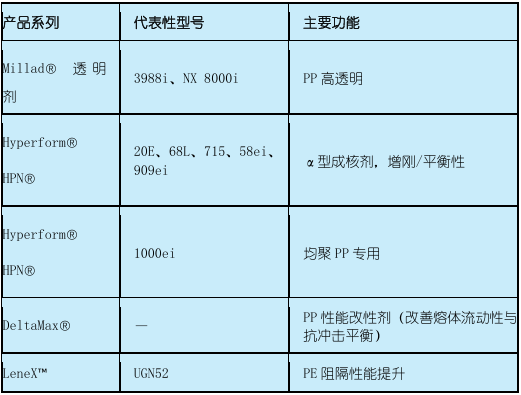
1. Millad® 3988i (Milliken) — The most mainstream third-generation sorbitol-based clarifying agent globally, with a DMDBS structure, FDA certified. Adding 0.1% to 0.3% can reduce haze by 40% to 80%, with a melting point of 255 to 265°C. The 3988i version contains 3% synthetic amorphous silica, making it easier to add and reducing bridging issues.
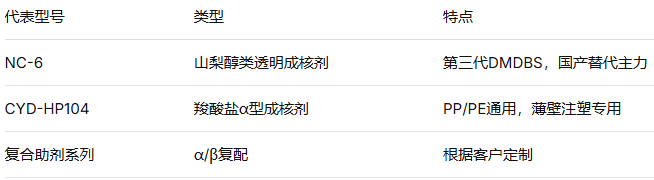
3. NC-6 — A mainstream domestic third-generation sorbitol-based transparent nucleating agent. Key parameters: melting point >260°C, whiteness >90, dosage 0.15%–0.25%; suitable for food-contact transparent PP products.
4. CH-2 - Transparent nucleating agent, adding 0.2% can reduce the haze of injection-molded food containers to below 15%, suitable for food packaging containers.
6. XL-NA2002 (Fourth Generation) - Further optimized for anti-reflective effect and thermal stability based on the third generation, suitable for higher processing temperatures.
7. Ruisubao® NA Series — a sorbitol-based transparent nucleating agent for polypropylene, non-toxic and odorless, suitable for higher processing temperatures (above 230°C), and can effectively solve the odor exudation issues of traditional sorbitol-based products during processing.
YS-689 — Adding 2.0% to 2.5% can convert ordinary PP resin into a high transparency, high rigidity specialty PP resin, significantly enhancing performance and added value.
9. CYD-HP104 (Chenghe Technology) — a carboxylate-based α-nucleating agent compound for PP/PE systems, capable of significantly shortening the half-crystallization time; suitable for the production of thin-wall or large-size PP injection-molded products.
10. NA-21 (ADEKA) — A representative third-generation sorbitol-based product (on par with Millad 3988), capable of raising the heat distortion temperature of PP to above 110°C and reducing haze by up to 50%.
11. NA-03 — Lithium salt substituted aryl heterocyclic phosphate nucleating agent. Adding 0.2% can increase the tensile strength of iPP by about 10%, increase the flexural modulus by about 30%, and reduce haze by about 40%.
12. NA-19—A potassium salt-substituted aryl heterocyclic phosphate nucleating agent, which also exhibits excellent nucleating performance while enhancing both transparency and rigidity.
13. NHS-9999 — a fifth-generation sorbitol-based patented product. Compared with the third generation, it offers significant improvements in both transparency and stiffness enhancement, with superior overall performance. Two invention patents have been granted.
14. NA9988 (Pulex New Materials) - Third-generation nucleating agent, suitable for high transparency modified PP.
15. NA8800 (Pulee New Materials) - PP high transparency nucleating agent, performance comparable to imported products.
(2) Toughening modified nucleating agents (mainly organic phosphates/carboxylates to enhance rigidity and heat distortion temperature)
The core of stiffening modification is to regulate the α-crystal crystallization behavior of PP by using organic phosphate or organic carboxylate nucleating agents, thereby significantly improving flexural modulus and heat deflection temperature. At the same time, β-crystal nucleating agents can be introduced to balance rigidity and toughness. Representative products are as follows:
16. ADK STAB NA-11 (ADEKA) — An organic phosphate-based α-type high-efficiency nucleating agent with outstanding bloom resistance. It can significantly improve the flexural modulus and heat distortion temperature of PP, and delivers especially remarkable performance when used in combination with talc-filled PP, making it the preferred choice for automotive parts. Melting point: >400°C; volatility: <0.5%.
17. Hyperform® HPN® 68L (Milliken) — a highly efficient alpha nucleating agent for PP/PE, significantly increases crystallization temperature, accelerates part demolding, improves production efficiency by 10%–20%, and enhances dimensional stability
18. Hyperform® HPN® 20E (Milliken) — a high-performance α-nucleating agent for injection molding, balancing rigidity and processing efficiency.
19. Hyperform® HPN® 715 (Milliken) — an α-form nucleating agent that can reduce the amount of PP filler used, enabling downgauging and weight reduction, improving design freedom, and lowering costs.
20. Hyperform® HPN® 58ei (Milliken) — the latest PP nucleating agent launched in 2025, designed to improve the optical properties, isotropic shrinkage, and recycled material quality of PP sheet and thermoformed parts, while achieving a better balance between stiffness and impact resistance and reducing energy consumption. It is particularly suitable for packaging for beverages, meat, microwave foods, and electronic products.
21. TD-531 (phosphate ester hydroxyl aluminum salt) - α-type nucleating agent, with an addition amount of only 0.075%, can raise the crystallization peak temperature of PP to 131.8℃, reduce the semi-crystalline time to 0.35 min, increase the bending modulus to 1377 MPa, and enhance the impact strength to 68.9 kJ/m², compared to blank PP, it increases by 330 MPa and 22.3 kJ/m² respectively.
22. NA-1000ei/HPN 1000ei (Milliken) — A nucleating agent specifically designed for homopolymer polypropylene, optimizing rheological properties and crystallization efficiency, significantly reducing haze, shortening molding cycles, and improving the appearance and stability of recycled materials.
(3) Flame Retardant/Cooperative Nucleating Agent (Synergistic Design to Enhance Flame Retardancy)
Nucleating agents mainly play a synergistic role in flame-retardant modification: by improving the crystalline morphology and char layer structure, they work together with the primary flame retardant to enhance flame-retardant performance, especially in polypropylene foaming and cable applications. Representative products are as follows:
24. XS-CH-401 (Xusen) — Combines the dual functions of a nucleating agent and a halogen-free flame retardant. Suitable for PP systems, it can improve the crystallization rate and refine the crystal structure while also providing flame-retardant performance.
(IV) Conductive modified nucleating agents (crystallization regulation to promote the formation of conductive networks)
The technical principle of conductive modified nucleating agents is to increase the crystallinity of PP and, by using the volume exclusion effect of crystalline regions, distribute conductive fillers (such as carbon nanotubes, graphene, nickel-plated glass fibers, etc.) more uniformly in the amorphous regions, thereby promoting the formation of conductive networks and improving electrical conductivity. Representative technical approaches include:
25. β-Nucleating Agent-Modified Carbon Nanotube System — By non-covalently functionalizing multi-walled carbon nanotubes (MWCNTs) with aromatic dicarboxamide β-nucleating agents (such as β-NA), the dispersion of nanocarbon materials in PP and their crystallization regulation effect are significantly improved, achieving a synergy of high electrical conductivity and excellent mechanical properties.
IV. Overview of Mainstream Manufacturers’ Product Lines
1. Milliken & Company
A global leader in nucleating agents, long commanding half of the industry. It offers the most comprehensive product lines of nucleating agents and clarifying agents, including:
2. Chenghe Technology
The leading domestic nucleating agent enterprise expects to achieve nucleating agent revenue of 511 million yuan in 2024 (a year-on-year increase of 24.09%). Its product range covers over 200 sub-models, with representative products including:
3. ADEKA
A long-established Japanese fine chemicals company, with representative products including NA-11 (PP stiffening), NA-21 (PP transparency), NA-03/NA-19, etc. Its NA-11 is the benchmark product for stiffening modification of PP automotive parts.
4. Hubei Xinnanhua
The earliest enterprise in China to produce sorbitol-based transparent nucleating agents, with an annual production capacity of 5,000 tons of plastic nucleating agents and 55,000 tons of compounded additives, focusing on the transparent nucleating agent market.
5. Xinglong Chemical Industry
Third-generation/fourth-generation sorbitol-based transparent nucleating agents, the XL-NA2001/2002 series products are comparable to mainstream imported models, with significant cost-performance advantages.
6. Pulixin Materials
The product line covers PP clarifying nucleating agents (NA8800, NA9988), β-nucleating agents (NA8100 for low-temperature toughening), and a series of nucleating agents specially designed for PA.
7. Other Domestic Manufacturers
Chenyuan Molecular has pursued a differentiated path by developing specialty nucleating agents based on dendritic polymers; companies such as Guangzhou Chenghe have also built competitive strengths across multiple niche segments. Domestic manufacturers are generally in a phase of accelerated catch-up, with the import substitution rate rising from around 30% in 2022 to 34% in 2023, and expected to increase further by 2025.
V. Application and Selection Guide
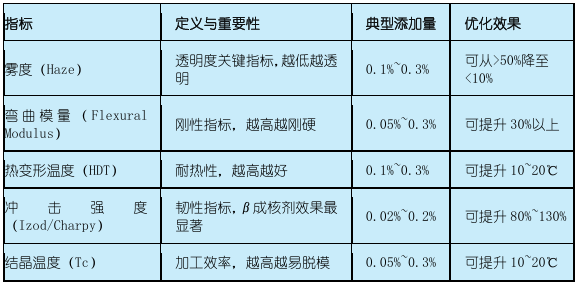
1. Key Performance Indicators
3. Selection Recommendations for the Four Major Functional Areas
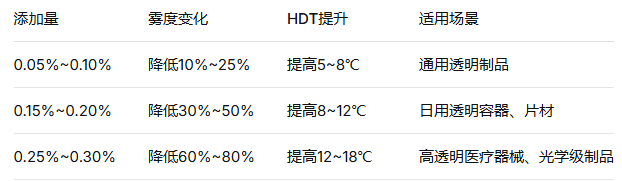
Transparency modification: Sorbitol-based nucleating agents are preferred (third-generation DMDBS and fourth-generation upgraded products), with recommended grades including Millad 3988i, NC-6, XL-NA2001, and CH-2, at an addition level of 0.1%–0.3%. Priority should be given to FDA-certified products to ensure food-contact safety.
Stiffness enhancement modification: Organic phosphate-based additives (such as NA-11 and HPN-20E) are used to increase stiffness through α-crystal formation, improving flexural modulus by more than 30%. When compounded with talc or β-crystal nucleating agents, they can enhance stiffness while maintaining toughness. When selecting them, it is necessary to balance the toughness improvement brought by the β-crystal form against the loss of rigidity associated with the α-crystal form.
Flame retardancy/synergistic effect: adopt a composite system of “nucleating agent + primary flame retardant.” The recommended is a combination of NA-11 + HPN-68L or a flame-retardant synergistic nucleating agent (such as XS-CH-401), applied in PP wires and cables as well as foamed products.
4. Process Adaptation Guide
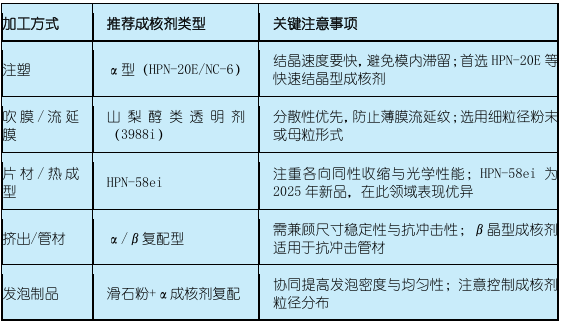
VI. Industry Trends and Outlook
1. Domestic substitution accelerates, with the market continuing to grow.
The current global market size for polyolefin stiffness-enhancing nucleating agents is approximately USD 285 million (2025), with a compound annual growth rate of about 6.85%. Demand in the Chinese market has grown from 7,700 tons in 2020 to 13,000 tons in 2024, representing a compound annual growth rate of approximately 13.99%. Domestic manufacturers are accelerating their catch-up, with companies such as Chenghe Technology having achieved independent R&D and global certification of core products, making the trend of import substitution clear.
2. Parallel Development of Greening and Efficiency
The industry will develop in the following directions: food contact safety (residual monomer content ≤ 50ppm has become the mainstream standard); odorless technology (third-generation sorbitol-based odorless products are gradually gaining popularity); energy efficiency (nucleating agents can shorten processing cycles by 10% to 20%, significantly reducing energy consumption); compatibility of biobased and biodegradable plastics (such as PLA toughening nucleating agents becoming a new growth point).
3. Compounding and Multifunctional Integration
Composite nucleating agents (α/β crystal form combinations, nucleating agent + flame retardant combinations) will become mainstream to achieve a balanced performance of “high transparency, high rigidity, high toughness, and high flame retardancy,” meeting the continuously upgraded performance requirements for polyolefin materials in packaging, automotive, electronics and electrical appliances, and other fields. Single-function nucleating agents will gradually be replaced by multifunctional composite systems.
【Copyright and Disclaimer】The above information is collected and organized by PlastMatch. The copyright belongs to the original author. This article is reprinted for the purpose of providing more information, and it does not imply that PlastMatch endorses the views expressed in the article or guarantees its accuracy. If there are any errors in the source attribution or if your legitimate rights have been infringed, please contact us, and we will promptly correct or remove the content. If other media, websites, or individuals use the aforementioned content, they must clearly indicate the original source and origin of the work and assume legal responsibility on their own.
Most Popular
-

A Look at the Material Suppliers Behind SpaceX
-
Ethylene: Production Capacity Accelerates Expansion, Global Industry Landscape Is Being Reshaped
-
Ethylene Industry Enters Production Boom Period! Multinational Giants and Domestic Leaders Compete in Trillion-Dollar Track
-

Target To Reduce Plastic By 30%! South Korea Enters Plastic Recycling Controversy, Involving National Interests
-

Amer Sports Releases 2025 Sustainability Report, Apparel And Footwear Recycled Material Proportion Reaches 19.3%