United States Imposes 12.5% Tariff on 60 Countries for "Forced Labor Tax," Plastic Industry Becomes Primary Target
Zhuansu Vision has learned that the Office of the United States Trade Representative (USTR) recently issued a major announcement: pursuant to Section 301 of the Trade Act of 1974,It plans to impose a new round of tariffs on goods from 60 trading partner countries.because these countries "have failed to adopt and effectively enforce bans on the importation of goods produced with forced labor." According to the USTR's estimates,Approximately $37.5 billion worth of goods related to plastic imports may face additional tariffs of 10% to 12.5%.。
Image source: Internet
The news quickly sent shockwaves through global trade circles. But if one looks beyond the surface narrative of “forced labor,” a different picture emerges.
A survey with two tax rates.
The tariff storm began on March 11, 2026. At that time, the USTR launched a series of investigations under Section 301, one of which was a special investigation into 60 economies for “failing to implement and effectively enforce bans on the importation of products made with forced labor.” In less than three months, the USTR completed the investigation and put forward a proposed plan.
USTR has proposed a two-tier differentiated tariff scheme:
10% segmentEconomies that the USTR considers to have “enacted or committed to enact bans, but with insufficient enforcement.” This category includes 14 economies: Canada, Mexico, Ecuador, the European Union, Indonesia, Pakistan, as well as Argentina, Bangladesh, Cambodia, El Salvador, Guatemala, Malaysia, Taiwan, China, and the United Kingdom.
12.5% tierThis covers the remaining 46 economies, includingMainland China, Hong Kong, ChinaJapan, South Korea, India, Vietnam, Australia, Brazil, Russia, Saudi Arabia, Singapore, Switzerland, etc.
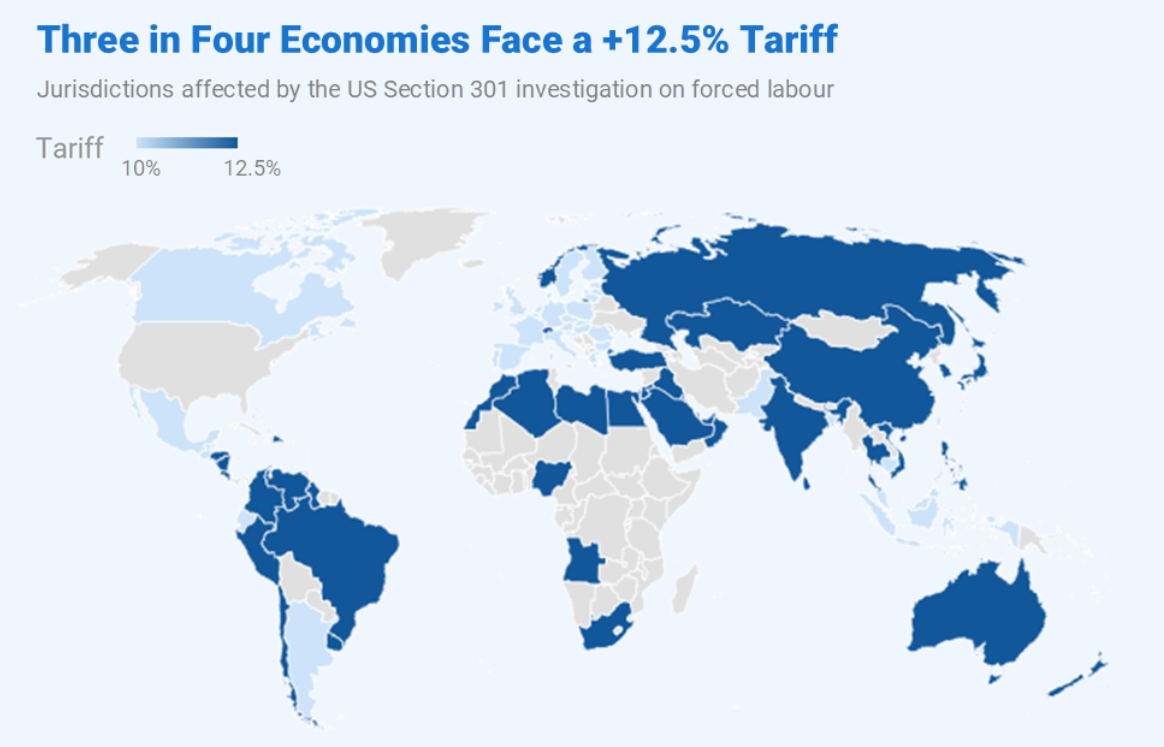
Image source: Global Trade Alert
In a statement, U.S. Trade Representative Ambassador Jamieson Greer declared that it is “unacceptable” that major trading partners have failed to effectively address the issue of products made with forced labor, resulting in “unfair competition” for American workers globally.
"Customs Revitalization Under the Guise of 'Forced Labor'"
Many legal institutions and industry observers have pointed out that this measure...Tariff actions taken in the name of “forced labor” are, in essence, an attempt to find a new legal pretext for tariffs that are about to expire.
On February 24, 2026, the U.S. Supreme Court ruled that the baseline tariffs and reciprocal tariff framework previously imposed by the Trump administration under the International Emergency Economic Powers Act (IEEPA) were unlawful. Meanwhile, the 10% temporary tariff imposed under Section 122 of the Trade Act of 1974 is also set to expire on July 24, 2026. Against this backdrop, the USTR has turned to Section 301 in an attempt to use it as the long-term legal basis for tariffs.
In other words, this is not a genuine policy innovation aimed at eliminating forced labor, but a carefully orchestrated “tariff repackaging” operation—using the new label of “forced labor” to extend the life of old tariffs.
III. Plastic Industry: The Targeted Bullseye
Plastics becoming a key target of this round of tariffs is by no means accidental.
Using 2024 as the baseline year, before the 2025 tariff implementation and the multiple rounds of tariff adjustments in 2026, U.S. imports of plastic products from countries covered by the investigation totaled $52.8 billion. After excluding machinery and equipment that qualify for exemptions under the United States-Mexico-Canada Agreement (USMCA) and those already subject to Section 232 tariffs, approximately $37.5 billion in plastic imports still face the risk of being taxed.
In its proposal, the USTR established a targeted exemption list, exempting 18 categories of plastic resins and 12 plastic products under Chapter 39 of the Harmonized Tariff Schedule of the United States (HTSUS), which covers plastics and articles thereof. However, according to estimates by Perc Pineda, chief economist of the Plastics Industry Association, the exemptions cover only about 28.9% of import value—meaning that roughly 71.1% of plastic imports could still be subject to the new tariffs.
Targeted Exemption List:
-
18 types of plastic resinsPolyethylene (PE), polypropylene (PP), polytetrafluoroethylene (PTFE), vinyl ester copolymers, acrylic polymers, polyamide (PA), cellulose ethers, etc.
-
12 types of plastic productsSpecific plastic semi-finished products and industrial products
-
Goods subject to Section 232 tariffs(Some plastic machinery and parts, for example, are subject to a 15% Section 232 tariff through the end of 2027 and are no longer subject to this Section 301 tariff.)
-
USMCA-compliant goods from Canada and Mexico
No exemption examples.HTSUS 3925.20.00 (plastic door and window frames and sills), 3926.90.10 (plastic buckets/containers), and other finished products will be subject to taxation.
Although some base resins in the plastics industry are exempt, a large number of finished products remain within scope.
IV. Who Is Speaking, and Who Is Silent
Reactions to this proposal have varied sharply among different parties.
Plastics Industry AssociationChief Economist Pineda pointed out from an economic perspective: “Forced labor undermines the functioning of the labor market, distorting wage standards, working conditions, and the logic of labor allocation. From an economic standpoint, this is not only a human rights issue, but also a major cause of market failure and a disruption to fair competition.” At the same time, he emphasized that industry submissions are crucial and will help the U.S. side determine which products should be included on the exemption list, so as to “minimize unintended supply chain disruptions.”
American Chemistry CouncilThe American Chemistry Council (ACC) has taken a more pragmatic stance. In its submitted opinions, ACC stated that the chemical industry achieved a trade surplus in 2025, with exports nearing $156 billion, accounting for 9% of total U.S. goods exports, making it the second-largest export manufacturing sector. ACC urges the USTR to adopt a "value chain-oriented" approach, identifying the American production sectors that truly face risks while preserving import channels for key raw materials and intermediate products—many of which are not produced in the U.S. but are essential for maintaining domestic manufacturing and exports.
China sideThe reaction from China was more direct. The China Council for the Promotion of International Trade issued a statement saying that the U.S. move "is an attempt to export domestic standards and unilateral rules to other economies, lacking legal basis under international law and deviating from the rules of the multilateral trade system." The spokesperson for the Ministry of Commerce, He Yongqian, stated that...China opposes all forms of unilateral restrictive measures, including a series of trade restrictions imposed on China under the pretext of “forced labor.”
5. The Double-Edged Sword of International Law
It is worth noting that, in its proposal, the USTR specifically cited two core International Labour Organization conventions—the 1930 Forced Labour Convention (No. 29) and the 1957 Abolition of Forced Labour Convention (No. 105)—and claimed that the tariff scheme “is consistent with the obligations of member states under these conventions.”
However, this very citation contains a logical paradox: nearly all countries in the world have ratified Convention No. 29, and most have ratified Convention No. 105. If the United States truly used international conventions as the standard, then the vast majority of the 60 trading partners have already fulfilled their obligations under those conventions. By equating “having ratified the conventions” with “failing to effectively enforce the prohibition,” USTR is in effect placing its unilateral domestic standards above the international consensus.
More ironically, the United States itself has not ratified a number of the International Labour Organization’s core conventions. Holding others to international standards while shielding itself behind domestic ones—this kind of “double standard” in rule-making is precisely a deep-rooted cause of the current turmoil in the global trading system.
6. Timeline and Unknowns
According to the schedule published by the USTR:
-
June 22, 2026Deadline for applying to attend the hearing
-
July 6, 2026Deadline for submission of written comments
-
July 7, 2026Public hearing
-
Within five days after the hearing, rebuttal opinions may be submitted.
Whether it will ultimately be implemented, how it may be revised, or whether it will be withdrawn entirely will be decided after soliciting public opinion.
The current round of 301 tariffs, labeled as "forced labor," appears to be a human rights issue, but in essence, it is a complex trade game. It serves as a lifeline for tariff policies following the U.S. Supreme Court ruling and is also a pawn in the wave of global supply chain restructuring.
For the plastics industry, 71.1% of imported products face the risk of tariffs, meaning the entire value chain from raw materials to finished goods will come under pressure.For the 46 economies listed in the 12.5% bracket, the final outcome of this tariff storm will gradually become clear after the hearing on July 7.
However, one thing is certain: when "forced labor" is weaponized as a political tool for trade protectionism, the ones who truly suffer are not only the efficiency and stability of global supply chains, but also the dialogue foundation and mutual trust that the international community has built over many years in the field of labor rights.
Editor: Winnie
【Copyright and Disclaimer】This article is the property of PlastMatch. For business cooperation, media interviews, article reprints, or suggestions, please call the PlastMatch customer service hotline at +86-18030158354 or via email at service@zhuansushijie.com. The information and data provided by PlastMatch are for reference only and do not constitute direct advice for client decision-making. Any decisions made by clients based on such information and data, and all resulting direct or indirect losses and legal consequences, shall be borne by the clients themselves and are unrelated to PlastMatch. Unauthorized reprinting is strictly prohibited.
Most Popular
-
Layoffs, Divestments, Plant Closures While Pouring Billions: BASF Undergoes Major Transformation!
-
Ascend Adipic Acid Hit By Force Majeure, Market Expects Supply Resumption In Mid-September
-
Raw Material Supply Shortage! INEOS Phenol Declares Force Majeure on Phenol and Acetone Businesses
-
South Korea initiates anti-dumping investigation against Chinese PVC suspension resin! The target is Tianjin Bohua and Wanhua Chemical. How to break through?
-

Sixth national procurement set to be implemented: A “Reshuffling” Moment for the $10-Billion Medical Device Market