



United States Expected To Ease Tariff Restrictions On Automotive Industry
According to a report by Bloomberg, after significant lobbying by U.S. automakers to mitigate the negative impact of record-high import tariffs, the White House is preparing to ease tariff restrictions on the country's automotive industry, a move that would represent a major victory for car manufacturers.
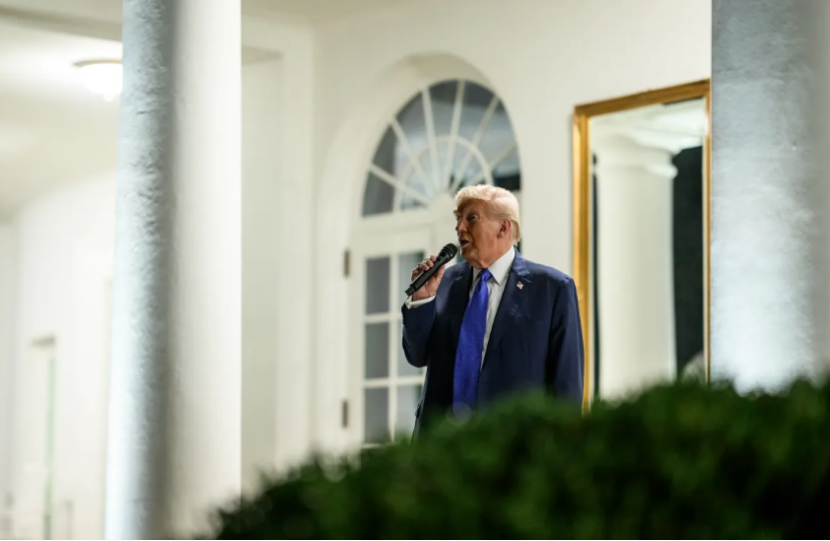
Image Source: The White House
Informed sources revealed that the U.S. Department of Commerce plans to announce an extension of a policy arrangement for five more years, which allows automakers to reduce the tariff burden on imported auto parts. Previously, this provision was originally set to expire in two years.
According to informed sources, the relevant announcement may be released as early as October 17, but they also pointed out that similar tariff announcements have been delayed in the past. The United States is expected to detail this policy in government documents, which will also officially announce tariffs on imported trucks.
In the previous months, American automakers such as Ford and General Motors have been actively lobbying to secure tariff exemptions from the Trump administration's tariff policies. U.S. automakers are facing cost pressures due to tariffs imposed by Trump on imported cars, parts, as well as raw materials like steel and aluminum.
After the report was, General Motors' stock price rose by 3.8%, and the stock prices of Ford Motor and Stellantis also increased.
Ford Motor Company's CEO Jim Farley has stated that considering Japan's lower labor costs and exchange rate advantages, the US-Japan trade agreement gives competitors like Toyota a cost advantage of several thousand dollars per vehicle compared to equivalent models produced domestically in the US. It is reported that the agreement has reduced tariffs on Japanese imported cars from 27.5% to 15%.
Previously, automakers could offset a portion of the 25% tariffs imposed on imported parts. According to the regulations at that time, automakers producing and selling complete vehicles in the U.S. could apply for an offset limit, with a maximum of 3.75% of the value of domestically produced cars. This offset ratio was originally planned to decrease to about 2.5% after one year and be completely eliminated in the following year.
Trump has imposed a 25% tariff on imported vehicles earlier this year. In addition, among the tariffs imposed separately on Canada and Mexico, there is an exemption clause: vehicles that meet the current domestic parts content requirements of the United States-Mexico-Canada Agreement (USMCA) can enjoy tariff exemptions.
【Copyright and Disclaimer】The above information is collected and organized by PlastMatch. The copyright belongs to the original author. This article is reprinted for the purpose of providing more information, and it does not imply that PlastMatch endorses the views expressed in the article or guarantees its accuracy. If there are any errors in the source attribution or if your legitimate rights have been infringed, please contact us, and we will promptly correct or remove the content. If other media, websites, or individuals use the aforementioned content, they must clearly indicate the original source and origin of the work and assume legal responsibility on their own.
Most Popular
-

Mexico Imposes Tariff Up to 36% on Cross-Border E-Commerce Products, Effective January 1, 2026; Plastic Shows Partial Fluctuation Today
-
4.5 Million Tons! Wanhua Chemical Dominates Globally in MDI, Heavy Investment in Battery Materials Spurs New Storm
-
Trump Delays Tariff Increase on Furniture, Cabinets, and Vanities
-
Wanhua Chemical Invests $27.3 Billion, 2026 Investment Map Revealed, $1.1 Billion Bet on Battery Materials
-
Back-to-back major joker moves! covestro’s 1.32 million ton mdi dual-line expansion and hdi acquisition reshape global polyurethane landscape


