The United States has announced a 25% tariff on imported cars! Is South Korea the biggest victim? What is the impact on China?
According to Xinhua News Agency, U.S. President Trump signed a notice at the White House on the 26th, announcing a 25% tariff on imported cars, with the related measures to take effect on April 2. That afternoon, he told reporters that the U.S. government would start imposing this new tariff on April 3.
According to a document released by the White House on that day, Trump imposed a 25% tariff on imported cars and certain auto parts under Section 232 of the Trade Expansion Act of 1962, claiming the move was to protect U.S. "national security." The document states that the 25% tariff will apply to imported passenger vehicles (sedans, SUVs, etc.) and light trucks, as well as critical auto parts (engines, transmissions, etc.), and will be expanded to other parts as necessary.
Trump stated that tariffs would encourage more production to move to the United States, generate new revenue for the government, and help reduce national debt. However, economists believe that tariffs will drive up car prices and harm consumer interests.
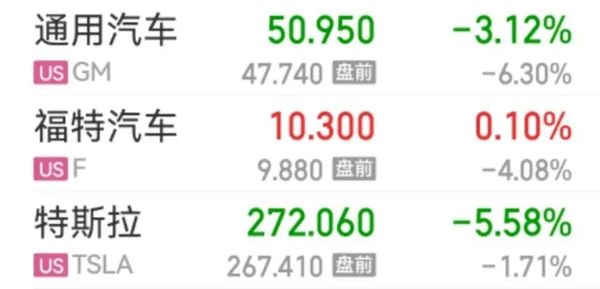
Affected by the news of automotive tariffs, General Motors saw its stock drop over 8% in after-hours trading on Wednesday, while Ford's stock fell over 5% in after-hours trading. As of the time of writing, General Motors was down 6.3% in pre-market trading, Ford was down over 4%, and Tesla was down 1.71% in pre-market trading.
Japanese and South Korean automotive stocks fell broadly.
The governments of the two countries will take measures to respond.
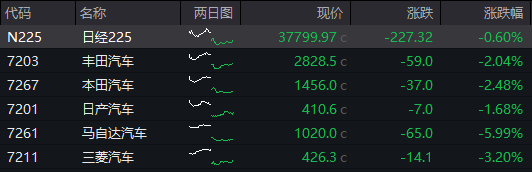
On March 27, influenced by automotive tariffs, Japanese and South Korean automotive stocks generally fell.
As of the time of reporting, in the Japanese stock market, the Nikkei 225 index fell by 0.6%. Toyota Motor Corporation dropped by 2.04%, Honda Motor Co. declined by 2.48%, Nissan Motor Co. fell by 1.68%, Mazda Motor Corporation decreased by 5.99%, and Mitsubishi Motors Corporation dropped over 3%.
In the South Korean stock market, the KOSPI fell by 1.39%, Hyundai Motor dropped by 4.28%, and Kia Motors declined by 3.45%.

Citigroup analysts stated that U.S. President Trump plans to impose a 25% tariff on imported cars and auto parts, which could potentially dampen South Korea's GDP growth by 0.12%.
It is understood that,The United States is the largest market for South Korean automotive manufacturers, with South Korea's automotive exports to the U.S. reaching $34.7 billion in 2024, accounting for 49.1% of total automotive exports. Exports of cars and automotive parts make up 14% of South Korea's total exports. South Korea has become the second largest supplier in the U.S. imported automotive market, second only to Mexico.
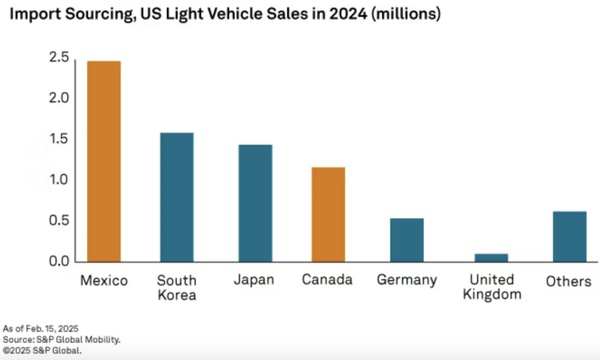
(The major countries of origin for imported cars in the United States, source: S&P Global Automotive)
Last year, Hyundai Motor and Kia Motors sold a total of 1.77 million vehicles in the United States, of which 630,000 were produced domestically, 140,000 were produced in Mexico, and approximately 1 million were directly exported from South Korea to the United States.
If the new tariff measures are implemented, the export prices of approximately 1 million South Korean cars will rise significantly, greatly diminishing the price competitiveness of South Korean automobiles in the U.S. market. The situation is even more severe for GM Korea, as over 90% of its production is exported to the United States. Faced with such high tariffs, the company may even face a survival crisis.
According to the economic research report from the Korea Small and Medium Enterprises Bank, once the 25% tariff is imposed, South Korea's automobile exports to the U.S. are expected to decrease by approximately 9.1 trillion won (around 6.3 billion dollars). Considering the recent growth in automobile exports to the U.S. and exchange rate fluctuations, the actual loss could exceed 10 trillion won.
Data shows that the domestic production ratio of Hyundai and Kia in the United States is only 35%, lower than that of Japanese companies such as Honda and Toyota, which makes Korean automakers more vulnerable to changes in trade policies.
According to CCTV News, on March 27, the Minister of Trade, Industry and Energy of South Korea stated that after the implementation of the auto import tariff policy advocated by U.S. President Trump, it is expected to bring "considerable difficulties" to the South Korean automotive industry. The South Korean government will take emergency response measures in the coming month.
In response to the United States imposing a 25% tariff on imported cars, Japanese Prime Minister Shigeru Ishiba stated on the 27th local time that the Japanese government is considering measures to address this issue. Ishiba mentioned that the Japanese government has strongly requested the U.S. government to withdraw the increased tariffs on Japan.
EU: Regret, Canada: Retaliation
Trump warns: Don't unite against the United States.
On the evening of the 26th local time, European Commission President Ursula von der Leyen stated in a statement, "I deeply regret the U.S. decision to impose tariffs on car exports to the EU."
Von der Leyen stated that tariffs are taxes, "which are detrimental to businesses and even more so to consumers in the United States and the European Union." The EU will continue to seek to resolve issues through negotiations while defending the economic interests of the EU.
NBC reported that Canadian Prime Minister Carney stated at a press conference that the U.S. government's actions are a "direct attack" on Canadian workers.
Carney said he is waiting for further details to assess the full impact of the tariffs on the Canadian economy. He also stated that these tariffs are "completely unreasonable."
Carney stated that he is considering additional retaliatory tariffs and said that discussions with Trump would be "appropriate."
On March 26, local time, U.S. President Trump posted on social media, "If the EU and Canada work together to harm the U.S. economy, then to protect America (and the best friends that the EU and Canada each have), we will impose large tariffs far beyond what is currently planned!"
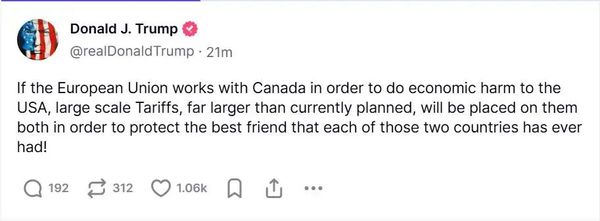
Image source: Jiemian News
Is South Korea the biggest victim?
How much impact does it have on China?
According to data from S&P Global Mobility, nearly half of the new passenger cars sold in the United States in 2024 will be imported from abroad. It is noteworthy that vehicles assembled in the U.S. also require imported components, and this round of 25% tariffs not only affects cars but also includes critical parts (such as engines, transmissions, etc.), and may extend to other components. Statistics from the U.S. Department of Commerce show that Mexico supplies 42.5% of the automotive parts imported into the U.S.
The United States currently imposes a 2.5% tariff on passenger cars and a 25% tariff on trucks. If an additional 25% tariff is imposed, passenger cars and trucks will face tariffs of 27.5% and 50%, respectively. The White House has revealed that a 25% tariff will also be imposed on key components such as engines, transmissions, and powertrains.
According to the consulting firm's estimates,In the United States, the price of each car may increase by $3,500 to $12,000 due to tariffs.
The impact of increased tariffs on Chinese car manufacturers is relatively small; in 2024, the U.S. market is expected to account for about 2% of China's total automotive exports and only 0.4% of China's total vehicle sales. Chinese automotive parts manufacturers may be affected somewhat more.
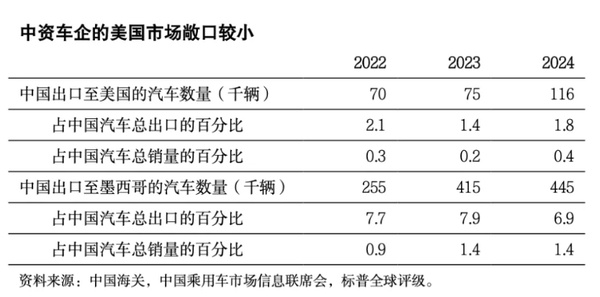
(Source: S&P Global Ratings)
Previously, many companies in China's automotive supply chain had begun preparing to invest in factories in Mexico. For example, BYD announced its plan to establish a car factory in Mexico for the first time in 2023, but this plan may now be delayed. Additionally, CATL had also considered building a battery factory in the United States or Mexico.
Huatai Securities believes that, based on the current situation, although many Chinese automotive parts manufacturers have invested in capacity in Mexico, the overall scale is still small and remains in the capacity ramp-up stage. Although the increase in tariffs will inevitably raise cost pressures in the short term, profitability can still be achieved in the future through methods such as sharing tariff pressures with downstream manufacturers and improving capacity utilization rates.
【Copyright and Disclaimer】The above information is collected and organized by PlastMatch. The copyright belongs to the original author. This article is reprinted for the purpose of providing more information, and it does not imply that PlastMatch endorses the views expressed in the article or guarantees its accuracy. If there are any errors in the source attribution or if your legitimate rights have been infringed, please contact us, and we will promptly correct or remove the content. If other media, websites, or individuals use the aforementioned content, they must clearly indicate the original source and origin of the work and assume legal responsibility on their own.
Most Popular
-

Mexico Imposes Tariff Up to 36% on Cross-Border E-Commerce Products, Effective January 1, 2026; Plastic Shows Partial Fluctuation Today
-
4.5 Million Tons! Wanhua Chemical Dominates Globally in MDI, Heavy Investment in Battery Materials Spurs New Storm
-
Trump Delays Tariff Increase on Furniture, Cabinets, and Vanities
-
Wanhua Chemical Invests $27.3 Billion, 2026 Investment Map Revealed, $1.1 Billion Bet on Battery Materials
-
Back-to-back major joker moves! covestro’s 1.32 million ton mdi dual-line expansion and hdi acquisition reshape global polyurethane landscape