



The Ministry of Commerce plans to expand the policy of tax refunds for departing tourists, which is favorable for the plastics industry's exports.
On March 25, important news came from the Ministry of Commerce, where Li Gang, the Director of the Consumer Promotion Bureau, clearly stated that the Ministry of Commerce plans to significantly enhance the effectiveness of the export refund policy. In subsequent measures, the ministry will collaborate with relevant departments to release a series of targeted policy measures. This move aims to stimulate domestic consumption from multiple angles, with enhancing the effectiveness of the export refund policy becoming a key lever to boost inbound consumption.
The exit tax refund policy refers to the policy of refunding value-added tax on goods purchased by foreign travelers at tax refund stores that are carried out of the country. Currently, this policy has been implemented in several provinces and cities in China, covering various product categories such as clothing, electronics, and handicrafts. This policy trend may bring new development opportunities for the export of plastic products in China.
**Potential Impacts of the Plastics Industry on the Environment** 1. **Pollution and Contamination**: The plastics industry is a significant source of pollution and contamination in the environment. Plastics can leach chemicals into waterways, harm aquatic life, and contaminate soil and air. 2. **Climate Change**: The production and disposal of plastics contribute to greenhouse gas emissions, which exacerbate climate change. 3. **Resource Depletion**: The extraction and processing of plastics require non-renewable resources, such as fossil fuels, which can lead to resource depletion and environmental degradation. 4. **Waste Management**: The plastics industry generates massive amounts of waste, which can be difficult to manage and dispose of properly. 5. **Human Health**: Exposure to plastics and their chemicals has been linked to various health problems, including cancer, reproductive issues, and neurological damage. 6. **Food Waste**: The production and packaging of plastics contribute to food waste, as packaging materials are often not biodegradable or compostable. 7. **Landfill Waste**: The plastics industry generates a significant amount of landfill waste, which can take hundreds of years to decompose. 8. **Marine Life**: Plastics can entangle and kill marine life, and can also contribute to the spread of plastic debris in the ocean. 9. **Economic Impacts**: The plastics industry can have significant economic impacts, including job losses, pollution costs, and environmental damage.
According to data from the General Administration of Customs, in January 2025, the export value of plastic products was $10.13 billion, a year-on-year increase of 0.9%; the import value was $1.21 billion, a year-on-year decrease of 8.6%. In February, the export value of plastic products was $5.03 billion, a year-on-year decrease of 22.5%; the import value was $1.29 billion, a year-on-year increase of 7.8%. From January to February, the export value of plastic products was $15.16 billion, a year-on-year decrease of 8.3%; the import value was $2.5 billion, a year-on-year decrease of 0.8%, resulting in a trade surplus of $12.66 billion. Among these, plastic household products, packaging materials, and other products account for a certain proportion. Analysis suggests that if these products could benefit from an export tax rebate policy, it would further enhance the price competitiveness of China's plastic products in the international market.
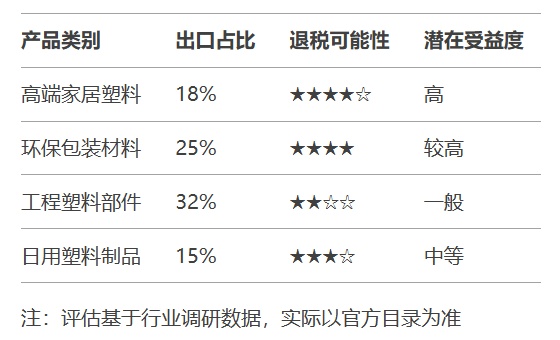
Export tax rebate rate for plastic products:
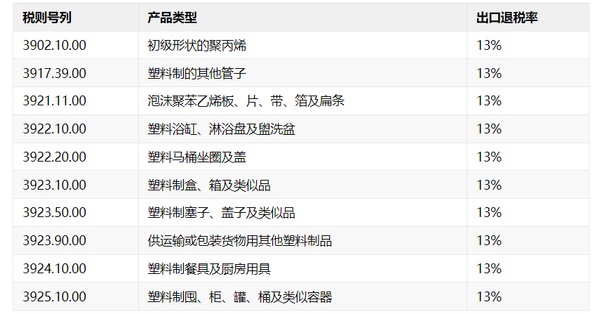
The export tax rebate rate for plastic products depends on the specific commodity code. Below are common plastic products and their corresponding rebate rates:
Value chain transmission effect
Upstream raw material supply lines: PP, ABS, and other engineering plastics demand may increase.
Manufacturing sector: The capacity utilization rate of export-oriented enterprises is expected to improve.
End-user: Increased Price Competitiveness of Refundable Goods
② Implementation Policy
According to international experience, a well-implemented border tax-free trade regime can boost tourism and shopping consumption. For China's plastic industry,
Short-term (within 1 year): Expected to boost export growth, primarily benefiting terminal products such as home goods and packaging.
Mid-term (3 years): Promote industrial upgrading, environmental plastic products export market share expected to rise.
Long-term: Assist in building a "dual circulation" development pattern to create a synergistic effect between international consumption center cities and manufacturing bases.
It's worth noting that the implementation of the policy also requires the improvement of supporting measures. Plastic companies should prepare in advance for product certification, channel layout, and other tasks, while also enhancing the added value of their products to fully benefit from the policy.
【Copyright and Disclaimer】This article is the property of PlastMatch. For business cooperation, media interviews, article reprints, or suggestions, please call the PlastMatch customer service hotline at +86-18030158354 or via email at service@zhuansushijie.com. The information and data provided by PlastMatch are for reference only and do not constitute direct advice for client decision-making. Any decisions made by clients based on such information and data, and all resulting direct or indirect losses and legal consequences, shall be borne by the clients themselves and are unrelated to PlastMatch. Unauthorized reprinting is strictly prohibited.
Most Popular
-

Mexico Imposes Tariff Up to 36% on Cross-Border E-Commerce Products, Effective January 1, 2026; Plastic Shows Partial Fluctuation Today
-
4.5 Million Tons! Wanhua Chemical Dominates Globally in MDI, Heavy Investment in Battery Materials Spurs New Storm
-
Trump Delays Tariff Increase on Furniture, Cabinets, and Vanities
-
Wanhua Chemical Invests $27.3 Billion, 2026 Investment Map Revealed, $1.1 Billion Bet on Battery Materials
-
Back-to-back major joker moves! covestro’s 1.32 million ton mdi dual-line expansion and hdi acquisition reshape global polyurethane landscape


