Textile and apparel exports fell by 6.9% in January-February! The new U.S. tariff policy has triggered market turbulence.
At the beginning of 2025, the textile and apparel industry is facing a complex foreign trade environment. The United States' imposition of additional tariffs on Chinese textile and apparel products and the cancellation of tariff exemptions for small packages have significantly impacted China's textile and apparel exports. Against the backdrop of a high export base in the same period last year, there has been a slight decline in textile and apparel exports in the first two months of 2025.
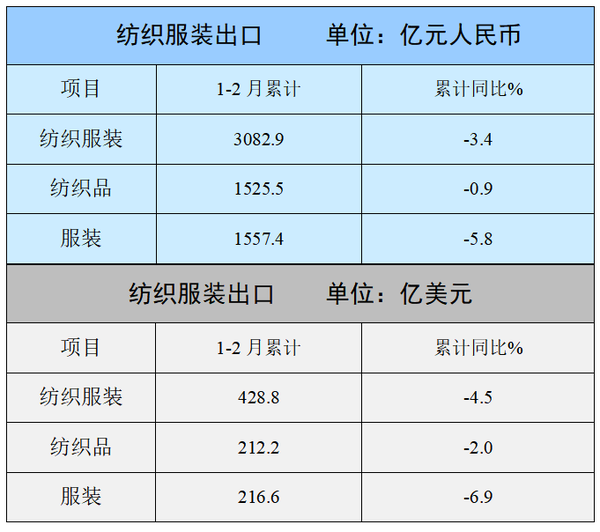
According to the latest data released by the General Administration of Customs on March 7, in US dollars, the cumulative export of textiles and clothing from January to February was $428.8 billion, a decrease of 4.5% year-on-year, with textile exports at $212.2 billion, down 2%, and clothing exports at $216.6 billion, down 6.9%. In RMB, for January to February 2025, the cumulative export of textiles and clothing was 3082.9 billion yuan, a decrease of 3.4%, with textile exports at 1525.5 billion yuan, down 0.9%, and clothing exports at 1557.4 billion yuan, down 5.8%.
Data source: China Textile Export Chamber of Commerce
re-examination of export strategy
From a market perspective, the increased uncertainty in the U.S. market has forced many companies to reassess their export strategies. Some companies have started to look for other potential markets, such as the EU and ASEAN, to diversify risks. However, the development of these markets is not something that can be achieved overnight, requiring companies to invest more resources in market research, product adaptability, and customer relationship building.
According to relevant data, in 2025, the growth rate of China's textile and apparel exports to the EU will increase, but the overall market share remains relatively small. When companies are exploring new markets, they need to have a deep understanding of local market demands and consumer habits, and develop targeted market strategies. At the same time, with the increase in the export growth rate of textiles and apparel from Southeast Asian countries such as Vietnam, China's textile and apparel industry is also facing competitive pressure from neighboring countries.
chain reaction in the industrial chain
In terms of the industrial chain, the fluctuation of upstream raw material prices also affects the export of textile and apparel. The instability of the prices of major raw materials such as cotton and chemical fibers increases the production costs and procurement difficulties for enterprises. Some small enterprises, due to limited financial strength, find it difficult to cope with large fluctuations in raw material prices, leading to a disadvantage in market competition.
In addition, changes in the downstream market are also worth noting. As consumers' demands for environmental protection and quality increase, the demand structure for textile and apparel products is changing. Products with environmental certification and high quality are gradually gaining favor in the market, prompting companies to increase investment in research and development as well as in environmental protection to meet market demand.
Technological Innovation and Market Expansion: A Dual-Wheel Drive Approach
Facing the current situation, textile and garment enterprises need to take active response measures. On one hand, enterprises should strengthen the diversification of market layout and reduce dependence on a single market; on the other hand, they should increase efforts in technological innovation and product development, enhance the added value of products, and strengthen market competitiveness. At the same time, the government should also introduce relevant policies to support enterprises in dealing with trade frictions and promote the stable development of the textile and garment industry.
Some enterprises have already begun to explore and practice in areas such as smart manufacturing and green production. By introducing advanced production equipment and technology, they improve production efficiency and product quality; by adopting environmentally friendly materials and processes, they reduce environmental pollution during the production process and enhance the environmental performance of the products.
Opportunities and challenges intertwine and move forward
In the future, as the global economy gradually recovers and the market landscape adjusts, the textile and apparel industry is expected to usher in new development opportunities. Enterprises need to closely monitor market dynamics, flexibly adjust their business strategies, and stand invincible in fierce market competition.
According to the industry analysis report, by 2025, China's textile and apparel industry will exhibit a trend of growth driven by the recovery of consumption and the resilience of exports. Enterprises should seize this opportunity to continuously enhance their core competitiveness and promote high-quality development in the industry.
【Copyright and Disclaimer】The above information is collected and organized by PlastMatch. The copyright belongs to the original author. This article is reprinted for the purpose of providing more information, and it does not imply that PlastMatch endorses the views expressed in the article or guarantees its accuracy. If there are any errors in the source attribution or if your legitimate rights have been infringed, please contact us, and we will promptly correct or remove the content. If other media, websites, or individuals use the aforementioned content, they must clearly indicate the original source and origin of the work and assume legal responsibility on their own.
Most Popular
-

Mexico Imposes Tariff Up to 36% on Cross-Border E-Commerce Products, Effective January 1, 2026; Plastic Shows Partial Fluctuation Today
-
4.5 Million Tons! Wanhua Chemical Dominates Globally in MDI, Heavy Investment in Battery Materials Spurs New Storm
-

Trump Delays Tariff Increase on Furniture, Cabinets, and Vanities
-
Wanhua Chemical Invests $27.3 Billion, 2026 Investment Map Revealed, $1.1 Billion Bet on Battery Materials
-
Back-to-back major joker moves! covestro’s 1.32 million ton mdi dual-line expansion and hdi acquisition reshape global polyurethane landscape