



Strong Alliance to Jointly Advance the Commercialization of Bioengineered Corneas
On March 27, Xi'an Eyedeal Medical Technology Co., Ltd. (referred to as Eyedeal Medical) signed a cooperation agreement with the U.S.-based Pantheon Vision to jointly advance the production and commercialization of bioengineered corneas, aiming to provide a revolutionary treatment solution for the 13 million corneal disease patients worldwide.
Guo Guangxu, founder, chairman, and CEO of Yandele Company, stated: 'Pantheon Vision has assembled a world-class ophthalmic design team, whose groundbreaking thinking has driven the revolutionary development of an integrated polymer artificial cornea, aimed at restoring patients' vision. Once commercialized, this innovative technology will fundamentally eliminate the reliance on corneal donations, bringing new hope to patients worldwide in need of corneal transplants.'
Globally, more than 13 million patients are affected by corneal blindness. The current standard treatment involves replacing the damaged or diseased cornea of patients with human donor corneas. However, due to a shortage of donor tissue, the complexity of the surgery, and persistently high failure rates, the accessibility of this therapy is severely limited.
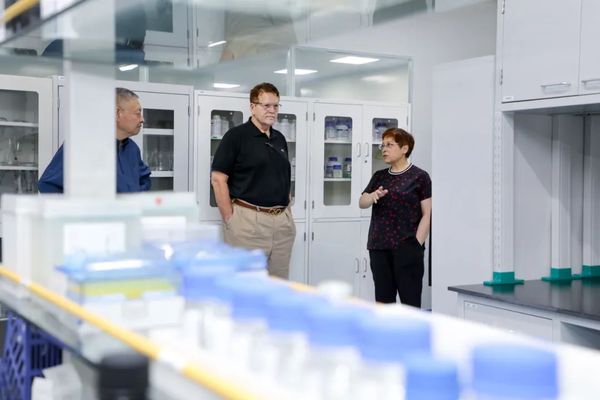
Dr. John Sheets, President and CEO of Pantheon Vision, recently visited Xi'an EyeDeal.
Pantheon Vision President and CEO Dr. John Sheets Jr. stated, "This collaboration is a key step in advancing our mission—to treat and restore vision globally through bioengineered corneal solutions. We are grateful for our partnership with Eyedeal Medical and believe that the innovative solutions we will create together will bring meaningful benefit to patients suffering from corneal blindness."
Guo Guangxu concluded, "We are honored to collaborate with Pantheon Vision to achieve this medical breakthrough, leveraging our proprietary materials and technology. Both parties will fully utilize their complementary strengths to refine this artificial cornea solution, aiming to bring this transformative medical device to clinical use as soon as possible, restoring vision for corneal disease patients worldwide."
Introduction to Biological Cornea and Artificial Cornea (Keratoprosthesis)
Biological cornea
Biological cornea refers to naturally sourced corneal cells/tissues, such as those isolated and cultured from pig corneas, fish scales, human skin, amniotic membrane (mainly obtained from discarded human placentas, unrelated to sheep), etc., used in corneal repair. The reason I don't refer to it directly as corneal transplantation is that cells from different sources play different roles in the corneal repair process. For example, pig corneal cells, as one might expect, serve as substitutes for the cornea and are transplanted into the eye. Meanwhile, amniotic membrane cells sometimes act as scaffolds or promote the proliferation of corneal limbal stem cells, rather than directly serving as corneal substitutes.
Artificial Cornea (Keratoprosthesis)
Artificial cornea refers to the cornea made of synthetic materials, including PMMA, PHEMA, titanium alloy, etc. Some artificial corneas also require cell materials. Foreign approved products highly favor the use of such polymer materials, and domestic products also follow this technical route. For example, the products of Beijing Mihe Medical belong to pure artificial cornea.
Artificial corneas can usually be divided into several types as well.
1) Boston Type I Keratoprosthesis (also known as: Boston Type I Artificial Cornea)
The Boston Type I artificial cornea has a "button-fastened" design (see the figure below), and is mainly made of PMMA, a transparent carbon-containing high molecular organic compound often used as a material for artificial lenses. It has a light transmittance of 92%, a refractive index of 1.491, is lightweight, highly moldable, shatterproof, acid and alkali resistant, and non-biodegradable. It consists of three parts: the front plate, the back plate, and the fixing titanium ring.
2) AlphaCor type
Similar to implanting contact lenses into the patient's cornea, there are many postoperative complications, and the implantation process is complex and needs to be performed in two stages. There is basically no application in China.
3) Osteo-odonto keratoprosthesis (OOKP)
Similar to AlphaCor, the difference lies in replacing the supporting material with autologous materials such as the tooth root-alveolar bone complex and cartilage to reduce immunogenicity. Currently, this type of surgery is also not widely performed.
【Copyright and Disclaimer】The above information is collected and organized by PlastMatch. The copyright belongs to the original author. This article is reprinted for the purpose of providing more information, and it does not imply that PlastMatch endorses the views expressed in the article or guarantees its accuracy. If there are any errors in the source attribution or if your legitimate rights have been infringed, please contact us, and we will promptly correct or remove the content. If other media, websites, or individuals use the aforementioned content, they must clearly indicate the original source and origin of the work and assume legal responsibility on their own.
Most Popular
-

Mexico Imposes Tariff Up to 36% on Cross-Border E-Commerce Products, Effective January 1, 2026; Plastic Shows Partial Fluctuation Today
-

4.5 Million Tons! Wanhua Chemical Dominates Globally in MDI, Heavy Investment in Battery Materials Spurs New Storm
-

Trump Delays Tariff Increase on Furniture, Cabinets, and Vanities
-
Wanhua Chemical Invests $27.3 Billion, 2026 Investment Map Revealed, $1.1 Billion Bet on Battery Materials
-

Back-to-back major joker moves! covestro’s 1.32 million ton mdi dual-line expansion and hdi acquisition reshape global polyurethane landscape


