



Stop Focusing Only on the Number of LiDARs, Automakers Have a New Battlefield in Material Stacking
The Shangjie H5, as the only model in the HarmonyOS family that offers full-featured Huawei assisted driving for under 200,000 yuan, experienced a surge in sales during the National Day holiday, with weekly sales reaching 5,500 units.
In the past, there were not many models capable of full-range navigation assistance driving for just a hundred thousand yuan or so. The main reason is that vehicles in this price range typically do not come equipped with LiDAR, while the urban driving assistance solutions of most domestic manufacturers require this sensor.
At the beginning of this year, the XPeng MONA M03, which follows a visual route and can achieve full-domain navigation assistance, became quite popular because there aren't many choices for users in this price range.
Now, domestic manufacturers have opted to enhance hardware, not only introducing models like the Shangjie H5 and Lynk & Co 07 EM-P that offer excellent full-domain navigation assistance experiences at a price point of around a hundred thousand yuan, but also upgrading the hardware architecture of mid-to-high-end models to deliver better assisted driving experiences.
Next, we will showcase the updated hardware architecture for driver assistance from popular brands. One image will help you understand which is the "king of material stacking" among domestic driver assistance systems.
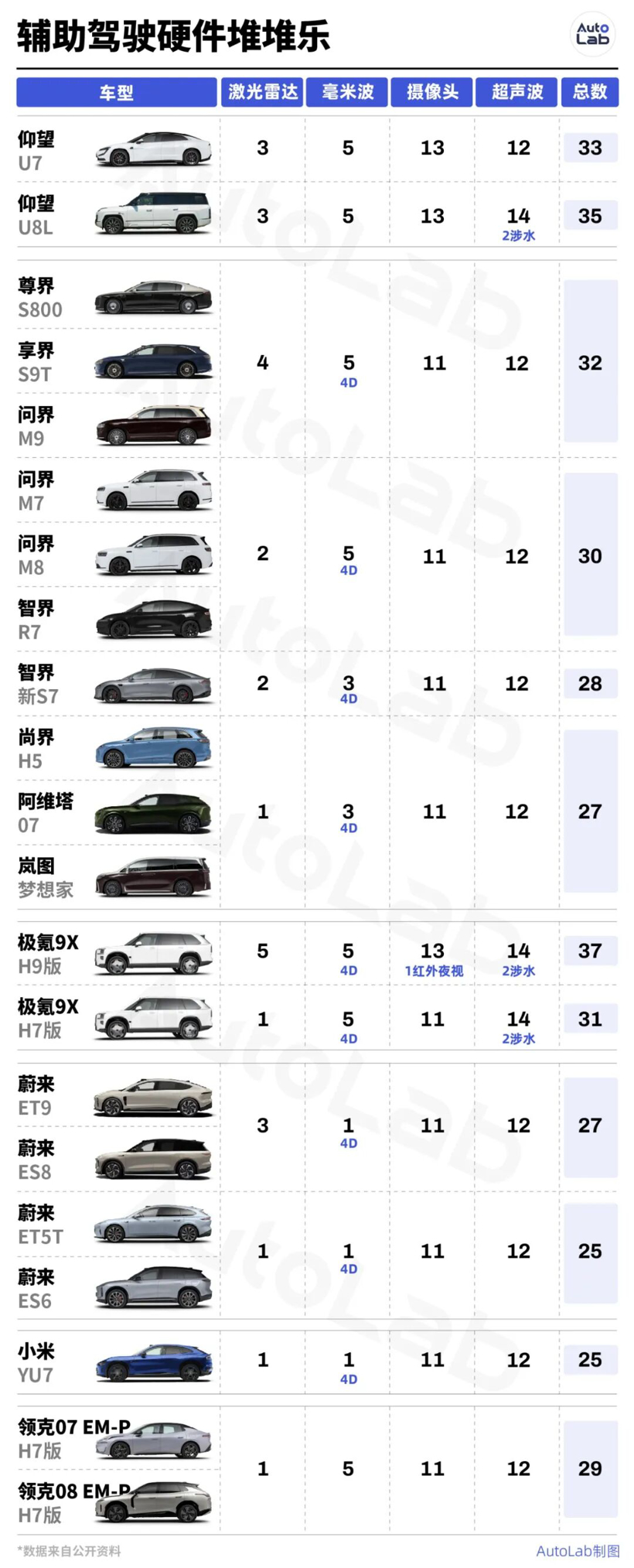
In the millimeter wave column, those not labeled "(4D)" refer to traditional 3D millimeter wave radar.
Most manufacturers have started equipping their cars with 4D millimeter-wave radar.
Traditional millimeter-wave radar can measure the distance, horizontal angle, and radial velocity of a target, but the problem is that it cannot identify height information; a bridge and the ground appear essentially the same to it.
The 4D millimeter-wave radar, on this basis, adds height information, allowing it to almost directly reconstruct the environment through a denser point cloud.
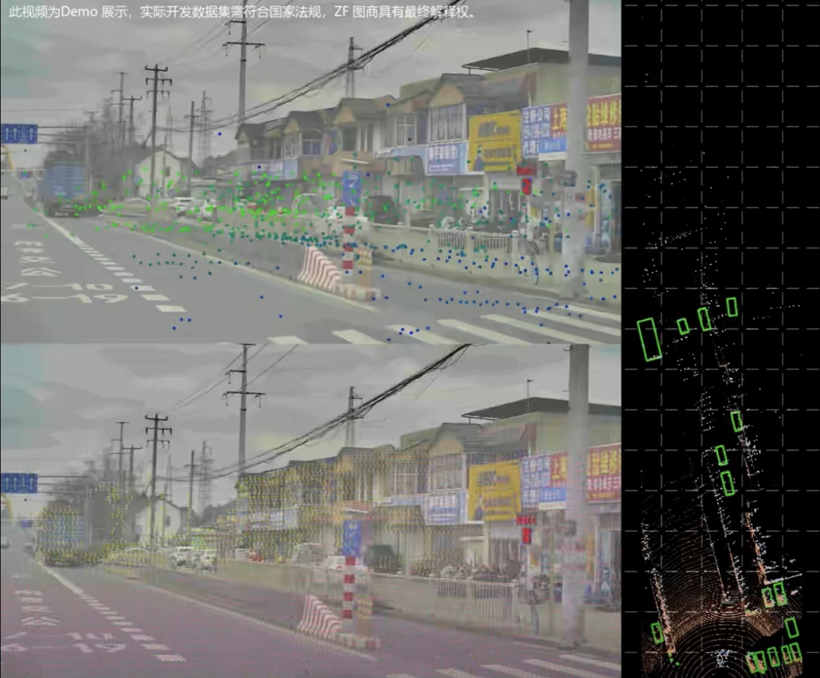
With high-level information, vehicles can more accurately distinguish the types of obstacles, reducing the probability of false alarms or missed detections.
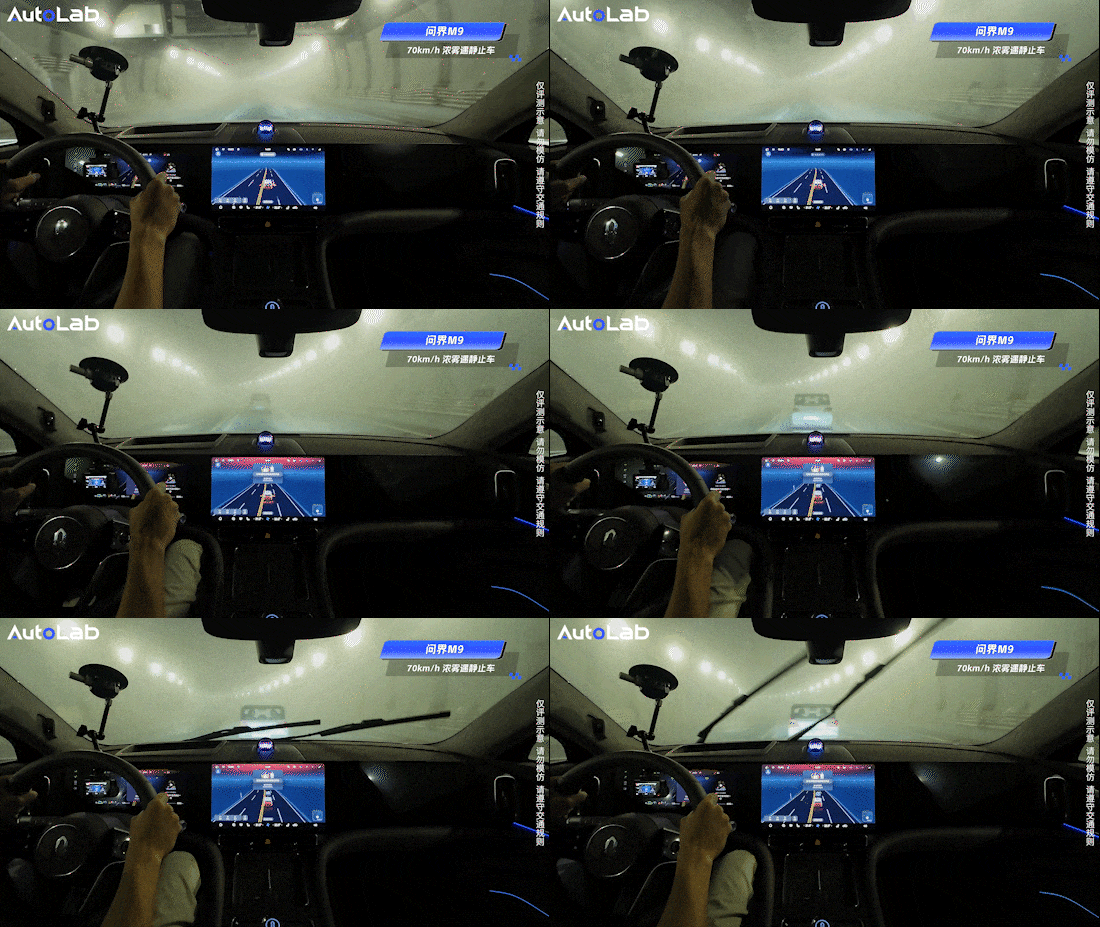
At the same time, due to the working principle of millimeter-wave radar using electromagnetic waves for sensing, 4D millimeter-wave radar can, to some extent, penetrate rain, fog, and dust, becoming an important line of defense for advanced driver-assistance systems in the face of adverse weather conditions.
The volume of hardware numbers is becoming increasingly popular in the field of assisted driving.
Especially for Huawei-affiliated car models, regardless of the brand, the forward-facing LiDAR is equipped with a 192-line specification, and the combination of three 4D millimeter-wave radars is particularly generous.
Yangwang, as a high-end brand, features 3 standard lidar sensors in its models, with a total of over 30 sensors.
In this chart, the hardware configuration of the Lynk & Co twins is relatively ordinary, but considering the model's price range and the upgrades from the old version to the new version, these two cars are still quite worthy of making the list.
For different models of the same brand, manufacturers assign different configurations.
The most notable is still the Huawei system, with a single LiDAR increasing to four LiDARs, and three 4D millimeter-wave radars increasing to five 4D millimeter-wave radars, offering a full range of combinations.
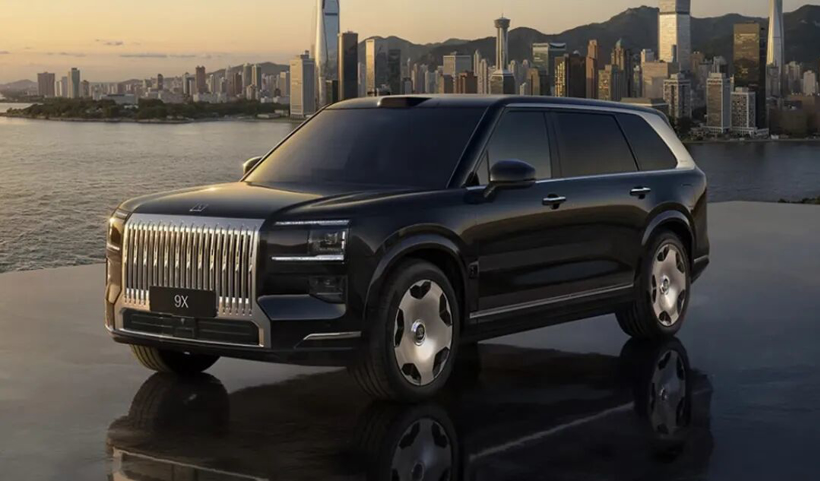
The Zeekr 9X has also launched the Qianli Haohan H7 version, which is currently available, and the Qianli Haohan H9 version, which is still in pre-order. Among them, the hardware architecture of the Zeekr 9X H9 version is the most highly configured in terms of quantity and variety on this list.
The number of hardware components is a fundamental reference when we choose a smart car, which can help us to some extent in assessing its assisted driving capabilities.
The actual level of assisted driving functions must also consider software capabilities and cannot be ranked by quantity alone.
The good news is that domestic manufacturers are becoming increasingly adept at leveraging hardware capabilities. In our actual tests, many pieces of hardware have proven to be more than just decorative.
For example, the 4D millimeter-wave radar installed in Huawei-related vehicles has brought the capability of "negative obstacle detection".
When we reverse the AITO M9 in a scenario with a negative trench behind, the AITO M9 will reliably detect it and trigger AEB to stop the vehicle.
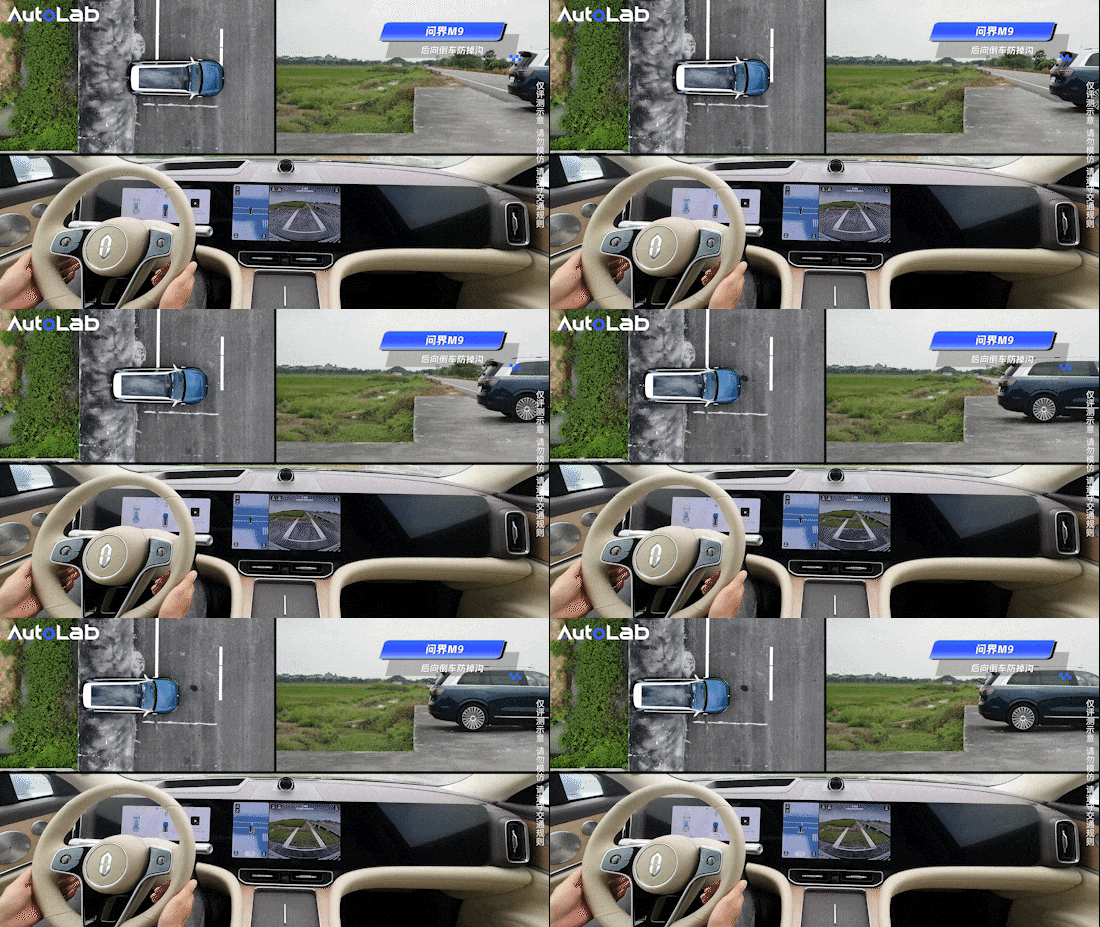
The distribution of multiple sensors also enables vehicles to achieve all-around perception. For instance, during the recent experience with the Zeekr 9X H7 version, it was noticeable that the vehicle was more responsive in avoiding obstacles such as side two-wheeled vehicles, making the assisted driving experience more reassuring.
In Conclusion
"Stacking materials" has accelerated domestic assisted driving, as leading manufacturers have reduced the costs of what were once "luxury items" like LiDAR and 4D millimeter-wave radar through large-scale application, making the path to "technological equity" in intelligent driving increasingly smooth.
How much does the number of hardware features influence your car selection? Feel free to share your thoughts in the comments section.
【Copyright and Disclaimer】The above information is collected and organized by PlastMatch. The copyright belongs to the original author. This article is reprinted for the purpose of providing more information, and it does not imply that PlastMatch endorses the views expressed in the article or guarantees its accuracy. If there are any errors in the source attribution or if your legitimate rights have been infringed, please contact us, and we will promptly correct or remove the content. If other media, websites, or individuals use the aforementioned content, they must clearly indicate the original source and origin of the work and assume legal responsibility on their own.
Most Popular
-
Mexico Imposes Tariff Up to 36% on Cross-Border E-Commerce Products, Effective January 1, 2026; Plastic Shows Partial Fluctuation Today
-
4.5 Million Tons! Wanhua Chemical Dominates Globally in MDI, Heavy Investment in Battery Materials Spurs New Storm
-

Trump Delays Tariff Increase on Furniture, Cabinets, and Vanities
-
Wanhua Chemical Invests $27.3 Billion, 2026 Investment Map Revealed, $1.1 Billion Bet on Battery Materials
-
Back-to-back major joker moves! covestro’s 1.32 million ton mdi dual-line expansion and hdi acquisition reshape global polyurethane landscape


